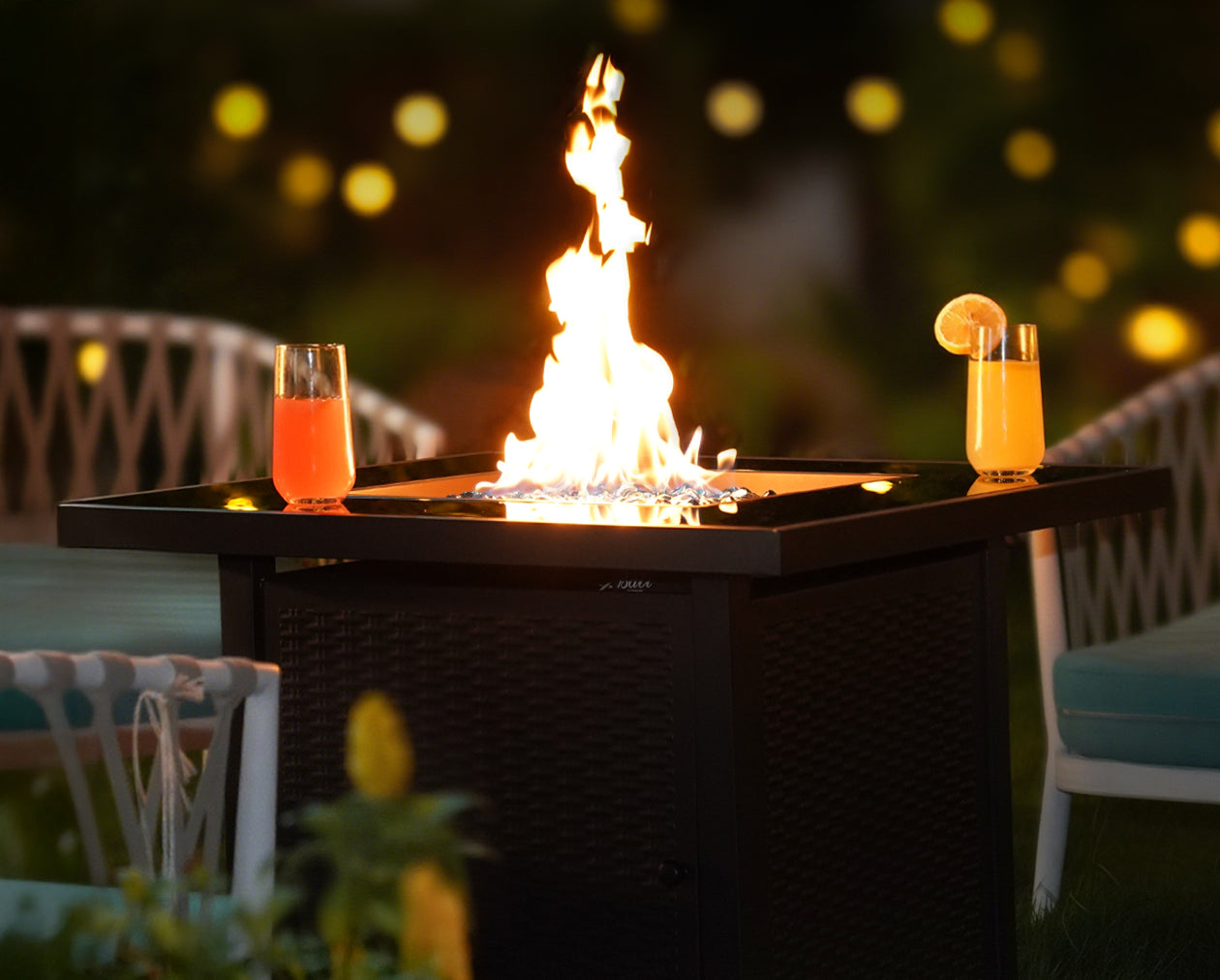


Fire pit tables come in three main shapes: round, square, and rectangular. The shape you choose will actually change how your patio feels and functions—from how easily people can chat to how you move around the space. Round tables are great for creating cozy conversation circles. Square tables bring a modern vibe with plenty of room to set things down. And rectangular tables? They're perfect for those long, narrow patios. Let's walk through everything you need to know to pick the right shape for your outdoor space.
Why Choose a Round Fire Pit Table
Perfect for Conversation
There's something special about gathering around a round fire pit table. Everyone faces the center equally, so no one ends up sitting at an awkward "head of the table" position. It just feels more welcoming and inclusive—perfect for those evenings when conversation flows naturally.
The circular shape also encourages people to pull their chairs a little closer on chilly nights. If you've ever sat around a campfire, you know that warm, cozy feeling. That's exactly what a round table brings to your backyard.
Easy to Move Around
Here's a practical advantage: no sharp corners to navigate around. This really makes a difference in smaller patios or areas where people are moving around frequently. You won't be doing that awkward sideways shuffle to get past someone's chair.
A 42-inch round fire pit table fits comfortably in a 10' x 10' space—that's about 15% less room than you'd need for a similar square table. If you're working with a tighter patio, this extra breathing room can make your space feel much more comfortable.
Softens Your Patio Design
If your backyard has a lot of straight lines—think rectangular pools, linear decking, or modern architecture—a round fire pit creates a nice visual contrast. Those curves help soften all those hard edges and make your outdoor area feel more relaxed and inviting. It's a simple design trick that really works.

Why Choose a Square Fire Pit Table
Modern, Clean Look
Square fire pit tables have that crisp, contemporary feel that works beautifully with modern outdoor spaces. The clean lines create structure and visual order—exactly what you want if you're going for a sleek, minimalist aesthetic.
The geometric shape makes a strong statement as a focal point, too. It looks especially sharp when paired with square pavers, straight fencing, or a modern pergola. Everything just clicks together visually.
More Table Space
Let's talk about one of the biggest practical differences: table surface area and footprint. A 48-inch square fire pit table gives you about 16 square feet of usable tabletop, compared to roughly 12 square feet for a 48-inch round. That's 30% more space for setting down drinks, plates, your phone, or those evening snacks.
Even with the fire burning in the center, you've got plenty of room around the edges. If you like to entertain with food and drinks, or if you're planning outdoor dinner parties, that extra corner space really comes in handy.
Works with Linear Seating
Square tables line up naturally with L-shaped sectionals and straight benches. The parallel edges create visual harmony, and the shape helps distribute warmth evenly to all the seats. If your outdoor furniture has straight lines, a square table just completes the look in a way that feels intentional and well-planned.
Should You Get a Rectangular Fire Pit Table?
You might be wondering about rectangular fire pit tables—they're actually a fantastic middle-ground option for specific situations. Typical sizes range from 50" x 30" to 70" x 36", and they really shine in three scenarios:
You Have a Long, Narrow Patio
If your deck or patio is 14+ feet long but less than 10 feet wide, a rectangular table makes perfect use of that length without crowding the width. It's all about working with the space you have rather than fighting against it.
You Own an L-Shaped Sectional
The straight edge of a rectangular table aligns beautifully with sectional sofas and long outdoor couches. Everything runs parallel, creating that clean, cohesive look where your furniture and fire pit feel like they belong together.
You Need Maximum Serving Space
Here's where rectangular really excels: a 60" x 30" table gives you about 12.5 square feet of surface area. That's ideal if you're regularly serving appetizers, hosting outdoor dinners, or entertaining 8-10 people with food and drinks.
When to skip rectangular: If your patio is under 12 feet long, or if you prefer that circular conversation flow where everyone can easily see each other, stick with round or square instead.
What Size Fire Pit Table Do I Need?
Getting the size right matters just as much as picking the shape. Here's how to figure out what'll actually fit in your space.
Measure Your Patio First
There's a simple rule to follow: you need at least a 3-foot clearance around all sides of your fire pit table. This gives people room to sit comfortably and move behind chairs without feeling cramped.
Here's the easy math:
- Measure your patio's length and width
- Subtract 6 feet from each dimension (that's 3 feet per side)
- What's left is your maximum table size
Real examples to help you visualize:
- Got a 10' x 10' patio? You can fit up to a 42" round or 36" square
- Working with 12' x 12'? You're good for a 54" round or 48" square
- Have a 14' x 8' narrow space? A 60" x 30" rectangular is your best bet
Quick tip: Round tables actually need slightly less space than square ones because there are no corners sticking out into your walkways.
Match Your Furniture Style
Take a look at what you already own. Your existing furniture can really help guide this decision:
Round tables work beautifully with:
- Curved outdoor sofas and sectionals
- Adirondack chairs arranged in a casual circle
- Relaxed, flexible seating that you move around
- Garden settings with natural, flowing landscaping
Square tables pair well with:
- L-shaped sectionals and modular furniture
- Four matching chairs positioned symmetrically
- Modern outdoor dining sets
- Structured spaces with pergolas or outdoor kitchens
Rectangular tables are ideal for:
- Long straight sofas or extended sectionals
- Linear benches along one side
- Formal outdoor dining arrangements
- Patios with clear zones for different activities
Create a Focal Point
Both shapes can anchor your outdoor space, just in different ways. A round table in a square courtyard creates visual interest through contrast—it becomes an eye-catching centerpiece. A square table in a rectangular patio creates cohesion—everything feels intentional and well-organized.
Think about whether you want your fire pit to stand out as a statement piece or blend seamlessly into your overall design.
Does Fire Pit Shape Affect Heat Output?
Short answer: No, not at all. The warmth you feel comes entirely from the Appropriate BTU rating, not whether your table is round or square.

What is BTU
BTU stands for British Thermal Unit, and it's how we measure heat output. Most residential propane fire pit tables put out somewhere between 50,000 and 60,000 BTUs. That's enough to comfortably warm a seating area of about 150-200 square feet—basically, everyone sitting around your fire pit will feel cozy.
Higher BTUs mean more heat, but they also burn through propane faster. For most backyards, 50,000-60,000 BTUs hits that sweet spot of plenty of warmth without constantly refilling your tank. Our propane fire pit BTU guide covers how to match heat output to your climate and patio size.
Shape Doesn't Change Heat Distribution
Here's what actually happens: the burner shape often matches the table design (round burners for round tables, linear burners for rectangular ones), but that's just for aesthetics. A 60,000 BTU round table produces exactly the same amount of heat as a 60,000 BTU square or rectangular table.
What really affects how warm you feel:
- The BTU rating itself (higher numbers = more heat)
- Wind conditions on your patio
- How close you're sitting to the flames
- The outside temperature that evening
Bottom line: Pick your shape based on your space and style preferences. Pick your BTU level based on how toasty you want to be.
Safety and Storage: What's the Same, What's Different
Safety Requirements (Identical for All Shapes)
The good news is that safety guidelines are the same whether you choose round, square, or rectangular:
- Keep your fire pit at least 10 feet from your house, shed, or garage
- Maintain 3 feet of clearance on all sides for seating
- Make sure you have 10-15 feet of overhead clearance (no low branches or awnings)
- Leave 2-4 feet between the table edge and where people sit
Always double-check your local fire codes, though—some areas have stricter requirements.
One difference worth noting: If you have young kids or pets running around, round tables are a bit safer simply because there are no corners to bump into. Sharp corners aren't dangerous on their own, but they're one less thing to worry about with active children in the yard.
Propane Tank Storage
Most fire pit tables are designed to hide a standard 20-pound propane tank inside the base, which keeps your patio looking clean and organized.
Square and rectangular tables almost always have room for built-in storage compartments—that boxy base design makes it easy. Round tables usually hide tanks inside too, but some slim column-style models might require you to place the tank nearby instead.
Before you buy: Check the product specs if hidden storage is important to you. You'll want to confirm the internal dimensions—specifically, at least 18 inches of height and a door opening wide enough for a 12-inch diameter tank. Browse our fire pit tables to find the perfect fit for your outdoor space.
Which Fire Pit Table Shape Is Right for You?
Let's make this decision simple. Answer these three questions, and you'll know exactly which shape fits your situation best:
Question 1: What's Your Patio Size?
- Under 10' x 10'? Go with a round table (36-42" diameter). It'll give you the best space efficiency and traffic flow.
- Around 10' x 12' or larger and roughly square? A square table (42-48") will give you that symmetrical, balanced look.
- 14 feet or longer but narrow (under 10' wide)? A rectangular table (60" x 30") makes the most of your length.
Question 2: How Will You Actually Use It?
- Mostly casual conversation and drinks? Round is your best bet. Everyone can see and talk to each other equally.
- Planning to serve food or have outdoor dinners? Square or rectangular gives you way more surface area for plates and serving dishes.
- Regularly hosting 8 or more people? Rectangular offers the most seating capacity.
Question 3: What Furniture Do You Already Own?
- Got a curved sectional or Adirondack chairs? They pair naturally with round tables.
- Have four matching chairs or a modular set? Square tables create that nice symmetrical arrangement.
- Own a long sofa or L-shaped sectional? Rectangular tables align perfectly with those straight lines.
How to decide: If two of your answers point to the same shape, that's probably your winner. If you're getting mixed signals, go with Question 1—your space size determines what'll physically fit and function well.
A quick reality check: Both round and square tables provide excellent warmth and durability. There's no "wrong" choice here—just the one that works better for your specific situation. Think about your space, consider how you entertain, and trust your gut on what feels right. For more on how table placement affects walkability and seating comfort, our guide to designing traffic paths around a fire pit table covers practical layouts for every shape.
5 FAQs about Fire Pit Table Shapes
Q1: How much space do I need around my fire pit table?
You'll want to plan for at least 3 feet of clearance on all sides. This gives people enough room to sit comfortably and squeeze behind chairs when needed. Also keep the table at least 10 feet away from your house and other structures—though some local codes require even more distance. Always check your area's fire regulations and the manufacturer's recommendations before setting everything up.
Q2: Does shape affect how warm the fire feels?
Nope, not at all. The heat you feel depends entirely on the BTU rating (usually 50,000-60,000 BTU for residential models), not the table's shape. A round and square table with the same BTU rating will feel equally warm. What actually makes a bigger difference? Things like wind protection, the outside temperature, and how close you're sitting to the flames.
Q3: Which shape is safer for kids and pets?
Round tables win on this one—no sharp corners means nothing to bump into when kids or pets are running around. That said, any fire feature needs active supervision regardless of shape. You'll want to teach children to keep a safe distance (at least 2-3 feet from the flames), and never leave kids or pets unattended near any fire pit.
Q4: Can all shapes store the propane tank inside the table?
Yes, most fire pit tables are designed to hide a standard 20-pound propane tank in the base, which keeps things looking neat. Square and rectangular tables nearly always include internal storage. Most round tables do too, though some slimmer pedestal designs might need you to keep the tank next to the table instead. Just check the product specifications for "internal tank storage" before you buy to make sure.
Q5: What's the real difference in seating capacity?
The shape affects how people arrange themselves more than the total number of seats:
- A 42" round comfortably fits 4-5 people spread evenly around the circle
- A 48" square works for 4-6 people, with one or two per side
- A 60" rectangular handles 6-8 people, with 3-4 along the length
The real distinction? Round tables distribute everyone equally in that campfire-circle arrangement. Square and rectangular tables create distinct "sides" where some seats naturally end up closer to certain guests than others.
Conclusion
The right fire pit table shape really comes down to three things: your patio's actual dimensions, how your furniture is arranged, and how you like to spend time outdoors. Round tables excel at creating intimate conversation spaces and work great in tighter areas. Square tables balance modern aesthetics with functionality and extra surface space. Rectangular tables, while less common, maximize seating for larger groups in long, narrow layouts. All three shapes provide identical warmth—the BTU rating handles that, not the geometry. Measure your space carefully, think about traffic flow, and choose the shape that makes your outdoor area feel complete and welcoming.
Round vs. Rectangular Fire Tables for Narrow Balconies
Choosing the Right Fire Table Shape for Your Narrow Balcony
Creating a cozy outdoor retreat on a narrow balcony or a small patio requires more than just an eye for style; it demands a methodical approach to spatial geometry and safety. For many homeowners, the central challenge is balancing the desire for warmth with the hard reality of limited square footage. When every inch counts, the choice between a round or rectangular fire table is not merely aesthetic—it is a functional decision that affects how you move, sit, and safely maintain your outdoor space.
In our experience assisting homeowners with compact outdoor setups, we have observed that the most frequent error is selecting a unit based on its appearance in a showroom rather than its footprint relative to a walkway. A fire table that looks perfectly sized in a large garden can quickly become an obstruction—or a safety hazard—on an 8-foot-wide balcony.
The 24-Inch Rule: Establishing a Safety Perimeter
Before comparing shapes, we must establish a baseline for safe movement. Based on common patterns from customer support and installation feedback, a critical "friction point" in small spaces is the lack of a clear walkway.
We recommend a minimum of 24 inches of clearance on at least two sides of the fire table. This 24-inch buffer allows a person to pass comfortably without brushing against the table or the balcony railing. If your clearance drops below this threshold, the space transitions from "cozy" to "congested," increasing the risk of accidental trips or contact with hot surfaces.
To determine if a fire table fits your space, use this simple heuristic: Table Width + 48 inches ≤ Balcony Width.
Logic Summary: The 48-inch addition accounts for 24 inches of walkway on both sides of the table. This is a practical baseline for self-checking your space before purchase. It may vary if you plan to place the table against a non-combustible wall, but for central placement, this rule preserves traffic flow.
Rectangular and Square Fire Tables: Maximizing Linear Alignment
Rectangular or square fire tables, such as the 28 Inch Propane Fire Pit Table, Black, are popular for their modern, architectural lines. In narrow spaces, these shapes offer a specific advantage: they can be aligned with the long axis of the balcony.
When you orient the long side of a rectangular table parallel to the balcony's longest wall, you preserve the natural "corridor" of the space. A common mistake we see is placing a rectangular table perpendicular to the walls, which effectively creates a "dead end" on the balcony and forces users to squeeze through narrow gaps.

The Walkway Trap
While square tables like the 30 Inch Propane Fire Pit Table for Outdoor, Black provide a generous surface area for drinks and snacks, their sharp corners can be "snag points" in tight quarters. If your balcony is exceptionally narrow, these corners can intrude into the 24-inch walkway. If you choose an angular design, ensure the corners do not point directly into the primary path of travel.
Round Fire Tables: The Flow Advantage
For balconies with irregular shapes or very tight dimensions, round fire tables often provide a superior solution for traffic flow. Because a circle lacks corners, it naturally "softens" the edges of the room, allowing people to move around the unit in a more fluid, circular motion.
Round tables are particularly effective when you have seating arranged in a semi-circle. They eliminate the "corner-to-knee" interference that often occurs with square tables in small seating groups. If your balcony serves as a primary thoroughfare to another part of the home, a round footprint is typically considered more effective at reducing accidental bumps.
Safety and Compliance: The Non-Negotiables
Regardless of the shape you choose, safety must be your primary filter. According to the U.S. Fire Administration (FEMA), maintaining a safe distance from structures is vital. While FEMA often cites a "10-foot rule" for open fires, gas-powered fire tables are often subject to different local codes. You must check your HOA rules and local fire ordinances, as some jurisdictions have specific requirements for gas appliances on balconies.
The 90-Degree Tank Swing
A hard-learned lesson in small-space design involves the propane tank compartment. Most fire tables house the tank internally. For safe operation, the compartment door must be able to swing open fully—usually at a 90-degree angle—to allow you to reach the regulator and tighten the connection properly.
If you place your fire table too close to a railing or a wall, you may find it impossible to swap tanks without moving the entire (and often heavy) table. Always measure the door swing radius before finalizing your placement.
Carbon Monoxide Safety
It is a fundamental safety requirement that propane fire tables are used outdoors only. As noted by the Centers for Disease Control and Prevention (CDC), carbon monoxide is an odorless, colorless gas that can be fatal in enclosed spaces. Even a balcony with three walls and a ceiling can trap gasses if there is insufficient ventilation. Ensure your balcony has at least one entirely open side to allow for natural air exchange.
Enhancing Safety with Accessories
In narrow, elevated spaces like balconies, wind can become a factor. A sudden gust can cause flames to flicker toward furniture or railings. Using an accessory like the 18 Inch Fire Pit Glass Wind Guard Fence provides a protective barrier that keeps the flame contained and stable. This is especially important for square tables where the flame might be closer to the edge of the unit.

Comparison Matrix: Round vs. Rectangular
To help you decide, we have modeled the typical performance of both shapes based on standard balcony dimensions (approx. 6ft x 12ft).
| Feature | Rectangular / Square | Round |
|---|---|---|
| Space Efficiency | High (when parallel to walls) | Moderate (takes up more central width) |
| Traffic Flow | Linear (can create "dead ends") | Fluid (easier to walk around) |
| Seating Capacity | Best for 2-4 people in a row | Best for 3-5 people in a circle |
| Safety Clearance | Corners can be "snag points" | No sharp corners; safer for tight paths |
| Surface Area | Typically larger for dining | Often smaller/more decorative |
Method & Assumptions for Spatial Modeling
Our recommendations are based on a deterministic parameterized model of common balcony layouts. This is a scenario model, not a controlled lab study.
| Parameter | Value or Range | Unit | Rationale |
|---|---|---|---|
| Min. Walkway | 24 | Inches | Standard ergonomic clearance for one person. |
| Balcony Width | 72 - 96 | Inches | Typical range for "narrow" residential balconies. |
| Table BTU | 50,000 | BTU | Standard output for residential propane tables. |
| Door Swing | 90 | Degrees | Minimum clearance for tank maintenance. |
| Railing Setback | 36 | Inches | Recommended buffer for heat-sensitive materials. |
Boundary Conditions:
- This model assumes the balcony floor is level and structurally capable of supporting the table's weight.
- The 24-inch walkway rule may be insufficient for users with mobility aids (wheelchairs/walkers), who typically require 32-36 inches.
- Heat setback distances may need to increase if the balcony railing is made of vinyl or other low-melting-point materials.
Final Considerations for Your Selection
Choosing between a round or rectangular fire table ultimately depends on how you use your balcony. If your balcony is a long, narrow "catwalk," a rectangular table like the 28 Inch Propane Fire Pit Table, Gray aligned with the wall will likely serve you best. It maintains the architectural lines and keeps the walkway open.
If your balcony is more of a "nook" or a square-ish corner, a round table will create a more inviting, communal atmosphere. It removes the physical and visual "barrier" of sharp corners, making the small space feel more expansive.
Before you buy, take a roll of painter's tape and mark the footprint of your desired table on your balcony floor. Walk around it. Open your patio door. Ensure you have the 24 inches of clearance you need to move safely. By taking these methodical steps, you can enjoy the warmth of a fire table without compromising the safety or comfort of your home.
Disclaimer: This article is for informational purposes only and does not constitute professional safety, legal, or fire-prevention advice. Always consult your local fire department, HOA guidelines, and the manufacturer’s manual before installing or operating a fire pit.