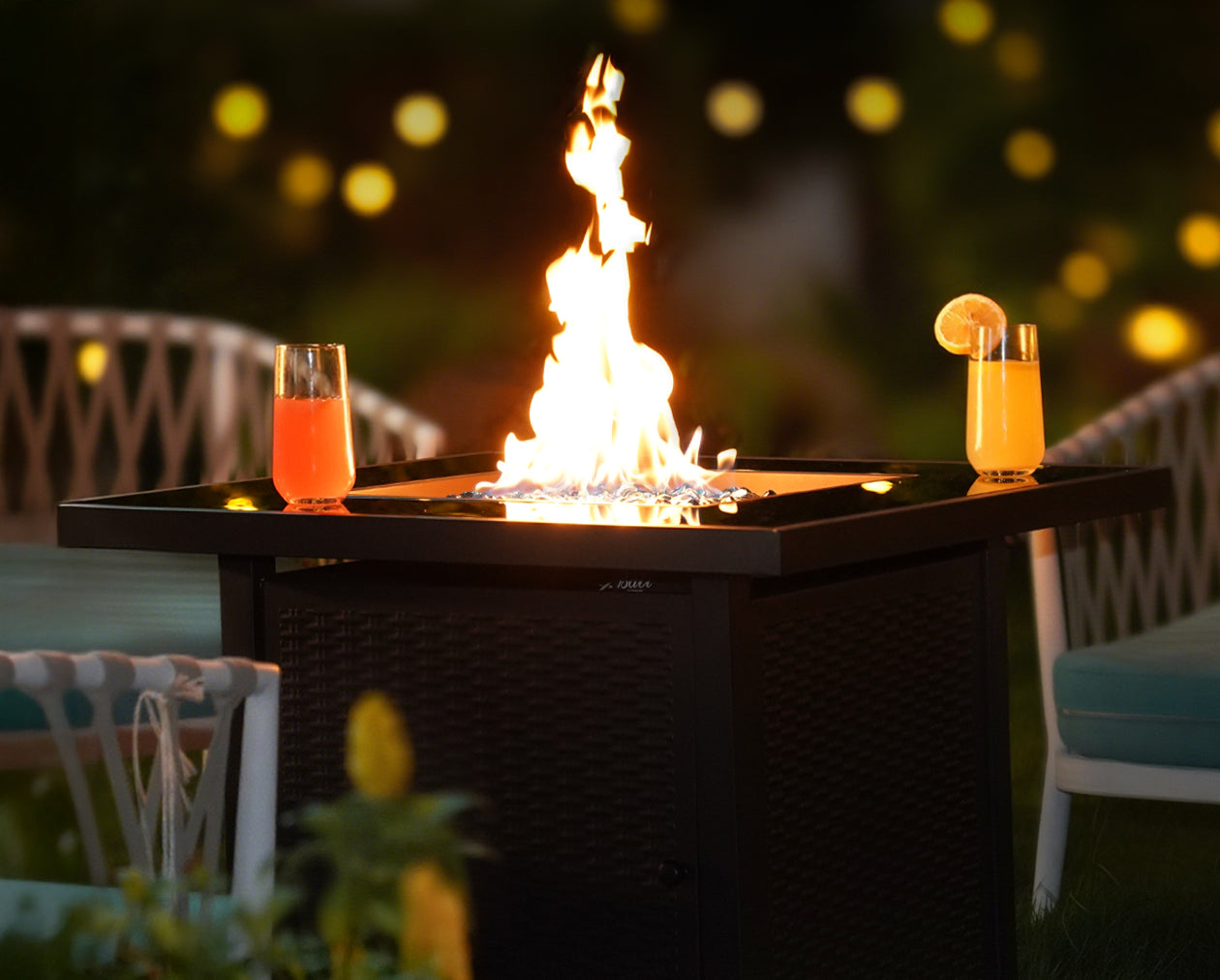


There's nothing quite like cozying up with family around a warm fire pit in the winter, sharing food and stories. But what if you lack the space? Maybe you don't have a backyard, or your balcony is just too small for a traditional fire pit. Or perhaps you're simply worried about the safety of an open flame in a smaller area. If that's the case, a small fire pit table might be the perfect solution you've been looking for.
Can I Safely Have a Fire Pit on My Small Patio or Balcony?
The answer is a conditional yes. While you don't have the wide-open space of a backyard, you can absolutely create a safe and cozy fire feature.
It all comes down to a 3-part safety check. Before you buy, let's walk through the three most important steps to do it right.
1. First: Get Your Building's Approval
This is the one step you can't skip. Before you even start shopping, you need to find out your building's rules. Many apartment complexes, condos, and HOAs (Homeowners Associations) have strict policies, and city fire codes also set rules for multi-family homes.
- Look at your lease agreement, your HOA's governing documents, or simply call your property manager.
- Ask, "What is the policy on open flames or propane fire pits for balconies/patios?"
This essential check tells you if a fire pit is a "go" or a "no-go" from the start. Most of the time, they will ban wood-burning pits (due to smoke and sparks) but may allow propane units.
2. Next: Choose a Propane Model with a Safety Label
For a small space, your choice is simple: you must use a propane or natural gas unit.
Wood-burning fire pits are not an option. They produce embers and thick smoke, which are serious fire hazards in a small, enclosed area. A propane fire pit, on the other hand, provides a clean, controlled flame with no sparks. Browse our compact fire pit tables to find the perfect fit for your outdoor space.
When you shop, look for one non-negotiable feature: a safety certification label. This will be a CSA (Canadian Standards Association) or UL (Underwriters Laboratories) mark. This label is your proof that experts have rigorously tested the product for safety and performance.
Additionally, pay close attention to the tank's required orientation (e.g., vertical or horizontal) to ensure proper gas flow and safety. For more details, see our guide on tabletop vs freestanding fire pits.
3. Finally: Create a "Safe Zone" for Your Setup
Once you have your approved propane fire pit, your final step is to set it up safely. This means giving it space to breathe and protecting the surfaces around it.
- Protect Your Deck: Never place a fire pit directly on a wood or composite deck, even if it has legs. The heat can warp or, in a worst-case scenario, ignite the surface. You must place it on a non-combustible base like concrete paver stones or a specialized fire-resistant mat designed to block heat.
- Give It "Breathing Room": Your owner's manual is your most important guide here. It will tell you the exact safe distance (clearance) you need. As a general rule, plan to keep your fire pit 3-4 feet away from any walls, railings, or furniture on all sides.
- Check Overhead: Don't forget to look up! You need at least 6-10 feet of clearance from any overhead roof, awning, or the balcony above you.
- Always Be Present: This is the most important rule of all. Always watch your fire. Never leave it unattended, even for a minute. When you're done, make sure it's turned off completely before you go inside.

The Top Choice for Compact Spaces: Small Fire Pit Tables
When you have limited space, every item needs a job. The small fire pit table is perfect for this. It’s the most practical choice because it expertly combines a fire feature with a useful piece of furniture.
A fire table for a small patio works as a centerpiece for your seating area. It sits at coffee table height, which gives you a handy surface for drinks or snacks. Many models include a matching lid. The lid instantly turns the unit into a full table when you are not using the fire.
Most of these units use propane. The best designs have a base that hides a standard 20-pound propane tank. This self-contained design is perfect for small spaces. It saves you from needing a separate fuel line or having an ugly tank taking up floor space. The mini fire table (models under 30 inches) is very popular because it fits on narrow balconies and in tight corners. For more details, see our guide on fire pit clearance guidelines.
Are Tabletop Fire Pits a Good Option?
If the small fire pit table still seems too large, a tabletop fire pit would be the best option. Tabletop fire pits are the smallest and most portable options available. They can even be placed directly on top of the table.
Here's why they are a great option:
- They save space: They create a cozy effect without occupying any floor space. This makes them ideal for balconies where the only space available can fit two chairs and a side table.
- They can be moved easily: Most tabletop fire pits are very light. They come with small propane tanks that weigh only 1 pound. These tanks are the type used during camping.
- They cost less: They tend to cost less compared to the full-sized fire tables. This makes them a cost-effective option for enjoying a real flame.
The Trade-Off: While portable, the following are the trade-offs. The smaller fuel capacity results in less usage time. For example, if the unit uses a 1-pound cylinder of propane, the burning time can last only 2-4 hours. They also generate less heat. A table-top fire pit provides illumination but will not warm up the entire patio. For more details, see our guide on convertible fire tables for small patios.
Comparing Your Small-Space Fire Pit Options
To help you decide, here is a quick comparison of the most common small fire pits for patios and balconies.
| Feature | Small Fire Pit Table | Tabletop Fire Pit | Portable Propane Fire Pit (Bowl) |
| Primary Function | Atmosphere & Furniture | Atmosphere & Accent | Atmosphere & Heat |
| Typical Footprint | Medium (e.g., 28"-32" square/round) | Very Small (Sits on a table) | Small (e.g., 19"-24" round) |
| Heat Output (BTUs) | Moderate (30,000 - 50,000) | Low (10,000 - 15,000) | High for its size (40,000 - 58,000) |
| Fuel Source | Internal 20lb Propane Tank | 1lb Propane Canister | External 20lb Propane Tank (via hose) |
| Portability | Sturdy; You can move it when cool. | Very Portable; "Grab-and-Go." | Very Portable; built for travel. |
| Best For | The patio centerpiece; adds table space. | Tiny balconies; enhancing a dining table. | Max heat in a small, portable unit. |
What to Look for in a Portable Propane Fire Pit
No matter which style you like, a portable propane fire table offers a great balance. Here is what you should look for when you shop:
Ignition and Control
Look for a push-button starter (also called electronic ignition). This is safer and easier than using a match. An adjustable flame control knob is also a must-have. It lets you control the flame height, heat, and how much fuel you use.
Essential Safety Features
Your fire pit must have a safety shut-off valve. This feature automatically cuts the gas if the flame goes out. This stops dangerous gas leaks.
Fuel Source and Storage
For fire tables, check that a standard 20-pound propane tank fits inside the base. For tabletop models, think about the cost and hassle of 1-pound canisters.
Durable Materials
Your fire pit will live outside, so it needs to handle the weather. Look for tough materials like powder-coated steel, rust-proof stainless steel burners, and strong tabletops (like ceramic tile or tempered glass).
Heat Output (BTUs)
We measure heat in British Thermal Units (BTUs). A large backyard fire pit might offer 70,000+ BTUs. For a small fire pit, a range of 30,000 to 50,000 BTUs will easily warm a cozy seating area. More BTUs is not always better in a small space. It can get too hot.
Measuring Your Space: How to Ensure a Perfect Fit
In a small space, every inch counts. Don't just "eyeball" the fit. This is a common mistake. Follow these simple steps to measure correctly:
Map Your "Fire Zone"
First, decide where your fire pit will go. Pick a level, fire-resistant spot that is not in a main walkway.
Use the Painter's Tape Trick
This is the best way to see the fire pit's size. Find the product's dimensions (like 28" x 28"). Use painter's tape to mark that shape on your patio floor.
Mark Your Safety Perimeter
Next, check the manual for the required clearance. Let's say it's 3 feet. Measure 3 feet out from all sides of your tape outline. Mark this bigger "safety box" with more tape. You must keep this area clear of walls, railings, and furniture.
Place Your Furniture
Arrange your chairs outside the safety box. Can you still move around? Is there a clear path to your door? This simple test tells you if the fire pit is the right size for your space.
Check Overhead Clearance
Look up. Do you have a roof, an awning, or a balcony above you? Make sure you have at least 6-10 feet of clear space (or whatever the manual says) above the fire pit.
Conclusion: Your Small-Space Oasis Awaits
Your small patio or balcony should be an extension of your home. It can be a place to relax, entertain, and connect with the outdoors. The right small fire pit table can turn your small space into a cozy retreat. When you choose a safe, propane model with a smart design, you can enjoy the warmth and glow all year.
To find the perfect fit for your space, look at the collection of CSA-certified small fire pit tables from Bali Outdoors®. We designed our collection with safety, durability, and small spaces in mind. We can help you create a warm, inviting spot on any patio or balcony.

3 FAQs about Patio Fire Pits
Q1: Can I put a fire pit on a patio?
Yes, you can. Just to remind everyone: when burning any open flame on your patio, safety has to come first. In general, the safest option for a patio would be the propane or natural gas fire pit table. Wood-burning pits are usually forbidden or dangerous when they are installed close to the house.
Q2: Are patio fire pits worth it?
Absolutely. A fire pit can be a great investment for your backyard. A fire pit can add warmth to your backyard and become the focal point of any party. A fire table for a smaller patio can become even more functional as it can become a coffee table.
Q3: How to maintain a fire pit?
Maintaining a propane fire pit is simple. Follow these steps:
- Keep it Clean: After the unit has cooled down thoroughly, the table surface should be cleaned. Dust should also be removed from the fire glass or the lava rocks.
- Use a Cover: This is very important. Using a high-quality weather-resistant cover will protect your fire pit from the elements. This will prevent the burner from clogging.
- Check connections: When changing the tank or at the beginning of the season, check the gas line for leaks. Use soapy water to check if bubbles form (bubbles indicate a leak). Also, during winter months, disconnect the tank to protect the gas lines and regulator from freezing temperatures.
- Inspect the Burner: Before each season when you are ready to use the fire pit again, check if the holes in the burner are free from blockages. Clean them gently if they are obstructed.