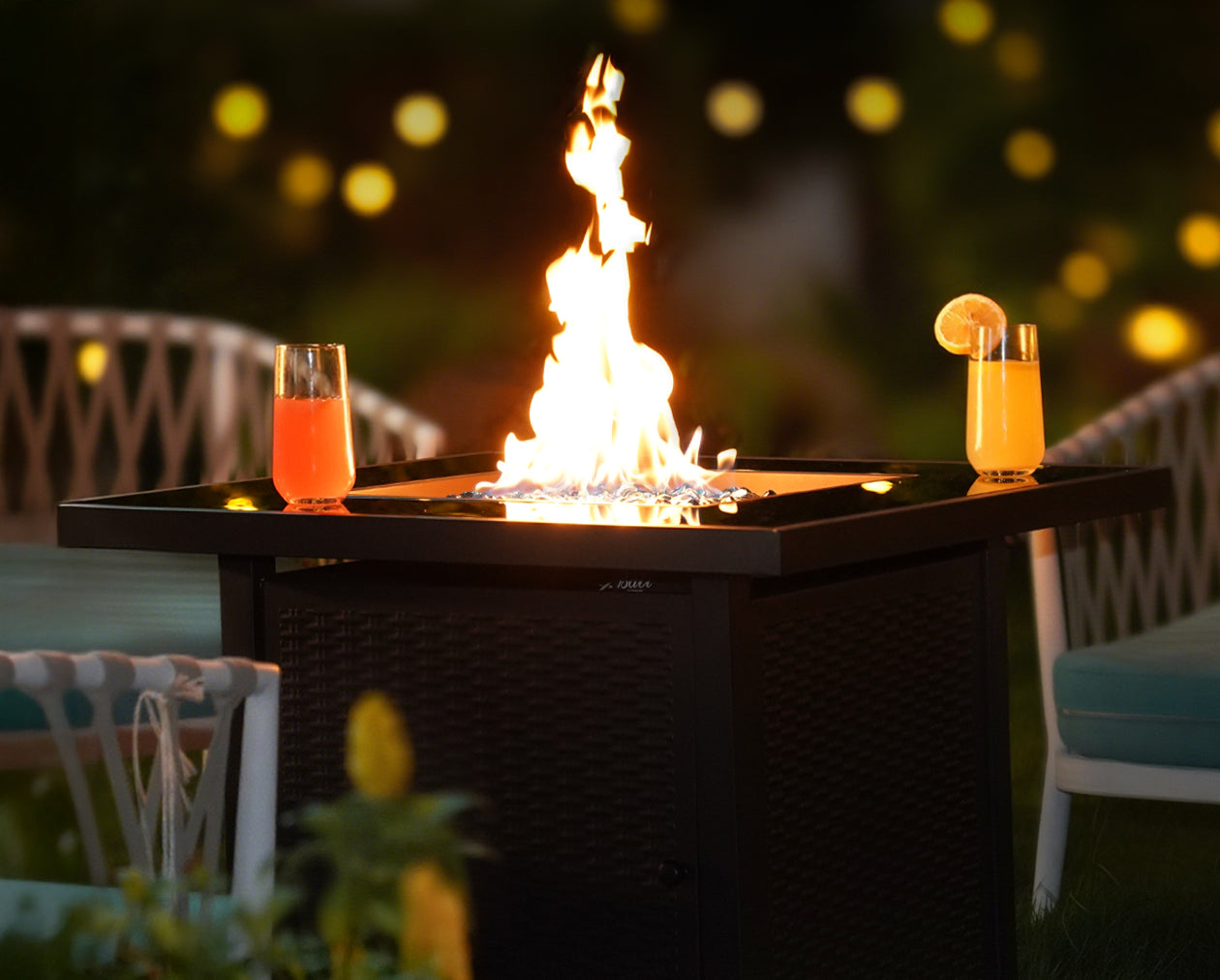


You finally settle into your patio chair with a glass of wine, but the evening chill forces you back inside within minutes. This is the problem a propane fire pit table solves. However, staring at technical specifications can feel overwhelming. Does a higher number always mean better warmth? We explain exactly how much heat your outdoor space actually requires for year-round comfort.
What BTU Means for Your Patio Comfort
BTU stands for British Thermal Unit. In simple terms, this unit measures heat energy. Specifically, one BTU equals the amount of energy needed to raise the temperature of one pound of water by one degree Fahrenheit.
Higher BTU means more heat. For example, a single wooden match outputs roughly 1 BTU; a massive bonfire might output hundreds of thousands.
For a propane fire pit table, the BTU rating tells you the maximum potential heat output the burner can generate per hour.
But the choice involves a trade-off. A unit with incredibly high BTUs consumes fuel faster, while a unit with a low rating might look pretty but leave your guests shivering.
You need a balance. The goal is to create a "warmth bubble" around the seating area. Most homeowners find that the industry standard for a high-quality residential fire pit lies between 40,000 and 60,000 BTUs. This range provides a robust flame and substantial warmth while maintaining reasonable fuel efficiency.
Factors That Affect How Much Heat You Actually Feel
Here's an important concept to clarify: the maximum BTU rating of your unit doesn't represent the actual heat you'll feel. That's because the warmth you experience is influenced by many other complex factors. For instance, if you're outdoors and it's windy or snowing, or if your fire pit lacks wind protection, more heat will be lost. Even indoors, your furniture layout can affect heat distribution.
1. The Wind Factor
Wind is the enemy of outdoor heating. A steady breeze strips away the layer of warm air the fire creates.
- If you live in a protected area, 50,000 BTUs is plenty.
- If you live in a breezy coastal area or a high-altitude region, a 60,000 BTU unit is highly recommended. The extra power helps compensate for the wind chill, ensuring the heat actually reaches you.
2. Fire Media Matters
The decorative elements inside the burner pan are not just for looks.
Lava Rocks: These porous rocks are excellent at absorbing heat and radiating it outward even after the flame flickers. They help stabilize the heat distribution.
Fire Glass: While stunning and reflective, glass beads tend to reflect heat upwards rather than retaining it like dense rock.
For maximum warmth, ensure your propane fire pit table utilizes high-quality lava rocks as a base layer.
3. Furniture Arrangement
Heat from a propane fire pit follows the inverse square law—intensity drops significantly as you move away.
Bad Setup: Chairs placed 6 feet back. You will only see the light, not feel the heat.
Good Setup: Deep seating or sectionals placed within 3 to 4 feet of the table edge. This keeps everyone inside the thermal bubble.
4. Table Height
Heat rises. On a low-profile coffee table design (approx. 12-15 inches high), the heat is generated at shin level, which helps warm your whole body as it rises. On a dining-height fire table (approx. 28-30 inches high), the heat starts at waist level. For pure warmth, lower tables often feel "cozier" because they warm your legs first.
Therefore, when choosing a fire pit, you also need to consider these factors. Generally speaking, you'll want to select a unit with a slightly higher BTU rating.
[[related_products_1]]
However, as we discussed earlier, higher BTUs not only produce more heat but also consume more fuel. So when making your choice, you still need to judge based on your actual situation.
How to Choose the Right BTU for Your Home
Heat dissipates quickly outdoors. Unlike an indoor heater that traps warmth within walls, a fire pit table fights against the open air. Therefore, the size of your patio, the wind conditions, and the arrangement of your furniture dictate the power you need.
- 50,000 BTU units are the industry "Gold Standard" for balancing warmth and fuel economy.
- 60,000 BTU units are the "Performance Choice," ideal for those who want a larger flame, better heat radius, or need to combat breezier conditions.
Use this guide to determine the right heat output for your specific setup:
| Patio Scenario | Seating Distance | Recommended BTU Range | Expected Experience |
| Small Balcony / Intimate Nook | 2–3 feet from flame | 30,000 – 40,000 BTUs | Gentle warmth, ambient lighting, ideal for 2 people. |
| Standard Patio / Deck | 3–5 feet from flame | 40,000 – 50,000 BTUs | Strong warmth, full flame presence, perfect for 4-6 people. Excellent fuel efficiency. |
| Open Yard / Windy Areas / Premium | 5+ feet from flame | 50,000 – 60,000+ BTUs | Maximum heat radius, combats open breezes effectively, suits larger gatherings or colder nights. |
The Verdict on Output:
For most American homes, a 50,000 BTU propane fire pit table is a versatile champion that balances heat with runtime. However, upgrading to a 60,000 BTU model offers you the ultimate flexibility: you can run it on high to warm up quickly or fight the wind, and dial it down to medium when you want to save fuel.
How to Manage Propane Use for Longer Burn Times
One concern with high-BTU units is fuel economy. Nobody wants the fire to die out in the middle of a dinner party. Understanding the relationship between BTUs and burn time helps you plan your evenings better.
A standard 20-pound propane tank holds roughly 430,000 BTUs of energy total. You can do the math simply: Browse our propane fire pit tables to find the perfect fit for your outdoor space.
- At 60,000 BTUs (Performance Setting): 430,000 ÷ 60,000 = approx. 7.2 hours
- At 50,000 BTUs (High Setting): 430,000 ÷ 50,000 = 8.6 hours
- At 30,000 BTUs (Low/Medium Setting): 430,000 ÷ 30,000 = 14.3 hours
For a more detailed breakdown of real-world burn times by flame setting, see our complete guide to 20 lb propane tank burn time.
Tips for Efficiency:

Start High, Then Low: Turn your fire pit table to the maximum setting for the first 10 minutes to heat up the lava rocks and the surrounding air. Once the rocks are hot, dial the knob back to medium. The rocks will continue to radiate heat, maintaining comfort while using less propane.
Check Your Tank Level: Many modern tables include a pre-installed tank seat or gauge. If not, weigh your tank. A full tank weighs roughly 37 pounds; an empty one weighs about 17 pounds.
Keep the Burner Clean: Soot or debris clogging the burner ports results in an uneven flame and wasted fuel. Inspect your burner ports before the season starts to ensure the propane flows freely.
Safety Clearances and Proper Placement for High BTU Units
With great heat comes the need for responsibility. A propane fire pit table is a controlled open flame. Whether you choose a standard 50,000 BTU model or a high-performance 60,000 BTU unit, placement is critical for safety.
Overhead Clearance is Key
Many homeowners forget about what is above the fire. Heat rises rapidly.
- Avoid placing units directly under low hanging tree branches, fabric awnings, or plastic pergolas.
- Rule of Thumb: Maintain at least 80 inches (approx. 6-7 feet) of clearance from the burner to any overhead structure. If you have a covered patio, ensure it is well-ventilated to prevent heat buildup.
Side Clearance
Combustible materials like wooden railings, siding, or fabric cushions should stay at a safe distance.
- Keep the unit at least 24 to 36 inches away from walls or deck railings.
- Ensure that walkways around the table are clear so no one accidentally brushes against the hot table edge.
Surface Protection
While most fire pit tables are safe for wooden decks, the heat is directed upwards. The base usually stays cool. However, for composite decking (which can soften with heat), check the manufacturer's guidelines. A heat-resistant rug underneath the table adds a layer of safety and style.
Ventilation
Never use a propane fire pit table in a fully enclosed space like a sunroom or screened-in porch with the windows closed. Propane requires oxygen to burn and produces carbon monoxide. These units are strictly for outdoor use or spaces with at least two open walls for cross-ventilation.
Conclusion
Selecting the right fire pit table requires balancing heat output with fuel efficiency and safety.
- For standard patios and everyday relaxation, a 50,000 BTU unit offers the perfect blend of cozy warmth and reasonable burn times.
- For those seeking premium warmth, superior wind resistance, and the ability to extend the outdoor season, a 60,000 BTU unit is the ultimate upgrade.
If you are ready to upgrade your backyard, Bali Outdoors® offers a range of premium propane fire pit tables designed to meet every need. From our efficient 50k classics to our powerful 60,000 BTU flagships, our designs prioritize safety and style. For a curated shortlist, our best propane fire pit tables guide picks the top models by patio size. If you want the full buyer's walkthrough, see our propane fire pit table buying guide.
4 FAQs about Propane Fire Pit Usage
Q1: Can I use a propane fire pit table on a covered porch?
You can, but only if the porch is open on the sides to allow for airflow. You must also ensure there is significant overhead clearance (usually at least 6 feet) above the flame to prevent heat damage to the ceiling. Never use propane units in fully enclosed rooms.
Q2: How do I convert BTUs to Watts if I want to compare with electric heaters?
The conversion is straightforward. 1 Watt is approximately equal to 3.41 BTUs. Therefore, a 50,000 BTU fire table produces roughly the same heat energy as a 14,600-Watt electric heater. This is equivalent to running about ten standard 1500W space heaters simultaneously, which is why propane fire pits are so much more effective outdoors.
Q3: Does the shape of the fire pit table affect the heat?
Yes, slightly. Round or square fire pits tend to concentrate heat in a central circle, which is great for conversation. Rectangular or linear fire pits spread the flame out over a longer area. While the total BTU output might be the same, a linear flame can cover a longer sofa setup more effectively.
Q4: Can I cook food over my propane fire pit flames?
Generally, no. Unless the manufacturer explicitly states it is a "cooking" unit, you should avoid roasting marshmallows or grilling food. Food drippings can clog the burner ports, damage the lava rocks, and attract insects or rodents when the unit is not in use.
BTU Basics: Sizing Heat Output for Small Rental Patios
Understanding BTU Basics for Small Outdoor Spaces
When setting up a small rental patio or a cozy balcony, the primary goal is comfort. However, we often see a recurring mistake among first-time buyers: the assumption that a higher BTU rating automatically equates to a better experience. In reality, choosing an oversized heater for a confined space can lead to "hot spots," wasted fuel, and significant safety hazards.
BTU stands for British Thermal Unit. In technical terms, it is the amount of heat required to raise the temperature of one pound of water by one degree Fahrenheit. When applied to outdoor heating, it measures the energy output of your fire pit or heater. For renters and homeowners with limited square footage, matching this output to your specific dimensions is the most effective way to ensure a pleasant environment without violating property rules or creating discomfort.
The Professional Sizing Rule: 40-50 BTU Per Square Foot
In our experience assisting customers with small-space configurations, we recommend a specific heuristic to avoid the "over-heating" trap. For standard, open-air patios, a reliable rule of thumb is to aim for 40 to 50 BTUs per square foot.
This calculation provides enough warmth to counteract a light breeze while maintaining a comfortable "buffer zone" around the heat source. For example, a 100-square-foot patio typically requires approximately 4,000 to 5,000 BTUs for ambient warmth. However, outdoor heating is rarely about warming the entire air volume; it is about creating a radiant heat zone where people actually sit.
The Semi-Enclosed Advantage
Many rental balconies are semi-enclosed, featuring two walls and a roof. In these scenarios, the structure acts as a thermal trap. Based on our scenario modeling, you should reduce your BTU requirements by 30% to 40% for semi-enclosed areas. Because the heat cannot dissipate as freely as it would on an open deck, a lower-output unit will often feel just as warm while consuming significantly less propane.
Logic Summary: This sizing model assumes average coastal or suburban wind speeds and standard propane combustion efficiency. The 30-40% reduction for semi-enclosed spaces is based on the increased thermal retention provided by vertical surfaces and overhead cover, which prevents the immediate vertical escape of radiant heat.
| Patio Size (Sq. Ft.) | Open Patio Requirement (BTUs) | Semi-Enclosed Requirement (BTUs) | Recommended Product Type |
|---|---|---|---|
| 25 - 50 | 1,000 - 2,500 | 600 - 1,500 | Tabletop or Small Portable |
| 50 - 100 | 2,000 - 5,000 | 1,200 - 3,000 | Compact Fire Pit |
| 100 - 150 | 4,000 - 7,500 | 2,400 - 4,500 | Mid-size Fire Table |
| 150 - 200 | 6,000 - 10,000 | 3,600 - 6,000 | Full-size Fire Table or Heater |

Radiant Heat vs. Ambient Heat Perception
It is important to distinguish between how a freestanding heater and a fire pit table distribute warmth. A common observation from experienced installers is that a 30,000 BTU fire pit table often feels as warm as a 40,000 BTU freestanding heater for those seated directly around it.
This occurs because a fire pit table, like the 15 inch Propane Fire Pit,Sliver, concentrates radiant heat at knee and waist level. Since the heat source is closer to the users, the "perceived warmth" is higher even if the total energy output is lower. Conversely, a tall heater, such as the 20 inch Propane Patio Heater, Brozne, emits heat from an elevated reflector, which is excellent for standing crowds but may lose efficiency in a seated balcony setting.
Safety Constraints and Clearance Requirements
For renters, safety is not just a personal preference—it is often a contractual obligation. High-output units (50,000 BTUs and above) generate significant rising heat. A unit with a 50,000 BTU rating frequently requires 36 to 48 inches of clearance from any overhead structures.
If you place a high-BTU unit on a covered balcony with a standard 8-foot ceiling, you may risk damaging the soffit or triggering a fire hazard. Before purchasing, you must measure the distance from the top of the burner to your ceiling. For very tight spaces, a lower-output unit like the 15 inch Propane Fire Pit,Sliver, which produces 25,000 BTUs, is often the safer and more compliant choice.
Critical Safety Guidelines
- The 10-Foot Rule: According to the U.S. Fire Administration (USFA), you should maintain at least 10 feet of distance between a fire source and your home or any combustible deck railings. While propane units are more controlled than wood-burning pits, this distance remains a gold standard for preventing accidental ignition.
- Carbon Monoxide Awareness: It is vital to remember that all gas-burning appliances consume oxygen and produce Carbon Monoxide (CO). As stated by the Centers for Disease Control and Prevention (CDC), CO is an odorless, colorless gas that can be fatal in enclosed spaces. You must never use a propane fire pit or heater inside a screened-in porch or any area without significant, continuous airflow.
- Supervision: Never leave an active unit unattended. Ensure that children and pets are kept at a safe distance to avoid accidental contact with hot surfaces or the protective steel grill.

Choosing the Right Unit for Your Space Scenario
To help you decide, we have analyzed two common rental scenarios based on typical property constraints.
Scenario A: The Open Apartment Deck
If you have an open-air deck with no roof, heat will dissipate quickly. In this case, you can afford a higher BTU output to ensure you stay warm during colder months. The 28 Inch Propane Fire Pit Table, Black offers 50,000 BTUs, which is highly effective for an open area of roughly 100-150 square feet. Its 2-in-1 design also serves as a functional table, which is a major space-saving benefit for small patios.
Scenario B: The Small, Covered Balcony
For a covered balcony where space is at a premium and heat is easily trapped, "less is more." A high-BTU heater will likely make the space uncomfortably hot and may cycle too aggressively, leading to inefficient fuel use. The 15 inch Propane Fire Pit,Sliver with its 25,000 BTU output is an optimized choice here. It provides a beautiful flame and sufficient warmth for two to four people without the risks associated with excessive heat output.
Maintenance and Best Practices for Renters
Since most renters do not have access to permanent gas lines, propane is the standard choice. Propane burns cleanly and is generally more accepted by HOAs than wood-burning options. However, if you do use wood-burning pits in a permitted area, the Environmental Protection Agency (EPA) emphasizes using only seasoned, dry wood. Wet or "green" wood creates excessive smoke, which will quickly frustrate neighbors in close quarters.
When it is time to end your evening, ensure the gas valve is fully closed at the tank. For those using portable wood units, the National Park Service (NPS) recommends letting the coals turn to ash and ensuring the area is "cool to the touch" before leaving. For propane users, this simply means allowing the unit’s metal surfaces to cool before applying a protective cover.

Method & Assumptions for Heat Modeling
To provide these recommendations, we used a deterministic parameterized model based on the following assumptions:
| Parameter | Value / Range | Unit | Rationale |
|---|---|---|---|
| Ambient Temp | 45 - 55 | °F | Typical "chilly" evening usage |
| Target Temp Increase | +15 - 20 | °F | Standard comfort delta for outdoor seating |
| Wind Speed | < 5 | mph | Assumes sheltered or typical residential conditions |
| Propane Efficiency | 90 - 95 | % | Standard for modern CSA-certified burners |
| Seating Distance | 24 - 36 | inches | Typical distance for small-space furniture |
Boundary Conditions:
- These estimates may not apply in extreme wind conditions (>15 mph) where radiant heat is stripped away too quickly.
- The semi-enclosed reduction assumes at least 50% of the perimeter is walled and an overhead roof is present.
- Individual "cold sensitivity" varies; these ranges are designed for the 80th percentile of users.
Final Considerations for Small Spaces
Selecting the right heating solution for a small rental patio requires a balance of physics and practicality. By moving away from the "bigger is better" mindset and focusing on the actual square footage and enclosure level of your space, you can create a safe, inviting atmosphere.
Always prioritize units with safety certifications, such as those mentioned in the Ready.gov Home Fires Safety Guidelines, to ensure your equipment meets modern fire prevention standards. With the right BTU sizing, your small outdoor space can become your favorite "room" in the house, regardless of the season.
Disclaimer: This article is for informational purposes only and does not constitute professional safety, legal, or fire engineering advice. Always consult your local fire department, HOA regulations, and the manufacturer's manual before installing or operating outdoor heating equipment. Outdoor fire pits and heaters must never be used in fully enclosed indoor spaces.