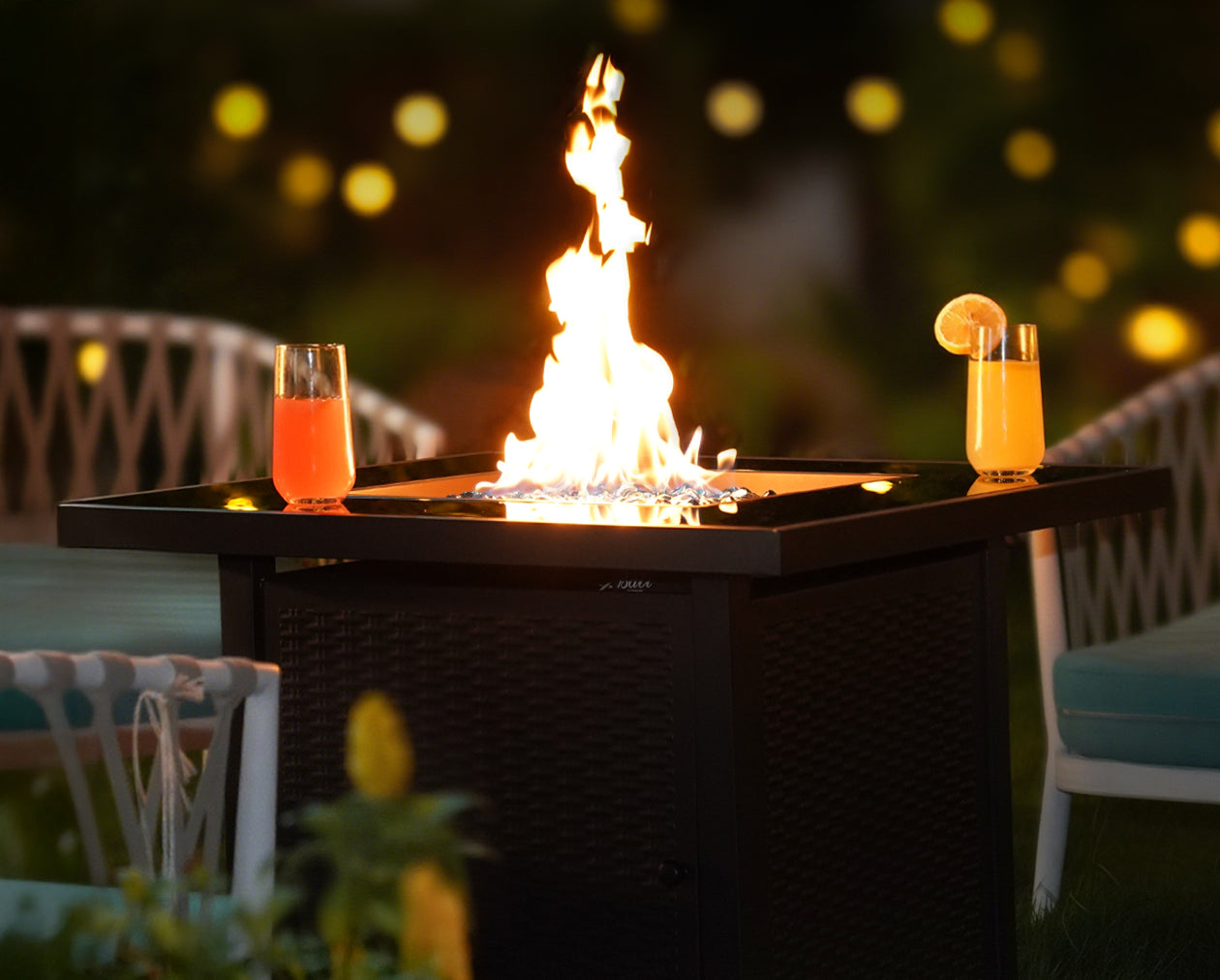


A propane fire pit table looks great until you notice the 20 lb propane tank sitting next to it. The bright blue or gray cylinder, the brass valve, the rubber hose running across the patio: none of it matches the clean outdoor setup you were going for. Hiding the propane tank is one of the most common fire table questions, and the good news is there are several solutions ranging from built-in to DIY.
Option 1: Fire Pit Tables with Built-In Tank Storage
The simplest way to hide a propane tank is to choose a fire table that was designed to hide it from the start. Most propane fire pit tables from brands like BALI OUTDOORS include an enclosed base cabinet that holds a standard 20 lb tank inside. A side door or removable panel provides access for tank replacement.

This is the cleanest solution because:
- The tank is completely concealed inside the table base.
- The hose runs internally, so there is no visible connection on the patio surface.
- The base is ventilated to prevent gas accumulation in case of a small leak.
- The weight of the tank lowers the table's center of gravity, improving stability.
If you have not purchased a fire table yet, choosing one with built-in tank storage eliminates the problem entirely. Browse propane fire pit tables to see enclosed base designs. For help choosing between table shapes, our shape comparison guide includes base storage differences.
Option 2: Propane Tank Cover or Enclosure
If your fire pit has an external tank (no built-in storage), a propane tank cover is the quickest fix. These are available in several styles:

Fabric Tank Covers
A fitted fabric cover slips over the tank and hides it visually. They come in colors that match common patio furniture (black, brown, tan) and cost $15–$30. The cover has an opening at the top for the valve and hose. They work well for casual concealment but do not look as polished as hard-sided options.
Wicker or Rattan Enclosures
A small wicker side table or cube that fits over the propane tank blends with outdoor furniture styles. Some are purpose-built for propane tanks and include a hinged lid and hose routing hole. Others are regular small side tables that happen to be the right size. A standard 20 lb propane tank is approximately 12 inches in diameter and 18 inches tall, so any enclosure with at least 14×14×20 inches of interior space will work.
Metal or Wood Enclosures
A small cabinet, planter box, or metal sleeve can hide the tank while matching your patio decor. If you build or buy a wood enclosure, ensure it has ventilation openings at the bottom and top. Propane is heavier than air, so any leak will settle at the bottom of an unventilated enclosure and create a hazard.
Ventilation is mandatory for any tank enclosure. Never seal a propane tank inside an airtight box, drawer, or cabinet without ventilation openings. Even purpose-built fire table bases include vent holes for this reason.
Option 3: Hose Extensions and Remote Tank Placement
If hiding the tank next to the fire table is difficult, you can move the tank further away. A longer propane hose (6, 10, or 12 feet) lets you place the tank behind a planter, inside a garden bed enclosure, or behind a partition wall. Then the only visible element is a thin rubber hose running along the patio edge.

What You Need
- Extended propane hose: Available in 6-, 10-, and 12-foot lengths. Make sure it has the correct fitting type for your regulator (most residential fire pits use a Type 1 (QCC1) connection).
- Hose management: Run the hose along the patio edge, under furniture, or through a cable channel. Do not run it under rugs or mats where it could be compressed or damaged.
- Regulator placement: The regulator should stay at the tank end, not at the fire table end. This is how most systems are designed and it ensures proper pressure regulation.
Important Safety Notes for Extended Hoses
- Use only hoses rated for propane (LP gas). Do not use natural gas hoses or generic rubber tubing.
- Check for kinks. A kinked hose restricts gas flow and can cause low flame or ignition failure.
- Inspect the full length of the hose before each use. Extended hoses have more surface area exposed to weather, foot traffic, and animals.
- Do not exceed the maximum hose length specified by the fire pit manufacturer. Longer hoses can cause pressure drops that affect burner performance.
Option 4: Built-In Plumbing (Natural Gas Conversion)
The ultimate tank-hiding solution is eliminating the tank altogether. A natural gas line from your home's gas supply to the fire pit table provides an unlimited fuel source with no tank to hide, no tanks to refill, and no hose to manage.
Natural gas conversion involves:
- A licensed gas fitter to run a gas line from your main supply to the fire pit location.
- A natural gas conversion kit (orifice and regulator) compatible with your fire pit model. Not all propane fire tables are convertible, so check the manufacturer's specs before committing.
- A building permit in most jurisdictions for any new gas line installation.
- Cost: $500–$2,000 depending on the length of the gas line run, local labor rates, and whether the line can be routed above ground or needs to be trenched underground.
The upside is a permanent, invisible fuel supply. The downside is cost and the fact that your fire table becomes a fixed installation. For a full comparison, read our propane vs. natural gas fire pit comparison.
Option 5: DIY Concealment Ideas
If you prefer a custom approach, here are ideas that fire table owners have used successfully:
- Planter box surround: Build or buy a rectangular planter box with an open center compartment for the tank. Fill the visible sides with plants. The greenery hides the tank naturally.
- Side table with a hollow interior: An end table or storage cube next to the fire table conceals the tank inside. Add a hinged top for easy access.
- Skirted table cloth: A fitted outdoor table skirt that wraps around the fire table base hides both the base and the tank. Use fire-resistant outdoor fabric and keep the skirt away from the burner area.
- Stone or brick surround: Build a short stone wall or column around the tank. This looks permanent and high-end. Leave the top open or use a removable cap for tank access.
Whatever method you use, remember the two non-negotiable rules: the tank needs ventilation, and you need access to disconnect and replace it.
Safety Rules for Hidden Propane Tanks
Hiding a propane tank is fine as long as you follow these safety requirements:
- Ventilation. Any enclosure must have openings that allow gas to escape in case of a leak. Bottom vents are more important than top vents because propane sinks. A minimum of two vent openings (each at least 2×4 inches) on opposite sides of the enclosure is a good baseline.
- Access. You need to be able to reach the tank valve to shut it off quickly. In an emergency, seconds matter. Do not bury the tank behind furniture or inside a locked compartment.
- Heat distance. The tank should be at least 3 feet from the burner flame laterally. Built-in fire table bases are engineered for this clearance. DIY solutions need to account for it.
- Upright position. The tank must remain upright at all times, even inside an enclosure. Do not lay it on its side to fit into a shallow space.
- Hose protection. If the hose runs through or under an enclosure, make sure it is not pinched, kinked, or in contact with sharp edges that could wear through the rubber over time.
For complete propane handling and storage guidance, see our propane safety guide.
Frequently Asked Questions
What size is a standard propane tank for a fire pit table?
A standard 20 lb propane tank (also called a 5-gallon cylinder) is approximately 12 inches in diameter and 18 inches tall. This is the same tank used for gas grills. Some fire pit tables also accommodate 30 lb tanks (12 inches diameter, 24 inches tall). Check your fire table's base dimensions to confirm which size fits.
Can I put a propane tank in a closed cabinet?
Only if the cabinet has adequate ventilation. Propane is heavier than air and will accumulate inside an enclosed space if a leak occurs. Any cabinet holding a propane tank needs vent openings at the bottom and ideally on two sides. Purpose-built fire table bases include these vents by design.
How far should a propane tank be from the fire?
The tank should be at least 3 feet from the flame when positioned externally. Inside a fire table base, the manufacturer has already engineered the proper separation. If you are moving the tank to a remote location with an extended hose, maintaining 3 feet or more from the flame is easy to achieve. Our distance guide covers broader clearance rules.
Does hiding the propane tank void the warranty?
Using an aftermarket cover, enclosure, or extended hose does not typically void the fire table warranty, but using non-approved components (wrong hose type, incorrect regulator) can. Check the warranty terms. If you are extending the hose or modifying the gas connection, use only propane-rated components from reputable suppliers.
Is it cheaper to hide the tank or convert to natural gas?
A tank cover or enclosure costs $15–$100. A hose extension costs $20–$50. Natural gas conversion costs $500–$2,000 including the gas line installation. If the visual issue is your main concern, a cover or enclosure is the cost-effective fix. Natural gas conversion makes sense when you also want to eliminate tank refills and have unlimited burn time.