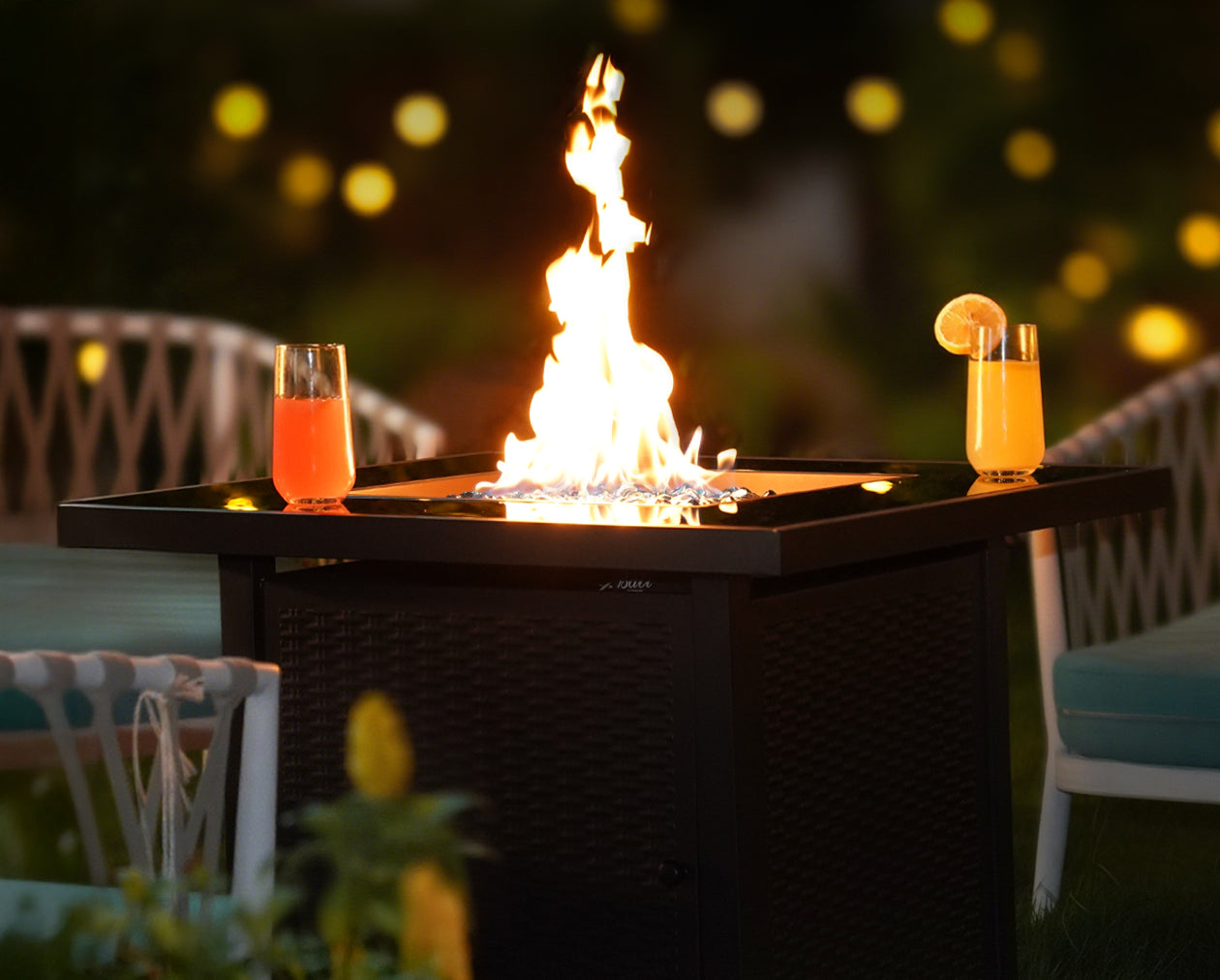


A grill brings people together for food, and a fire pit table creates a perfect spot for warmth and conversation. But behind that joy, the NFPA and CPSC report thousands of grill-related injuries and home fires annually.
Safety must always come first.
This guide provides a clear safety framework so you can enjoy your fire pit table with confidence.
Where Is the Safest Spot for Your Grill or Fire Pit Table
At Least 10 Feet from Your House
The "10-Foot Rule" is what all national safety groups say you should do. This includes the NFPA and the US Fire Administration (USFA). Any outdoor fire pit or grill needs to be at least 10 feet away from anything that can catch fire. That's your home, garage, shed, fences, and deck gates.
Homes with plastic siding need an extra warning. The 10-foot rule is the very least you can do because vinyl can melt and bend at much lower temperatures than wood.
On a Flat and Stable Surface
You must place your appliance on a flat, level, and stable surface. A grill or fire pit table on bumpy grass, a sloped patio, or shaky pavers can tip over. This is an immediate, severe hazard. It can spill burning fuel or hot parts and start an uncontrollable fire.
Clear of All Overhead Dangers
Safety isn't just horizontal; it's vertical, too. Always place your appliance away from any overhead obstructions. Heat and sparks rise, and these items can easily catch fire.
Look up for these hazards: low-hanging tree branches, roof eaves or home overhangs, awnings or pergola covers, and decorative string lights.
What About a Deck or Patio
Many of us want to put a fire pit table on a deck or under a patio. Whether this is safe depends on the appliance type. The rules for gas are completely different from the rules for wood.
On a Wood or Composite Deck:
Wood-burning pits should never go directly on a wooden or composite deck. The intense heat will scorch the deck boards, and flying embers are an unacceptable fire risk. Browse our grilling accessories to find the perfect fit for your outdoor space.
Gas fire pit tables are different. You can generally use a propane or gas fire table safely on a deck. Its design produces a controlled flame and, most importantly, no sparks or embers. But there's a mandatory precaution: Always place a heat shield (like a heat-resistant grill mat or pavers) underneath the appliance. This barrier protects your deck. Also, confirm your deck can support the full weight.

Under a Covered Patio or Screened Porch:
Wood-burning pits should never be used under any roof. The smoke and embers have nowhere to go. The fire risk is extreme.
Gas fire pit tables can be safe here, but only if you meet two strict conditions. First, ventilation: The area must be open and well-ventilated. Gas appliances use oxygen and release carbon monoxide (CO), an odorless, invisible, and deadly gas. A screened porch must have plenty of fresh air flowing through it to be safe. Second, vertical clearance: You must have serious overhead clearance. Heat rises, and a low ceiling can ignite. Many guidelines require a minimum of 80 inches (nearly 7 feet) of clearance from the appliance to the ceiling.
A Quick Placement Guide
| Feature / Location | Gas / Propane Fire Pit Table | Wood-Burning Fire Pit / Grill |
| Minimum Distance from House | 10 Feet | 10 Feet |
| Use on Wood/Composite Deck? | Yes (With Barrier) | NEVER |
| Use Under Covered Patio? | Yes (With Ventilation) | NEVER |
What 5 Steps You Must Do Before Every Use
A 5-minute safety check is a great habit. Before you light any grill or fire pit table, run through this simple list. This routine helps you catch the two most common problems: gas leaks and grease stains on fire tables.
1. Clean Your Appliance
For a grill, remove grease and fat buildup from grates and drip trays. This is a critical fire-prevention step. The NFPA reports that in 20% of all grill fires, the grill was not clean. Old grease is fuel. It can ignite and cause a dangerous grease fire.
For a fire pit table, clear out any dry leaves or debris from the burner. For more details, see our guide on maintaining your gas fire pit safely.
2. Inspect Hoses
Look at and feel all hoses from your propane tank. Check for cracks, brittleness, or holes. Make sure all connections are secure. A damaged hose is a top cause of gas leaks.
3. Check Burners
Check burner ports and tubes for blockages. Small spiders love to build nests inside these tubes, which can block gas flow. This blockage can prevent gas from flowing correctly and may cause a gas backup or leak. Use a pipe cleaner to gently clear obstructions.
4. Perform a Leak Check
Before connecting a new tank, always perform a leak check. We cover the steps in the next section.
5. Clear the Area
Set up a 3-foot safe zone around your appliance. Remove all flammable materials from this area, including paper towels, oven mitts, or towels.
How to Connect a Propane Tank and Check for Leaks
Gas appliances, including propane fire pit tables, are very safe when you use them right. The key is knowing how to handle the propane tank.
The Soapy Water Leak Test
This is the best low-tech, reliable way to check for a propane leak. Do this every time you connect a new tank.
- Start with the tank valve "OFF" (turn it clockwise).
- Create your solution. Mix a 50/50 solution of liquid dish soap and water.
- Apply the solution to all connection points. This includes the connection between the tank and regulator, the regulator itself, and the entire hose.
- Open the tank valve. Slowly turn the valve counter-clockwise. This pressurizes the system.
- Watch for bubbles. Look closely. If you see new bubbles forming, you have a leak.
What to Do if You Find a Leak
Immediately close the tank valve (turn it clockwise). Carefully tighten the leaking connection, then re-test. If bubbles persist, do not use the appliance. Disconnect the tank, move it to a well-ventilated area, and have your grill or fire pit table serviced.
The Top Rule for Gas Ignition
This rule applies to gas grills: Always open your gas grill lid before you light it.
Here's why: When you turn on the gas, it fills the cookbox. If the igniter fails, propane can pool inside. When you finally get a spark, this gas cloud can ignite all at once, creating a fireball.
If your grill flame goes out, turn off the burners and the tank. Open the lid and wait 5 to 15 minutes for the gas to clear before you relight it.
How to Control Your Fire and Prevent Flare-Ups
Once your fire is lit, "management" means different things. For a fire pit table, it means controlling the ambiance. For a grill, it means controlling flare-ups.
Flame Control for Gas Fire Pits
If your flames are too low, run through this checklist. Is the tank low or empty? Is the tank valve fully open? The regulator's safety device can "trip" if you opened the valve too quickly—to reset it, shut everything off, disconnect, wait a minute, reconnect, and open the tank valve very slowly. Are the burner ports clogged with debris or water?
High flames are dangerous in wind. The wind can blow the flame unpredictably, so keep it on low during breezy weather. A glass wind guard adds extra protection.
Manage Grill Flare-Ups
Prevent them by starting with a clean grill, trimming excess fat from meats, and letting marinades drip off first. For fatty foods, use a drip pan.
The best defense is setting up a two-zone fire at the start. On a charcoal grill, pile all hot coals to one side. On a gas grill, light burners on one side only. You'll have a hot zone and a cool safety zone. When flare-ups happen, move the food to the cool side with tongs until the flames die down, then move it back. For severe flare-ups, close the lid to cut off oxygen. For more details, see our guide on fire pit cooking foods and safety tips.
What Not to Do
Never use water to manage a flare-up. Water makes a grease fire worse by splattering the burning grease. It also kicks up ash on your food.
How to Keep Children and Pets Safe Around Heat
Kids and pets are drawn to a fire. It's our job to keep them safe.

The 3-Foot Kid-Free Zone
The NFPA, USFA, and fire departments agree on one simple, effective rule: create a 3-foot "kid-free zone"around your grill or fire pit table.
This 3-foot (or 1-meter) perimeter should be a household rule. Teach children this is a "no-go" area. This keeps them safe from flames, sparks, and radiant heat.
Total Supervision
The 3-foot rule is a guideline, not a replacement for active supervision.
Never leave a fire unattended. This is a primary rule of fire safety. Never walk away from an active grill or fire pit table. Always have a responsible adult supervising children and pets. Store matches, lighters, and fluid out of reach of children.
Beware of hot surfaces. The danger doesn't end when the flame is off. The surfaces of a grill or fire pit table stay dangerously hot for a long time. Teach children not to touch the appliance. Arrange seating a safe distance away.
What to Do in an Emergency
If something goes wrong, here's how to react. What you do for a grease fire is the opposite of what you do for a gas fire.
Scenario 1: Grease Fire
Cooking fat fuels this fire. You can fight this fire, but only if it is small and safe to do so.
Don't panic. Turn off the heat if you can safely reach the burners. Smother the flames—throw baking soda, kosher salt, or sand on the flames. Keep baking soda near your grill for this. Cut off the oxygen by closing the grill lid and vents to starve the fire. For more details, see our guide on roasting marshmallows on a fire table.
Caution: Never, ever use water to put out a grease fire. Water is denser than grease. It sinks, superheats, and vaporizes, causing a "fireball" explosion that splashes burning grease.
Scenario 2: Gas Leak or Tank Fire
The propane tank or gas line fuels this fire. Do not try to fight this fire.
DO NOT try to be a hero. FLEE. Get yourself and everyone else away immediately. Call 911 from a safe distance. If the propane tank is on fire, evacuate. Propane tanks can explode.
How to Shut Down and Clean Up Safely
The party is over, but the safety steps are not. A fire that isn't out all the way is a danger that can last all night. The shutdown process is different for gas and wood.
Shut Down a Propane Grill or Fire Pit
People are often confused about the correct shutdown sequence. Follow this safe two-step process:
- Step 1: Turn all burner control knobs on the appliance to "OFF".
- Step 2: Turn the main propane tank valve (clockwise) to "OFF".
Why this order? If you turn the tank off first, the flame goes out, but the knobs are still "ON". If you forget, gas will flow freely the next time someone opens the tank. Always turn the appliance off, then the fuel source.
Extinguish a Wood Fire Pit or Charcoal Grill
A wood fire is only "out" when it is cold.
Stop adding fuel 30 to 60 minutes before you leave. Douse with water—slowly pour water over the embers. You can also use sand or dirt. Stir the embers with a poker or shovel to expose hidden hot embers. Douse again. Listen. If you hear any hissing, it is still hot. Add water until the hissing stops. Confirm it is cold—the embers must be cool to the touch before the fire is out.
Safe Ash Disposal
Never scoop ashes into a plastic bin, paper bag, or cardboard box.
- WAIT: Let ashes cool completely, ideally for 24-48 hours.
- USE METAL: Only use a metal shovel and only place ashes in a metal container with a tight-fitting metal lid.
- STORE SAFELY: Place this metal container outside, on a non-combustible surface, 10 feet away from your house.
Conclusion
Building a few simple habits is way better than any long safety list that few people would read. Make these safety checks part of your routine—from proper placement and pre-ignition checks to correct shutdown and cleanup—and enjoy a safe and happy time with people you love.
Explore the Bali Outdoors® line of beautiful and reliable fire pit tables to find your perfect centerpiece.