

Choosing the Right Outdoor Heat for Small Rental Spaces
When space is extremely limited, the decision to add an outdoor heater or fire pit is rarely about finding the largest unit. For renters and residents of apartments, condos, or small patios, the choice is governed by three specific constraints: safety regulations, storage capacity, and surface protection. Should you opt for a compact tabletop model that sits on your existing furniture, or a slender freestanding unit that stands on its own?
This comparison evaluates how both tabletop and freestanding options perform in high-density living environments. We will weigh heat output, stability, and the "renter-logistics" that often determine whether you keep your security deposit at the end of the year.
The Renter’s Priority: Safety and Compliance
Before selecting a model, you must understand the rules governing your specific space. Most multi-unit buildings and Homeowners Associations (HOAs) have strict fire codes. According to the U.S. Fire Administration (USFA), a critical safety guideline is the "10-foot rule," which recommends keeping any fire source at least 10 feet away from structures, including walls and overhanging balconies.
For renters on small balconies, this 10-foot clearance is often impossible to achieve with traditional wood-burning units. This is why propane-fueled models are frequently the only compliant option, as they do not produce flying embers. Furthermore, the Centers for Disease Control and Prevention (CDC) emphasizes that gas-burning appliances must only be used outdoors to prevent Carbon Monoxide (CO) poisoning. In a small, enclosed patio, ventilation is not just a preference; it is a life-safety requirement.
Logic Summary: Our safety recommendations are based on standard fire prevention protocols and CO safety guidelines provided by federal agencies. We assume a "small space" refers to an area under 100 square feet with at least two open sides for ventilation. For more details, see our guide on best fire pits for small patios.

Tabletop Models: Versatility for the Smallest Footprints
Tabletop fire pits are designed for residents who lack floor space but have a sturdy outdoor table. These units are highly portable and easy to store when not in use.
The 6.5 Inch Wood Stainless Steel Tabletop Fire Pit
For those who prefer the scent and crackle of real wood, the 6.5 Inch Wood Stainless Steel Tabletop Fire Pit offers a unique solution. It utilizes secondary combustion technology—a process where air is preheated and injected into the top of the burn chamber. This creates a "woven" or tornado-like flame that is virtually smokeless.
Expert Insight on Wood Selection: To minimize smoke in close quarters, you should only use seasoned wood or wood pellets. The EPA Burn Wise Program notes that wood with a moisture content higher than 20% creates excessive smoke and pollutants. In a small rental space, "wet" wood will likely lead to neighbor complaints or a violation of air quality rules. For more details, see our guide on apartment fire table regulations.
Addressing the Stability "Gotcha"
Based on common patterns from customer support and return handling, the primary frustration with tabletop models isn't the heat—it’s stability. Lightweight tabletop units can shift on uneven surfaces.
- Heuristic: If your outdoor table is made of lightweight plastic or glass, avoid placing a fire pit directly on it.
- Pro Tip: We recommend adding non-slip, heat-resistant silicone pads to the feet of your tabletop unit. This prevents accidental sliding if the table is bumped in a cramped space.
Freestanding Units: Maximum Heat and Dedicated Placement
If you have a corner of floor space available, a freestanding unit typically offers higher heat output and a more permanent aesthetic.
The 15 Inch Propane Fire Pit (Silver)
The 15 inch Propane Fire Pit, Sliver is a prime example of a "vertical" solution. With a 25,000 BTU (British Thermal Unit) output, it provides significantly more warmth than a tabletop model. BTUs measure the amount of heat required to raise the temperature of one pound of water by one degree Fahrenheit. In practical terms, 25,000 BTUs can comfortably warm a small seating area for two to four people.
 Browse our tabletop fire pits to find the perfect fit for your outdoor space.
Protecting Your Security Deposit
One of the most frequent oversights for renters is "heat scarring." Even if a unit is freestanding, the area beneath it can become quite hot. Composite decking (like Trex) or stained wood can warp or discolor under sustained heat.
To prevent this, you should use a protective barrier like the 68x48" Large Grill Mat. This mat is engineered to withstand temperatures up to 2,000 degrees Fahrenheit, shielding the landlord's property from heat marks and potential embers. For more details, see our guide on portable fire tables for renters.
Methodology Note: The recommendation for grill mats is a "best practice" heuristic derived from property management feedback and heat-transfer observations. While most fire pits have legs to provide clearance, the radiant heat can still affect sensitive finishes over long durations (4+ hours of use).
Comparison: Tabletop vs. Freestanding
| Feature | Tabletop (e.g., 6.5" Wood) | Freestanding (e.g., 15" Propane) |
|---|---|---|
| Heat Output | Low to Moderate (Ambient) | High (25,000+ BTU) |
| Footprint | 0 sq. ft. (Uses existing table) | ~1.5 - 2 sq. ft. of floor space |
| Portability | Excellent (Fits in a bag) | Moderate (Requires two hands/handles) |
| Fuel Source | Wood Pellets / Small Sticks | 20 lb Propane Tank (Internal) |
| Primary Risk | Surface Stability / Tipping | Surface Heat Damage / Clearance |
| Storage | Fits in a kitchen cabinet | Requires a corner or cover |
The Logistics of Small Space Heating
Propane Tank Management
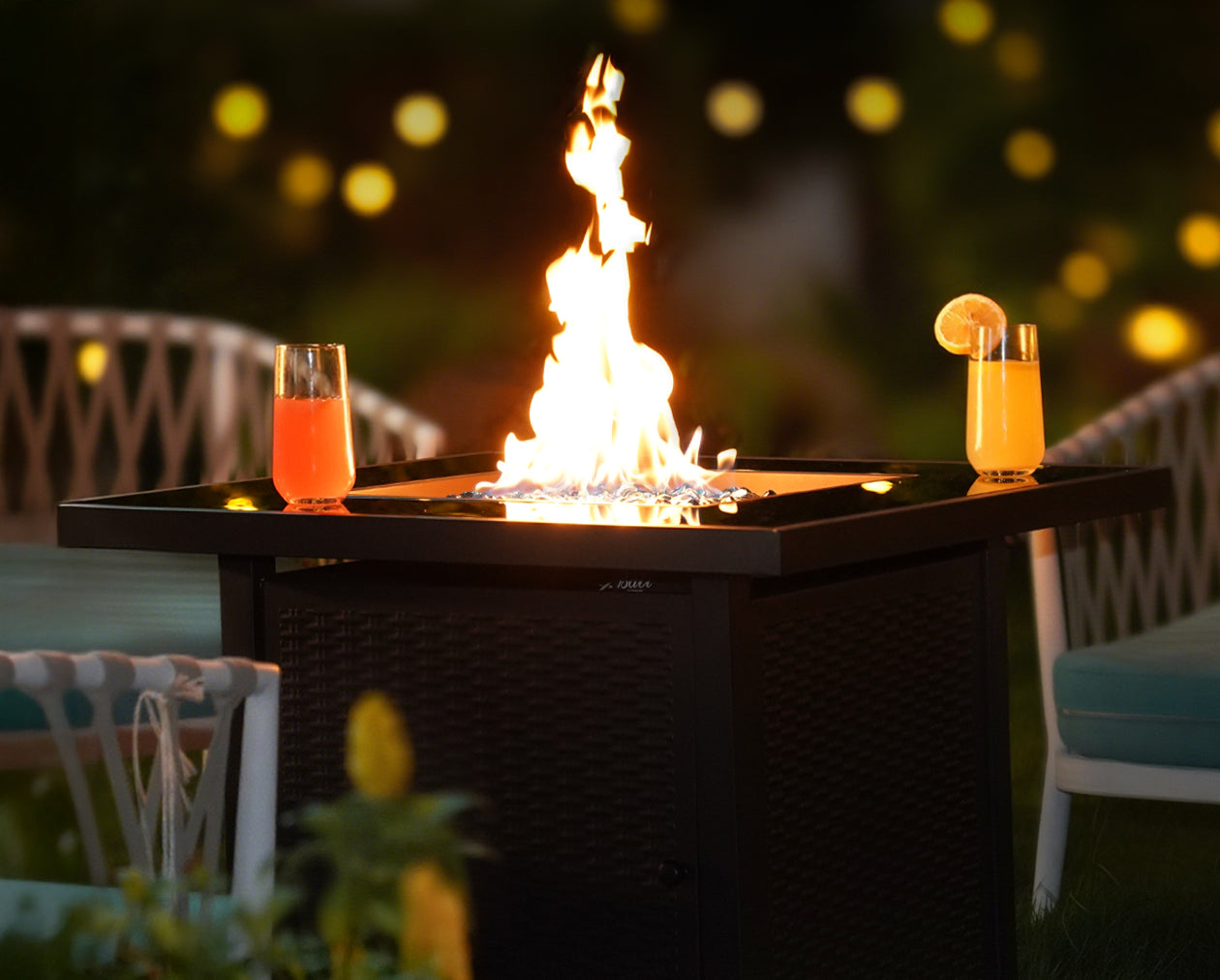
For units like the 42 Inch Propane Fire Pit Table, Black, the 20 lb propane tank is hidden inside the base. This is a major advantage for renters because it keeps the space looking tidy. However, you must check your local fire code regarding the storage of propane tanks on balconies. Some jurisdictions require tanks to be stored at ground level or in specific venting areas.
The Sound Factor
In a small, quiet space, the sound of the propane regulator's flow can be surprisingly noticeable. This is normal, but if the "hiss" is distracting, placing the unit further from the seating area (while maintaining safe clearances) can help. Always ensure your regulator is CSA certified and tightly connected to prevent leaks.
Extinguishing and Cleanup
Properly ending your evening is as important as starting it. For wood-burning tabletop models, the National Park Service (NPS) recommends that the remains should be "cool to the touch" before you leave them unattended. For propane units, the process is simpler: turn off the burner valve, then close the tank valve to ensure no gas remains in the line.
Decision Matrix: Which One Should You Choose?
Scenario A: The High-Rise Balcony Renter
If you live on the 10th floor with a small 4'x8' balcony and a glass-top table:
- Recommendation: Choose a compact freestanding propane unit like the 15 inch Propane Fire Pit, Sliver.
- Why: It keeps the heat source away from your glass table and provides a stable, heavy base that won't be easily knocked over in high-altitude winds. Use a grill mat to protect the balcony floor.
Scenario B: The Backyard/Patio Renter with Storage Limits
If you have a small ground-level patio but very little indoor storage space:
- Recommendation: Choose the 6.5 Inch Wood Stainless Steel Tabletop Fire Pit.
- Why: It provides the "real fire" experience you want but can be cleaned and tucked away in a small closet or under the sink when the season ends.

Final Safety Checklist for Small Spaces
- Check the Lease: Ensure "open flame" or "gas-burning" appliances are permitted.
- Verify Clearance: Measure for at least 10 feet of horizontal distance from walls and 15 feet of vertical distance from ceilings/balconies above (refer to your specific product manual).
- Surface Protection: Always use a heat-resistant mat or verify the surface (like concrete) can handle the temperature.
- Fuel Storage: Store propane tanks according to local fire department regulations.
- Supervision: Never leave a fire pit unattended, especially in a multi-unit building where a mistake can affect dozens of neighbors.
By prioritizing safety and understanding the physical requirements of your rental, you can enjoy the warmth of an outdoor fire without compromising your lease or your peace of mind.
Disclaimer: This article is for informational purposes only and does not constitute professional legal or fire safety advice. Always consult your local fire department, HOA, or landlord before installing or operating outdoor heating equipment. Follow all manufacturer instructions and safety warnings included with your specific product.
Sources
- U.S. Fire Administration - Outdoor Fire Safety
- CDC - About Carbon Monoxide
- EPA - Best Wood-Burning Practices
- National Park Service - Campfire Safety
- Ready.gov - Home Fire Safety
Related guides
- Fire pit table safety on decks, balconies & coastal patios — surface and clearance rules for renters and owners alike.
- Small patio fire table layout — fitting a tabletop or compact unit into limited square footage.
- Fire pit dining table set buying guide — when to upgrade from tabletop to full dining set.