

Your HOA can restrict your fire pit even if your city and state allow it. Homeowners associations set their own rules through governing documents called Covenants, Conditions, and Restrictions (CC&Rs), and those rules can be stricter than local fire codes. Before you buy a fire pit or light the one you already have, checking your HOA's position is not optional. It is a requirement that comes with owning property in a managed community.
This guide explains what HOAs typically regulate, how their rules interact with local fire codes, and what your options are if your HOA says no.
What HOAs Can and Cannot Regulate
HOAs have broad authority over the appearance and use of outdoor spaces in their communities. As the Community Associations Institute (CAI) notes, courts have consistently upheld HOA rules that restrict fire pits, provided those rules are applied uniformly and written into the governing documents.

What HOAs Commonly Regulate
- Fuel type: Many HOAs allow gas fire pits (propane or natural gas) but prohibit wood-burning models. The reasoning is practical: wood fires produce smoke, sparks, and ash that affect neighboring properties.
- Placement and distance: Rules often require a minimum distance from shared walls, property boundaries, and common areas. In townhome and condo communities, 10–15 feet from any structure is typical.
- Size limits: Fire pit diameter may be capped at 3 feet. Some HOAs also restrict flame height.
- Hours of use: Noise and nuisance rules may restrict fire pit use after 10 PM or 11 PM.
- Permanent vs. portable: Built-in fire features may require architectural review board approval. Portable gas fire pit tables often face fewer restrictions.
- Aesthetic standards: Some HOAs require fire pits to match the community's design aesthetic. A rusted steel bowl in a manicured courtyard will get flagged.
What HOAs Cannot Do
- Override safety codes: An HOA cannot approve a fire pit setup that violates local fire codes. If the city requires 25 feet of clearance, the HOA cannot authorize 10 feet.
- Enforce rules not in the CC&Rs: A board member's personal opinion about fire pits is not enforceable unless it is written into the governing documents or properly adopted as a new rule.
- Discriminate in enforcement: If the HOA allows some homeowners to use fire pits but restricts others without a documented rule difference, that is selective enforcement and can be challenged.
How HOA Rules Interact with Local Fire Codes
Think of it as two layers. Local fire codes set the minimum safety standard. HOA rules can add restrictions on top of that but cannot loosen them.
| Scenario | Local Fire Code | HOA Rule | What Applies |
|---|---|---|---|
| Gas fire pit, 20 ft from structure | Allowed (10 ft minimum for gas) | Must be 15 ft from shared wall | HOA rule applies (stricter) |
| Wood-burning fire pit | Allowed with 25 ft clearance | No wood-burning fires | HOA rule applies (no wood fires) |
| Gas fire pit on balcony | Prohibited in city code | Allowed per CC&Rs | City code applies (HOA cannot override safety code) |
| Any fire pit in common area | Allowed | Requires board approval | Both apply: get board approval AND meet fire code |
For a detailed look at fire codes by state, see our fire pit laws by state guide.
Getting HOA Approval for a Fire Pit
If your HOA requires approval, here is how to approach it:
Step 1: Read the CC&Rs
Before contacting the board, read the full text of your community's CC&Rs and any amendments. Look for sections covering outdoor fires, open flames, grilling, and outdoor equipment. Some documents are vague ("no outdoor fires"), while others are specific ("gas fire features under 36 inches permitted with architectural review board approval"). Knowing exactly what the documents say puts you in a stronger position.
Step 2: Choose a Compliant Fire Pit
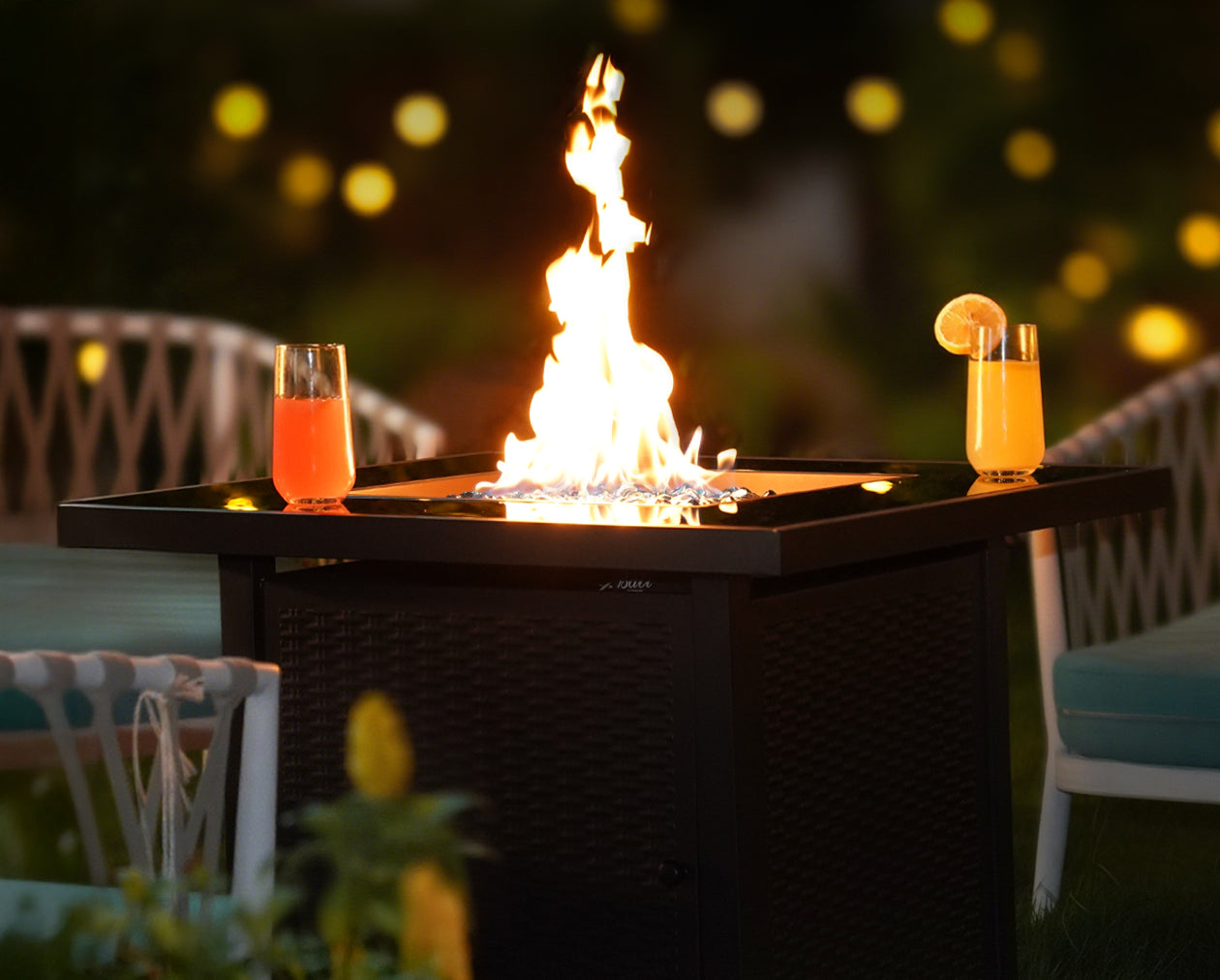
If the CC&Rs allow gas fire pits, choose one that fits the community's aesthetic and meets any size restrictions. A propane fire pit table with a clean design, enclosed base, and adjustable flame is easier to get approved than an open fire bowl. Browse propane fire pit tables for options that work in HOA communities.
Step 3: Submit a Written Request
Even if the CC&Rs seem to allow your fire pit, submit a written request to the architectural review committee or HOA board. Include:
- The fire pit model, dimensions, fuel type, and BTU rating
- Proposed placement with measurements showing clearance from structures and property lines
- A photo or rendering of the fire pit in context
- Reference to the specific CC&R section that permits it
A documented approval protects you if board membership changes or a neighbor complains later.
Step 4: Get It in Writing
Verbal approvals from board members are not reliable. Get the approval in writing, ideally via official HOA communication (email from the management company or a signed letter from the board). Save this document permanently.
What If Your HOA Says No?
If your HOA prohibits fire pits entirely, you have a few options:
Request a Rule Change
HOA rules can be amended. Gather support from neighbors who also want fire pits, draft a proposed rule that addresses safety concerns (gas only, minimum clearance, hours of use), and present it at a board meeting. Rule changes typically require a vote of the board or the full membership, depending on the CC&Rs.
Propose a Compromise
If the board's concern is safety or smoke, propose restricting fire pits to gas models only. Propane fire pit tables eliminate the smoke, spark, and ash issues that drive most HOA fire pit bans. A propane fire pit with no wood-burning option directly addresses the most common objections.
Use Alternative Fire Features
Some HOAs that ban traditional fire pits allow tabletop fire features, outdoor candle setups, or small ethanol burners. These produce less heat and pose less risk, making them easier to approve. They are not the same experience as a full fire pit, but they add ambiance within the rules.
Escalate Through Dispute Resolution
If you believe the HOA is enforcing a rule selectively or that the rule was not properly adopted, most states offer mediation or arbitration processes for HOA disputes. Check your state's homeowners association statute for the dispute resolution process. Legal action is a last resort and can be expensive, so exhaust informal options first.
HOA Fire Pit Rules in Different Housing Types
Single-Family Homes in HOA Communities
You have the most flexibility here. Backyards are private, and clearance requirements are easier to meet. HOA restrictions usually focus on aesthetics, fuel type, and sometimes hours of use. Gas fire pit tables on patios are approved in most single-family HOA communities that allow fire features at all.

Townhomes
Shared walls change the equation. Distance requirements from shared walls are typically 10–15 feet, which can limit placement on small patios. Smoke from wood fires affects adjacent units directly, which is why most townhome HOAs restrict fire pits to gas models. A compact round fire pit table fits the space constraints of most townhome patios.
Condos and Apartments
Condo associations have the strictest fire pit rules. Many prohibit open flames entirely on balconies and patios due to building fire codes and insurance requirements. Where fire features are allowed, they are almost always limited to small, gas-powered units with enclosed flames. Check both the condo association rules and the building's fire safety plan.
Liability and Insurance
Regardless of HOA approval, you as the homeowner are responsible for any damage caused by your fire pit. This includes:
- Property damage: Scorch marks on a shared wall, melted siding on a neighbor's unit, or a deck fire. Your homeowner's insurance may cover this, but some policies exclude fire pit incidents or require a rider.
- Personal injury: Burns, smoke inhalation, or other injuries to guests or neighbors. Your liability coverage applies, but the HOA may also sue for damages to common areas.
- Fines and assessments: HOA fines for violations escalate. A first offense may be $50–$100, but repeat violations can reach $500+ per incident in some communities, with daily fines for ongoing non-compliance.
Call your insurance company before installing a fire pit. Ask whether fire pit use is covered, whether you need to notify them, and whether a gas fire pit versus wood-burning makes a difference in your coverage. In most cases, gas fire pits are treated as standard outdoor equipment, while wood-burning pits may trigger additional questions.
Frequently Asked Questions
Can my HOA fine me for using a fire pit?
Yes, if the fire pit violates a rule in the CC&Rs or a properly adopted HOA regulation. Fines must follow the enforcement process outlined in the governing documents, which typically includes a written notice and an opportunity to respond before a fine is imposed. Fines that were issued without following the documented process can be challenged.
My HOA does not mention fire pits. Am I free to use one?
Not necessarily. If the CC&Rs include general language about outdoor fires, open flames, or nuisance behavior, the board may argue that fire pits fall under those broader categories. When the documents are silent, submit a written request to the board to establish a clear position. A documented "no objection" response protects you better than assuming silence means approval.
Can I use a fire pit in the common area?
Only with explicit board approval. Common areas are managed by the HOA, and any modification or activity requires authorization. The HOA may also need to verify that fire pit use in common areas is covered by the community's insurance policy.
What type of fire pit is easiest to get HOA approval for?
Propane fire pit tables with enclosed bases, no visible flame spillover, and a clean design have the highest approval rate in HOA communities. They address every common objection: no smoke, no sparks, no ash, instant shutoff, and controlled heat output. Pair it with a matching fire pit cover for off-season aesthetics.
Does my homeowner's insurance cover fire pit accidents?
Most standard homeowner's policies cover fire-related liability, but coverage varies. Some insurers require notification that you use a fire pit, and some exclude specific scenarios (like fire pit use on a wood deck without proper protection). Gas fire pits are generally viewed as lower-risk than wood-burning models. Contact your insurer to confirm your specific coverage before using a fire pit on your property.