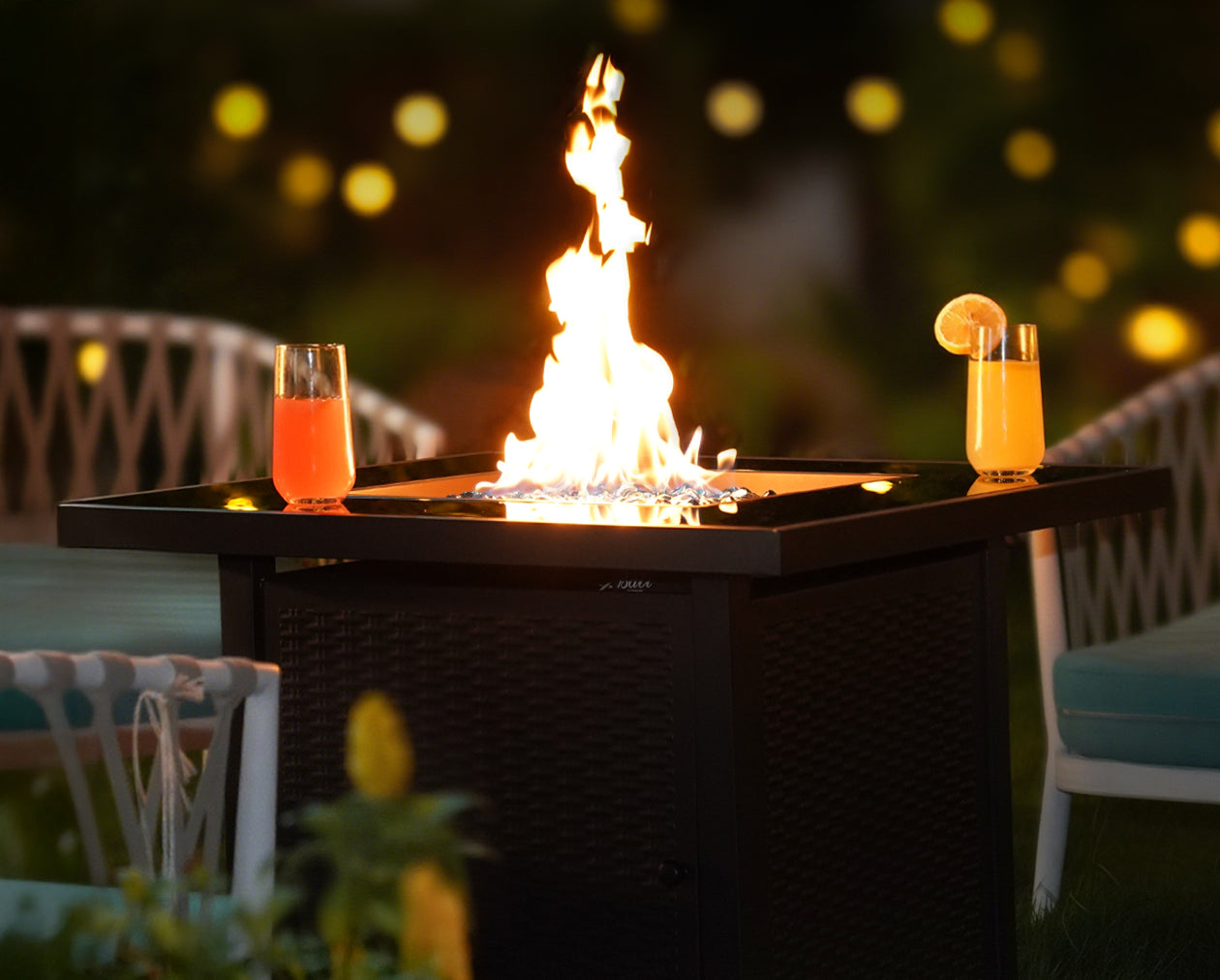


Standing vs hanging vs tabletop patio heater — the choice between these three form factors decides whether your heat lands where people actually sit. Standing heaters give you the highest BTU and widest coverage; tabletop heaters put gentle warmth right where people sit; hanging heaters use overhead space you already have without claiming any patio floor. Picking the wrong one is the most common reason a heater "doesn't feel warm enough" — the heat is going somewhere, just not where you sit.
This guide breaks down all three on coverage, fuel, mounting, install effort, and best use cases. By the end you should know exactly which one fits your patio.
Quick Verdict
| Pick… | If you have… |
|---|---|
| Standing propane | Open patio, 4–6+ people, occasional dinner parties or year-round shoulder-season use |
| Tabletop propane | Bistro table for 2–4, balcony, or as a supplement to a standing heater |
| Hanging electric infrared | Pergola, covered porch, gazebo, or any patio with overhead structure |

Standing Patio Heaters
The standing patio heater is the workhorse of residential outdoor heating. The classic mushroom shape — a 32-to-36-inch reflector cap on top of a vertical post — was designed specifically to spread heat in a 360-degree downward cone over a seating area. Modern variants include glass-tube and pyramid designs that prioritize visible flame.
Specs
- Output: 30,000-48,000 BTU (propane is the standard; commercial natural gas conversions hit similar ranges)
- Coverage: 5-6 ft warmth radius from the post
- Height: 7-9 ft (86-108 in) typical
- Fuel: 20-lb propane tank stored in the base, or natural gas line for permanent installs
- Footprint: ~30 in. base diameter
- Runtime: 8-10 hours per 20-lb tank at full output
Strengths
- Highest BTU per dollar in the patio heater category
- 360-degree coverage suits group seating
- Built-in tank storage means no separate gas line needed
- Geared wheels (on most modern designs) make solo repositioning realistic
Weaknesses
- Footprint of ~30 in. costs floor space
- Cannot be used under a low awning — needs at least 36 in. of overhead clearance
- Heavy when the propane tank is full — 50+ lb total
- Most effective when wind is calm; a 10+ mph crosswind cuts perceived warmth significantly
Tabletop Patio Heaters
Tabletop heaters are the most underused category in residential outdoor heating. They put 10,000-12,000 BTU directly at table height, which is exactly where you want warmth during a meal. A standing heater 6 ft away may produce four times the BTU but loses most of it warming empty air — a tabletop heater puts a smaller burn closer to where people actually sit.
Specs
- Output: 10,000-12,000 BTU
- Coverage: The table itself plus 1-2 ft surrounding
- Height: 24-38 in. (table-mountable)
- Fuel: 1-lb disposable propane cylinder (most common) or 20-lb tank with adapter hose
- Runtime: ~3 hours on a 1-lb cylinder
- Weight: 8-15 lb — portable
Strengths
- Heats people, not floor
- Far smaller footprint than standing units
- Portable enough to move from patio to balcony to picnic table
- Lower entry price ($80-$200 typical)
Weaknesses
- Coverage is local — one tabletop heater does not warm a 6-person seated arrangement
- Disposable cylinders cost more per BTU than 20-lb tank refills
- Less stable on glass tables than on stone or wood — check tilt-protection certifications
- Wind affects them more than standing units because they sit lower
Hanging Patio Heaters
Hanging heaters are almost always electric infrared, designed to mount from a pergola joist, gazebo crossbeam, or porch ceiling. Instead of warming the air, they warm objects (and people) directly below the unit using infrared radiation. The technology is closer to a heat lamp than a flame heater.
Specs
- Output: 1,500-2,500W (~5,000-8,500 BTU equivalent)
- Coverage: 6-10 sq ft directly below the unit
- Mount: Hard-mount via U-bracket or chain to a ceiling joist or pergola crossbeam
- Power: 110V or 220V depending on wattage
- Required clearance: 8-12 in. above; varies by model
Strengths
- Zero floor footprint — uses overhead space you already have
- No flame, no fuel storage, no tank swaps
- Works under low awnings or covered structures where propane heaters cannot vent safely
- Instant on/off, no warm-up time
- Quiet operation
Weaknesses
- Lower BTU equivalent than propane — one hanging unit is not a replacement for a 40,000 BTU standing heater
- Directional warmth — sit in the beam, not 4 ft to the side
- Requires sturdy overhead structure for safe mounting
- Electrical work may be needed for 220V units
- Higher operating cost in regions with expensive electricity
Side-by-Side Comparison
| Factor | Standing | Tabletop | Hanging |
|---|---|---|---|
| BTU / equivalent | 30,000–48,000 | 10,000–12,000 | 5,000–8,500 (1,500–2,500W) |
| Coverage | 5–6 ft radius | Tabletop + 1–2 ft | 6–10 sq ft below unit |
| Floor footprint | ~30 in. base | Sits on table | None |
| Best fuel | Propane (20 lb) | Propane (1 lb or 20 lb) | Electric |
| Install effort | Assembly only | None | Mounting + electrical |
| Mobility | Wheeled | Highly portable | Fixed once installed |
| Required overhead clearance | 36+ in. | None (open air) | 8–12 in. above unit |
| Indoor compatible | No | No | Some models, with manufacturer approval |
| Typical price | $150–$500 | $80–$200 | $150–$400 |
| Group size | 4–8 | 2–4 | 2–6 directly under |
Coverage Math: Why Type Matters More Than BTU
A 40,000 BTU standing heater positioned 4 ft from a 4-person dinner table delivers more total heat to the air around the table — but most of that heat rises before it reaches face level. A 10,000 BTU tabletop heater positioned at the table delivers less total heat, but most of it stays in the conversation zone.
This is why the right answer for a small bistro table is rarely "buy a bigger standing heater." It is "buy a tabletop and stop fighting physics."
For a covered porch or pergola, a hanging infrared positioned directly above the seating area delivers warmth straight down without losing any to the open air above — which is what a standing heater does outdoors.
Best Type by Scenario
| Scenario | Best Type | Notes |
|---|---|---|
| Open backyard dinner for 6–8 | Standing propane mushroom | 40k BTU + 360° suits the seating geometry |
| 2-person bistro on a 6x10 ft balcony | Tabletop propane | Standing model would dominate the space |
| Covered patio with pergola | Hanging electric infrared | Propane requires venting; infrared mounts to existing beams |
| Restaurant outdoor seating | Multiple standing propane | Replaceable, redundant, easy refuel |
| Apartment-rules: no propane | Hanging or wall-mount infrared | Most rentals allow electric where they ban gas |
| Existing standing heater + need for table-level warmth | Add a tabletop | Layered heating works better than one bigger unit |
| Low-budget first heater | Standing propane (entry tier) | 32-inch mushroom propane around $150–$200 is the highest BTU per dollar |
Common Mistakes
- Buying a standing heater for a small balcony. A 30 in. base on a 6 ft x 8 ft balcony eats nearly 10% of the floor. A tabletop heater serves the actual seating better.
- Putting a propane standing heater under a low awning. Without 36 in. of overhead clearance, you are creating a fire and CO risk. If the patio is covered, look at hanging electric instead.
- Expecting a hanging electric to heat a 200 sq ft patio. One 1,500W unit covers about 6-10 sq ft. You need multiple units, or you need propane.
- Skipping the tabletop because BTU sounds low. 10,000 BTU at the table beats 40,000 BTU 6 ft away.
- Mounting a hanging heater on a non-rated surface. Pergola joists must support the weight; chains and brackets must match the model's spec. Read the install manual.
BALI OUTDOORS Picks
- Standing propane mushroom — 32-inch reflector, 40,000 BTU, push-and-turn ignition, auto tilt shut-off, geared wheels. The best-value standing heater in the BALI line.
- Standing glass-tube — 71.2-inch tall, spiral flame, 360-degree heating. For buyers who want the visible flame look.
- Tabletop — portable propane tabletop heater. Pairs well with bistro setups and fits an existing standing heater as a layered solution.
BALI OUTDOORS does not currently make a hanging electric infrared heater. If your patio specifically calls for a hanging infrared (covered porch, pergola), look at established infrared brands like Bromic, Solaira, or Heat Storm.
See the full patio heater collection, and pair any unit with the right cover from the heater cover collection to extend its life. Sizing details in the patio heater cover guide.
Bottom Line
Match the heater to the use, not the use to the heater. Standing for groups, tabletop for tables, hanging for overhead structures. Many residential patios benefit from a standing-plus-tabletop combination, where the standing unit warms the seating perimeter and the tabletop unit handles the dining surface. Single-heater setups work fine — just pick the right form factor for the layout you actually have.