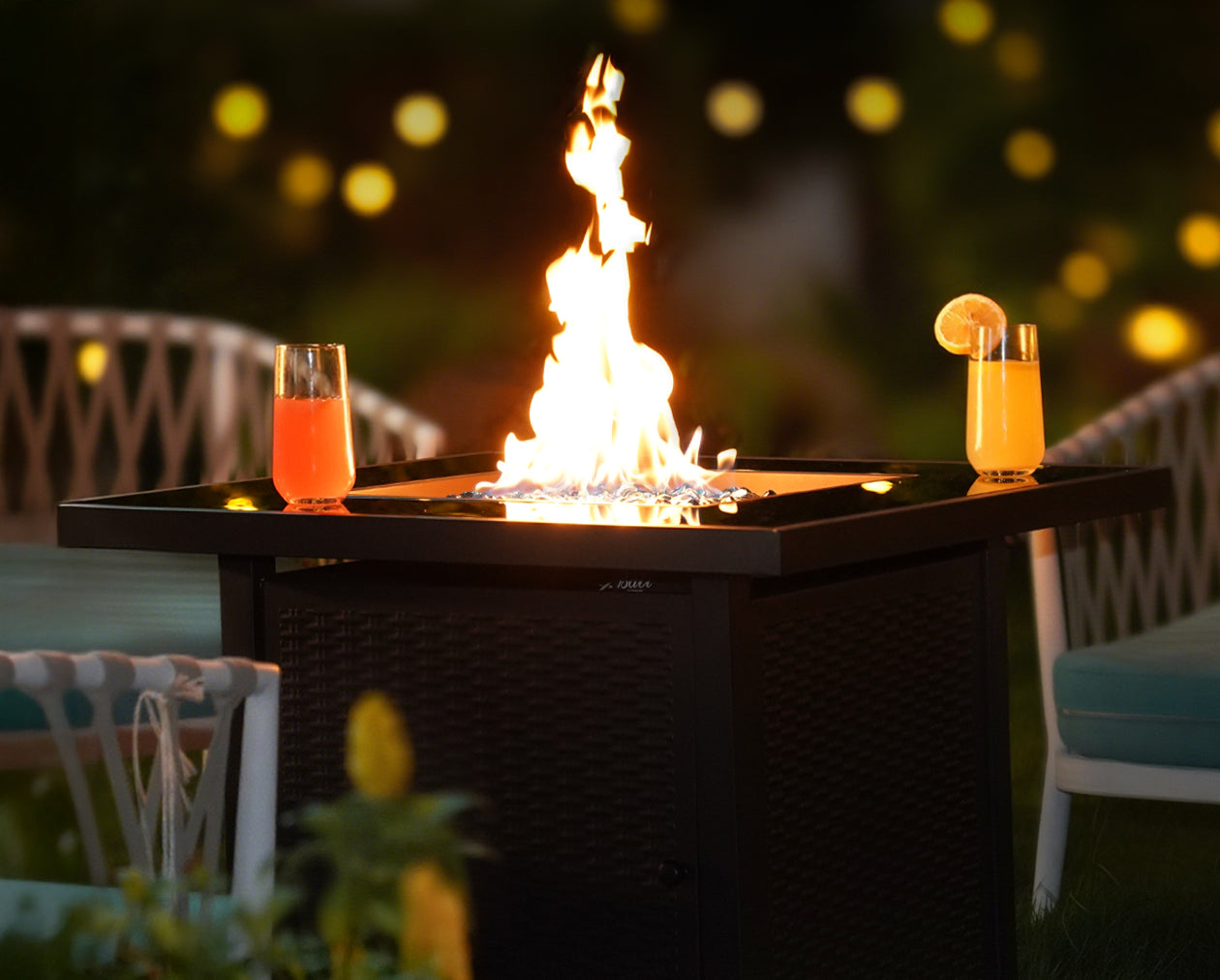


Why Surface Type Changes Every Fire Pit Table Decision
A fire pit table that runs cleanly on a flagstone patio can warp a Trex board in three hours, rust through within one coastal season, or trip an HOA citation on a fifth-floor balcony. The unit itself rarely changes. The surface and surroundings do. This guide pulls together six environments where buyers most often run into trouble: composite decks, wood decks, balconies, salt-air coastal patios, semi-enclosed porches, and structures with questionable weight capacity. For each, you will get the specific clearances, BTU ceilings, hardware specs, and inspection routines that keep both the deck and the appliance intact.
Fire safety guidance throughout this article references the U.S. Fire Administration 10-foot rule and the CDC position that gas-burning appliances are rated for outdoor use only. Every numeric heuristic below carries a source note.

Composite Decking: The 180°F Threshold You Cannot See
Composite boards from brands like Trex, TimberTech, and Azek are PE or PVC-capped thermoplastics. Technical data sheets for common composite decking materials show the resin starts to soften, sag, or permanently warp at temperatures around 180°F (82°C). That is well below the ignition point of pressure-treated wood, and it means a board can fail structurally before any flame is involved. The damage shows up as sagging between joists or "bubbled" wood-grain texture directly under the burner.
The danger zone is the area beneath the unit and the perimeter where heat reflects back off the deck. Three factors keep that zone below 180°F:
- Burner elevation — burners 20 inches or more above the floor of the unit dissipate heat before it reaches deck level.
- Active ventilation — open-base designs let ambient air carry away thermal load. Closed cabinet bases trap it.
- Heat shielding with an air gap — a multi-layer aluminum or stainless shield needs at least a 1-inch gap to the deck. Resting flat, the shield conducts heat instead of blocking it.
BTU output drives the vertical clearance you need from burner to deck surface. A practical heuristic used by patio installers is 12 inches of vertical clearance for every 10,000 BTU. Adjust upward for darker boards (they absorb more radiant heat), enclosed bases, and screened spaces with low airflow.
| BTU Output | Recommended Vertical Clearance | Unit Style | Why |
|---|---|---|---|
| 30,000 BTU | 36 inches (table height) | Standard table | Lower radiant intensity at base |
| 50,000 BTU | 60 inches total height | Tall / bar-height preferred | More air buffer needed |
| 60,000+ BTU | Specialized shielding required | Extra-tall base | Surface melt risk is high |
The 30-Minute Touch Test
Manufacturer claims aside, every deck environment is different. Before you settle on a permanent location, run this test on first use:
- Place the table on its intended spot, level and stable.
- Light the unit and run it at your typical flame height (usually medium-high).
- After 30 minutes, place your hand on the deck directly under and around the base.
- If the surface is too hot to keep your hand on (roughly 130–140°F), radiant heat is approaching the safe limit for composite material. Add a thicker heat shield, increase the air gap with non-combustible spacers, or pick a unit with a taller base.
For a more detailed treatment of pressure-treated and natural wood deck installation, see the companion piece on fire pit safety on wood decks.
Balcony Use: Wind Vortices, Egress, and HOA Reality
Balconies are tight, high, and aerodynamically unpredictable. A common assumption is that the leeward corner — the one sheltered from the prevailing wind — is the safest spot. In practice, wind hitting a building face creates downdrafts and vortex zones that can pull a flame sideways toward siding or suck unburned propane into a corner. The flame may even extinguish without the user noticing, leaving raw gas accumulating.
Three rules apply on every balcony, regardless of size:
- FEMA's 10-foot rule — keep the unit at least 10 feet from the home, railings, and overhangs. On a 50–80 sq ft balcony this is often impossible. When you cannot hit 10 feet, double the manufacturer's stated minimum from any vertical surface as a partial buffer.
- HOA and lease check — many associations specifically restrict open flame on elevated structures. See the broader rundown on HOA fire pit rules before you buy.
- Wind speed limit — avoid use when forecasts show sustained gusts above 15–20 mph, a common threshold in residential outdoor safety practice.
Anchoring matters more than buyers expect. Lightweight units under 50 lbs can shift or tip under a strong gust. Position any sub-50-lb table on a high-friction, level pad, or use an anchoring kit. Compact units like a 28-inch propane fire pit table are easier to keep within balcony clearance limits than a 42-inch rectangular model.
The Airflow Mapping Test
Before fixing a permanent location, map your balcony's air movement with a stick of incense or a handheld anemometer:
- Note the prevailing wind direction at your address.
- Hold the incense at the exact height the burner will sit, in each candidate corner.
- If smoke swirls, lingers, or visibly rotates more than a few seconds, that corner is a vortex zone. Pick a different spot.
- Repeat the test once in the morning and once mid-afternoon. Wind patterns shift with temperature.

Coastal and Salt-Air Patios: Material Science Decides Lifespan
Within one mile of saltwater, "rust tax" becomes a real line item. Coastal air keeps surfaces perpetually damp with a sodium chloride film, and that film acts as an electrolyte that accelerates oxidation. The most rapid degradation is rarely on the visible flat panels — it happens at crevices, screw heads, bolt washers, and inside burner ports. Standard outdoor fire features often show oxidation within a single season near the ocean.
If you live on the coast, three material specs separate gear that lasts a decade from gear that fails in 18 months:
| Component | Coastal Spec | Why It Matters |
|---|---|---|
| Powder coating | 4–6 mils thickness, with chromate pretreatment | Prevents salt penetration to base metal and stops filiform corrosion under the paint film |
| Tabletop | Tempered glass, ceramic, or polished stone | Inert materials that do not react with airborne salt |
| Burner | 304 or 316 stainless steel | Heat cycles accelerate oxidation; 316 adds molybdenum for chloride resistance |
| Fasteners | 316 stainless, with nylon washers between dissimilar metals | Prevents galvanic corrosion at aluminum-to-steel joints |
Brushed and rough finishes hold salt crystals in microscopic valleys and corrode faster than smooth or polished surfaces. On stainless steel, watch for "tea staining" — brown discoloration where the chromium oxide layer has been compromised. It is not immediate structural failure, but it tells you the material is under stress.
The 10:1 Weekly Wipe
Salt residue needs neutralizing, not abrasive scrubbing. Wire brushes and abrasive pads create micro-scratches in powder coating that become new entry points for corrosion. The standard coastal routine is a 10-to-1 water-to-white-vinegar solution, applied weekly:
- Confirm the unit is cool and the gas supply is shut off.
- Apply the 10:1 solution with a soft microfiber cloth across all exterior surfaces, focusing on joints and fasteners.
- Use a soft-bristle toothbrush dampened with the solution to reach screw heads and the burner base.
- Dry immediately with a clean microfiber towel. Standing moisture in crevices is the entire problem you are solving.
Inspect gas connections every 60 days, twice the standard inland frequency. Brass fittings in salt air develop "pitting" — localized corrosion that creates pinhole leaks too small for a soap test to catch reliably. Look for green or white powdery residue on brass threads, cracking or stiffness in the propane hose, and any clogged vent on the regulator.
Cover the Right Way
A waterproof cover on a wet table accelerates corrosion. Trapped humid, salty air becomes a sauna effect against the metal. The fix: dry the unit fully before covering, or choose a breathable 600D polyester cover that allows airflow. A 600D weave is heavy enough to resist wind-driven salt and rain without sealing in moisture. Once a season, pull the fire glass, rinse it in fresh water to remove salt dust, and clean out the burner pan. For sizing, see the fire pit cover sizing guide.
Semi-Enclosed Patios: The 8-Foot Rule and the Incense Test
A semi-enclosed space is anywhere with at least two walls or an overhead structure. Screened porches, three-sided lanais, and pergolas with solid roofs all qualify. These spaces trap two things you do not want to trap: heat reflected off walls and ceilings, and combustion byproducts including carbon monoxide.
The CDC is direct on this point — gas-burning appliances are for outdoor use only because incomplete combustion produces CO, an odorless and colorless gas that can be fatal in confined spaces. The risk is not theoretical. A burner starved of oxygen will shift from a clean blue base to yellow, "lazy" flame tips, dropping efficiency and increasing soot and CO output simultaneously.
FEMA's 10-foot rule sets the baseline. For sheltered environments, the field-tested adjustment is the 8-foot rule:
| Environment | Horizontal Clearance | Vertical Clearance | Why |
|---|---|---|---|
| Open deck or yard | 4 feet | 8 feet | Maximum natural dissipation |
| Semi-enclosed (2 walls) | 6 feet | 10 feet | Heat reflects off walls |
| Sheltered (3 walls or solid ceiling) | 8 feet | 12 feet | High risk of heat and CO trapping |
| Screened porch | 8 feet | 12 feet | Screens cut air velocity by up to 50% |
The Incense Test for Dead Air
Light a stick of incense at burner height in the intended spot. If the smoke rises vertically and lingers or swirls in place for more than a few seconds, the area is a dead air zone and your natural ventilation is inadequate. Smoke that gets pulled cleanly across the space tells you cross-ventilation is working.
For sheltered patios, target a moderate 40,000–50,000 BTU range rather than the largest available burner. High BTU outputs in confined spaces consume oxygen faster than the space can replenish it, which forces incomplete combustion. If the flame is flickering with yellow tips, dial it down. If you cannot pass the incense test, install an outdoor-rated ceiling fan or oscillating floor fan to force air exchange — the goal is steady airflow, not blowing the flame out. A glass wind guard helps stabilize the flame against swirling eddies and keeps heat moving vertically rather than sideways toward walls.
Deck Weight Capacity: The "Wet Weight" Calculation
Manufacturer shipping weight understates the actual operational load on your deck. A more accurate planning figure adds about 100 lbs to the dry weight to account for fuel, media, and dynamic load. The math:
Total Load = Base Unit Weight + Full Propane Tank + Fire Glass / Media + Dynamic Load
| Parameter | Estimate | Source |
|---|---|---|
| Base unit (30-inch propane) | 65–85 lbs | Typical manufacturer specs |
| Full 20 lb propane cylinder | 38 lbs | 20 lb fuel + ~18 lb tare |
| Fire glass / media | 20 lbs | 30-inch burner pan, 1.5" depth |
| Dynamic load (1–2 people leaning) | 50 lbs | Conservative heuristic |
| Total operational weight | 173–193 lbs | Cumulative concentrated load |
Most modern residential decks are designed for a live load of 40–50 lbs per square foot. To check whether your unit fits, divide the wet weight by the table's footprint. A 200 lb wet-weight unit on a 2 ft x 2 ft footprint puts 50 psf on four small contact points — at the upper limit of standard residential capacity, and worse if joists are 24 inches apart instead of 16, or if the wood shows soft spots.
Inspection and Load Distribution
- Joist spacing — check from below or from a deck plan. 16-inch on-center is standard; 24-inch reduces concentrated-load capacity significantly.
- Wood condition — probe for soft spots, especially around posts and where boards meet the ledger. FEMA flags structural integrity as a primary factor in fire-related deck failures.
- Point load mitigation — place a non-combustible load-spreading pad or concrete paver under each leg. This distributes force across multiple joists and prevents the feet from indenting deck boards.
For wood-burning units on a deck, a high-temperature grill mat rated to roughly 2000°F gives a secondary thermal barrier and catches stray embers — wood-burning is harder on a deck than propane because of the ember risk. For propane-only setups, a quality cover pulled tight enough to prevent water pooling and a level base do most of the structural protection work. For a closer look at when to step up to a non-combustible hearth pad, the wood deck safety guide covers material requirements in detail.

Wind Guards and Anchoring: Fixing the Two Most Common Failures
Two pieces of hardware solve a disproportionate share of deck and balcony incidents: a glass wind guard sized for the burner pan, and an anchoring or weighting strategy for lighter units.
Wind Guard Geometry
A wind guard's job is to stabilize the flame. Its effectiveness depends on the gap at the bottom edge. If the gap between the glass and the tabletop exceeds 0.5 inch, wind can be sucked under the glass at higher velocity and create a venturi vortex inside the guard — that is worse than no guard at all. Aim for a wind guard that holds a sub-0.5-inch gap and stands at least 6 inches tall, made of 8 mm tempered glass. That combination is enough to keep flame deflection contained without choking off the oxygen the burner needs.
Anchoring Light Units
Any unit under 50 lbs is a wind liability. The fix is mechanical:
- Place the table on a non-combustible, high-friction pad — a stone paver or rubber-backed mat works.
- Use the manufacturer's anchoring kit if one is available, especially on rooftop decks and high-floor balconies.
- Always store propane within the table's designated compartment. Never keep spare tanks in a semi-enclosed space.
Universal Pre-Burn Safety Checklist
Run through this list every season, not just at first install. Decking ages, fasteners shift, and wind patterns change as nearby trees grow or new construction goes up.
- Verify wet weight vs. deck capacity — Total load below 50 psf on the unit's footprint, with 16-inch joists and firm wood.
- Confirm the 10-foot rule — at least 10 feet from the home, railings, overhanging branches, and any combustible fence, per USFA and Ready.gov.
- Burner-to-deck clearance — 12 inches per 10,000 BTU as a baseline; double for dark composite boards or screened spaces.
- Pass the incense test — no swirling smoke or persistent dead air at burner height.
- Pass the 30-minute touch test — deck surface stays comfortably touchable after 30 minutes of flame at typical operating height.
- Check fasteners and hose — 60-day inspection in coastal areas, 90-day inland. Look for green corrosion on brass, hose stiffness, and any clogged regulator vent.
- Wind guard installed and seated — gap below 0.5 inch, glass intact and clean.
- Cover only when cool — the unit should be cool to the touch, the same standard the National Park Service applies to campfires before walking away.
- HOA / lease / local code — confirmed in writing for elevated structures.
- Egress path clear — at least one side of the patio open to a clear exit route. No furniture or heavy curtains blocking the cross-ventilation path.
For shopping by environment, browse fire pit and fire table options, and pair the unit with a properly sized 600D polyester cover from day one. The cover does as much for long-term lifespan as the burner spec does.
Disclaimer: This article is for informational purposes only and does not constitute professional fire safety, structural engineering, or legal advice. Fire pit regulations vary by jurisdiction, and decking material specifications vary by manufacturer. Always check local building codes, HOA rules, your lease, and the manufacturer's manual before installation. If you suspect a gas leak or carbon monoxide exposure, shut off the gas supply and seek qualified help immediately.
Sources
- U.S. Fire Administration — Outdoor Fire Safety
- CDC — About Carbon Monoxide
- EPA Burn Wise — Best Wood-Burning Practices
- Ready.gov — Home Fire Safety Guidelines
- National Park Service — Campfire Safety
- MedlinePlus — Carbon Monoxide Poisoning
- Heuristic note: The 12-inch-per-10,000 BTU rule, 180°F composite threshold, 4–6 mil powder coating spec, 40–50 psf deck live load, and 0.5-inch wind guard gap are derived from common patterns in residential installations and technical specifications for thermoplastic composite decking and marine-grade hardware. Verify your specific decking brand and deck engineering specs.