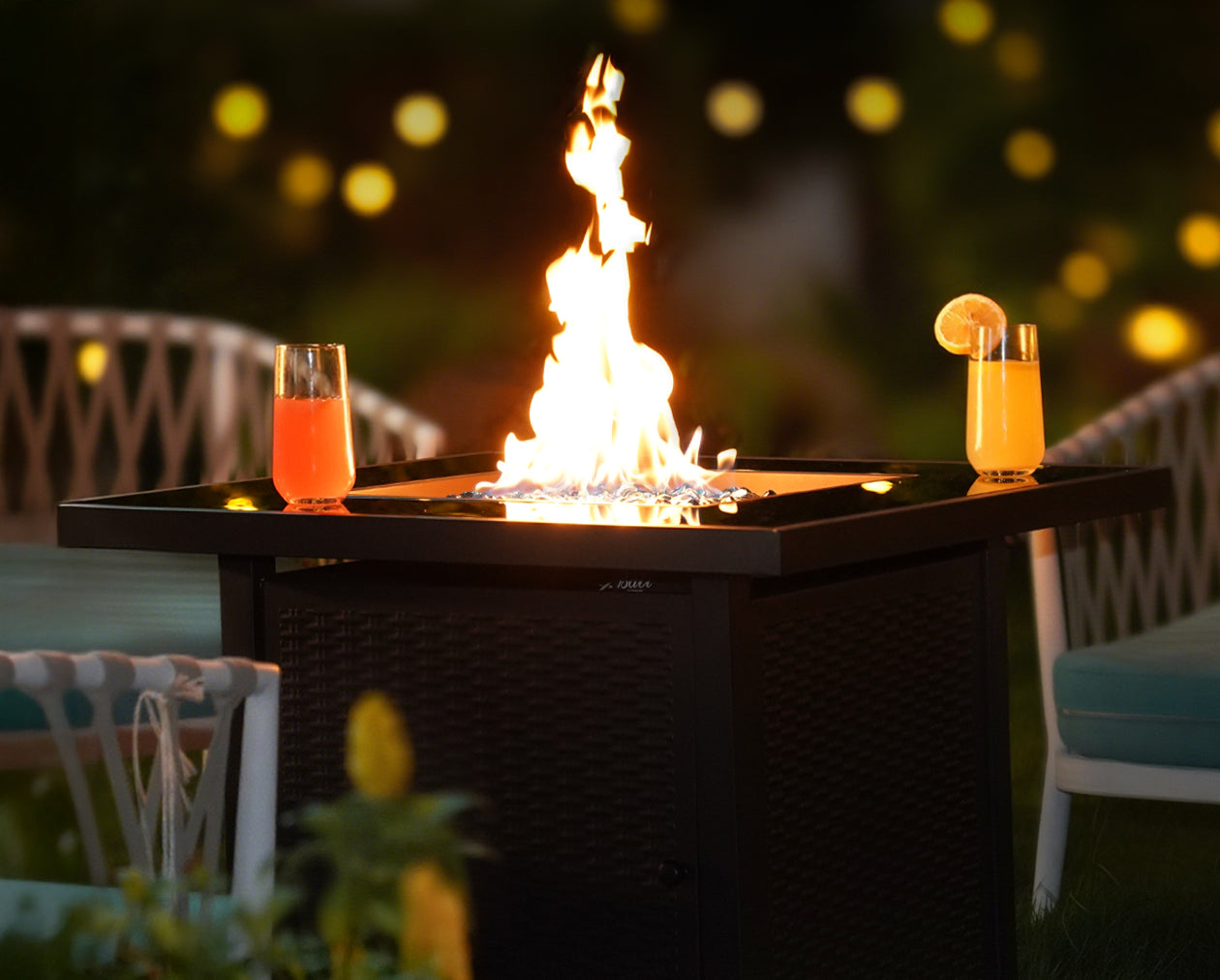


Fire Pit Table Maintenance: Cleaning, Rust & Winterizing Guide
Disclosure: This guide is published by BALI OUTDOORS. It links to products from our own catalog of propane fire tables, fire pit covers, and accessories.
A fire pit table earns its keep over a long horizon. The first season looks easy: wipe the top, refill the tank, light it. The third and fourth seasons separate the tables that still look like the showroom from the ones that have orange streaks running down the legs and grout that has turned the color of black tea. The difference is rarely a manufacturing defect. It is what happens between uses, especially in the four weeks after a heavy rain and the four months it sits under a cover.
This guide consolidates everything we have learned from warranty cases, customer support tickets, and our own product testing across the BALI OUTDOORS propane fire pit and fire table catalog. It covers tile vs. metal tabletops, daily and weekly cleaning, wine and grease stains, rust prevention on steel and powder-coated finishes, a winterizing checklist, cover replacement decisions, and what to do after a heavy rainstorm.

Tile vs. Metal Tabletops: Which Surface You Are Maintaining
Before any cleaning routine matters, identify what your tabletop actually is, because the failure modes are different. The two surface families on most BALI OUTDOORS fire tables are tile/ceramic tops and smooth powder-coated metal tops.
Tile and Ceramic Tops
Tile-topped tables like the 42 Inch Propane Fire Pit Table, Black bring texture and a heavier dining surface. The tile itself is highly stain-resistant. The grout between the tiles is the weak point. Standard cement-based grout is porous, and acidic liquids like red wine or oily food residue soak in if left overnight. Discoloration in the grout lines is the most common cosmetic issue we see on tile tops, and it is fully preventable with annual sealing.
Slate-look tables such as the 32 Inch Propane Gas Fire Pit Table, Brown hide water spots and minor dust better than glazed ceramic because the natural color variation absorbs visual noise.
Smooth Powder-Coated Metal Tops
Smooth metal tops on tables like the 30 Inch Propane Fire Pit Table, Black wipe clean with a damp microfiber cloth. There are no grout lines to trap debris. The trade-off is that the powder coating is the only thing keeping the steel underneath from rusting. Micro-scratches from sliding ceramic plates, hard metal trays, or scouring sponges create entry points for moisture, and once oxidation starts beneath the coating it bubbles outward from the inside.
Maintenance Comparison At a Glance
| Feature | Tile / Ceramic Top | Smooth Powder-Coated Metal |
|---|---|---|
| Daily cleaning | Brush or wipe with mild soap | Wipe with damp microfiber |
| Stain resistance (tile/coating) | High | Very high |
| Stain resistance (grout) | Low if unsealed | N/A |
| Scratch resistance | High | Moderate; shows micro-scratches in raking light |
| Annual maintenance task | Reseal grout (15 minutes) | Apply automotive wax to edges (15 minutes) |
| Forgives water spots | Yes (slate especially) | No; mineral spotting is visible on dark colors |
Daily and Weekly Cleaning Routine
The cleaning routine that keeps a fire table looking new is short and unglamorous. Five minutes after each gathering, ten minutes once a week. The goal is to remove acidic, oily, or salty residue before it has time to interact with the finish.
The 10:1 Cleaning Solution
For both tile and powder-coated metal, mix 10 parts warm water to 1 part mild dish soap (Dawn or a comparable surfactant-based dish soap). This ratio dissolves cooking oils and beverage residue without leaving a film or stripping the coating's gloss. Stronger concentrations or all-purpose sprays containing ammonia, bleach, or solvents accelerate UV damage on the polymer top layer.
The Five-Step Routine After Each Use
- Cool down. Wait until the tabletop is cool to the touch. Wiping a warm surface causes thermal stress where the metal and the powder coating expand at different rates, which can produce hairline fractures.
- Rinse loose debris. Use a low-pressure garden hose or a damp cloth to remove dust, ash, and food crumbs. Skip the pressure washer; high-pressure water forces moisture into fastener holes and the seam where the burner pan meets the tabletop.
- Apply the 10:1 solution. Use a soft microfiber cloth. Microfiber lifts particles off the surface instead of dragging them across it, which is what scours fine scratches into a glossy black finish.
- Rinse with fresh water. Soap residue left on the surface attracts dust and traps moisture against the coating.
- Buff dry. Use a separate dry microfiber towel. Air-drying causes mineral spotting on dark colors, especially in hard-water regions.
Weekly Detailing
Once a week, work a soft-bristled nylon brush along the rim where the burner pan meets the tabletop, around the control knob bezel, and along the bottom edge of the table apron. These are the seams where pollen, soot, and bird droppings collect. A toothbrush is the right tool for the gap around the ignition button.

Removing Wine, Grease, and Food Stains
The cleaning chemistry should match the spill. Liquid pigments respond to mild acids; viscous oily residue responds to alkaline pastes with dwell time. The single biggest mistake we see in customer support photos is steel wool, scouring pads, and "magic" melamine sponges, which all create the micro-grooves where rust eventually starts.
Red Wine, Coffee, and Tannin-Heavy Spills
- Blot, do not rub. A folded paper towel pressed straight down lifts the liquid. Rubbing pushes the pigment into the grout pores or the texture of the powder coating.
- Apply a 50/50 white vinegar and distilled water mix. The mild acetic acid breaks down the tannins and chromogens that stain.
- Aluminum exception. If your frame or top is aluminum, rinse the vinegar off within two or three minutes. Acetic acid will etch bare aluminum into a permanent dull spot if left to sit.
- Rinse and dry. Wipe with a clean damp cloth, then buff dry.
Grease and Oily Food Residue
- Mix a baking soda paste. Three parts baking soda to one part water until it forms a thick spreadable paste.
- Apply and wait 15 minutes. The alkaline paste emulsifies the fatty acids in cooking oil and butter. Dwell time matters more than scrubbing pressure here.
- Agitate gently. Use a soft nylon brush in small circles. Skip wire brushes and stiff plastic bristles.
- Rinse and dry. Wipe down with a damp microfiber, rinse with clean water, and buff dry.
Stain Removal Quick Reference
| Cleaning Agent | Best For | Surface Compatibility | Risk |
|---|---|---|---|
| 50/50 white vinegar + distilled water | Wine, coffee, tannin stains | Ceramic, powder-coated steel | Etches bare aluminum if left over 3 minutes |
| 3:1 baking soda paste | Grease, oily food residue | All powder-coated surfaces | Very low |
| 10:1 dish soap solution | Daily dust, light residue | All | Very low |
| Steel wool / scouring pads | Anything | None | Critical: destroys powder coating, voids warranty |
| Chemical degreaser | Heavy baked-on grease | Glazed ceramic only | Fades powder-coated colors |
Sealing Tile Grout Annually
If your table has a tile or ceramic top, schedule one 15-minute task per year. Pick a dry weekend in early spring before the entertaining season:
- Clean the grout lines. Soft brush, mild soap, rinse, and let dry overnight.
- Pick a penetrating grout sealer. Look for "penetrating" on the label, with silane or siloxane chemistry. Big-box hardware stores stock Aqua Mix, Miracle Sealants 511, and TileLab brands. Avoid topical sealers, which leave a glossy film that yellows over time.
- Apply with a small brush. Run the sealer directly along the grout line. Wipe excess off the tile face within 5 to 10 minutes per the bottle's instructions.
- Test after 24 hours. Drop water on the grout. If it beads, the seal is good. If it darkens and soaks in, apply a second coat.
Rust Prevention on Steel and Powder-Coated Finishes
Steel rusts because iron, oxygen, and water meet at the same place. Powder coating is the polymer skin that keeps them apart. Rust prevention is therefore about keeping that skin intact and giving water nowhere to sit, especially at the four predictable failure points: bolt holes, fastener heads, the underside of the table rim, and the seam where the burner pan attaches.
Seal-As-You-Build During Assembly
The single highest-leverage rust prevention step happens on assembly day, not three years later. Capillary action pulls water into tight gaps between metal surfaces and traps it there. Treat every pre-drilled hole as a future rust spot:
- Before inserting each bolt, lay a small bead of clear silicone sealant (GE Silicone II or comparable) around the rim of the hole.
- Tighten the fastener. The silicone compresses into a gasket between the bolt head and the powder-coated surface.
- Wipe excess silicone with a lint-free cloth before it skins over (about 5 minutes).
This works on any BALI OUTDOORS table assembled at home, including the 28 Inch Propane Fire Pit Table, Black.
The Automotive Wax Step
Twice a year, apply a thin coat of carnauba-based automotive paste wax (Meguiar's Gold Class, Turtle Wax, or similar) to the underside of the table rim, around bolts, and along any cut edges. Carnauba wax fills microscopic pores in the powder coating, creates a hydrophobic barrier, and causes water to bead and roll off instead of pooling. Skip silicone-based protectants; they leave a sticky residue that attracts dust and can trap moisture against the metal.
Coastal and High-Humidity Schedules
Salt is hygroscopic, meaning it pulls moisture out of the air and holds it against your steel. If you live within 5 miles of the ocean, the rinsing schedule matters more than any specialty cleaner. A 1:4 white vinegar to water wipe-down neutralizes salt deposits before they react with the coating.
| Environment | Fresh-water rinse | Soap-water clean | Wax application |
|---|---|---|---|
| Coastal (within 5 miles of sea) | Monthly, after every salt-spray event | Every 2 months | 3-4 times per year |
| High humidity / Gulf or Southeast | Bi-weekly | Quarterly | 3 times per year |
| Inland / Midwest / Northeast | Quarterly | Twice per year | Twice per year |
| Arid / Southwest | Monthly dust-off | Twice per year | Once per year |

Treating Early Surface Rust
If you find an orange speck or a small bubble in the finish, do not wait and do not reach for a wire brush. Aggressive brushing scratches the surrounding healthy coating and creates new rust sites.
- Use a Scotch-Brite type pad on a rotary tool or fine 220-grit sandpaper. Target only the rust spot. Feather the edges outward until you see clean metal.
- Apply a phosphoric acid rust converter (Naval Jelly or Loctite Naval Jelly Rust Dissolver). It chemically converts the remaining iron oxide into a stable black phosphate layer that bonds to the underlying steel.
- Prime with high-temperature primer (Rust-Oleum High Heat or Krylon High Heat). Two thin coats, 10 minutes apart.
- Touch up with matching paint. Most BALI OUTDOORS tables use a matte black or matte brown finish that flat-black grill paint matches closely after curing.
The "Coin Test" for Damage Triage
Use a 1-inch quarter as your gauge. If the bubbling, peeling, or rust spot is smaller than the diameter of a quarter, a spot repair as above will hold. If the failed area is larger than a quarter, the substrate underneath is corroding faster than visible, and a touch-up will only buy you a season. Plan for a panel refinish or replacement.
Winterizing Checklist
Most surface failure on fire tables does not happen in summer use. It happens during freeze-thaw cycles when trapped moisture expands inside grout pores, under the cover, or in burner ports. The off-season prep below has been refined over multiple winters of warranty data.
Step 1: Deep Clean
- Remove all fire glass or lava rocks and wash them in mild dish soap to remove soot. Store in a breathable mesh bag in a dry indoor location.
- Wash the entire frame with the 10:1 dish-soap solution using a soft microfiber cloth.
- Inspect for paint chips. Apply touch-up paint to any exposed metal before storage.
- Detail the rim where the burner pan meets the table with a soft-bristled brush.
Step 2: The 48-Hour Drying Rule
Air-dry the table in a shaded, breezy area for a full 48 hours before doing anything else. In high-humidity regions (above 70% ambient humidity), extend to 72 hours. Surfaces that "feel" dry to the touch often hold a microscopic moisture film, especially in the folded edges of the metal frame and inside the burner ports. Covering a damp table is the single most common cause of "mystery rust" discovered in spring.
Use a can of compressed air at 20-30 PSI to blow moisture out of the burner ports, the venturi tube, and the regulator cavity. Skip the hair dryer; high heat warps thin burner-port metal and damages plastic regulator fittings.
Step 3: Wax and Seal
- Apply a thin coat of carnauba automotive wax to all powder-coated metal surfaces, paying attention to the underside of the rim and the legs.
- For wood-burning units, wipe the cast-iron or steel ash tray with a light coat of vegetable oil to prevent rust on the bare metal during damp months.
- For tile tops, this is the right time for the annual grout sealing pass.
Step 4: Protect the Burner and Gas System
- If your table has a metal lid for the burner area, install it. This is your primary defense against snow, ice, and falling debris.
- Wrap the gas regulator in a small plastic bag secured with a rubber band. This prevents spiders and insects from nesting inside the orifice over winter, which is a leading cause of spring ignition failures.
- Place a silica gel desiccant pack inside the propane tank compartment. Residual humidity in the enclosed compartment is a common cause of rust on internal shelving and the regulator.
Step 5: Propane Tank Storage
Disconnect the propane tank from the table. Per Department of Homeland Security guidance and CDC carbon monoxide guidelines, propane tanks must be stored outdoors in a well-ventilated area and never in a basement, garage, shed, or any enclosed space. Tighten the valve, secure the valve protector cap, and place the tank at least 10 feet from any structure on a level non-combustible surface.
Step 6: Cover and Elevate
- Use a 600D polyester cover designed for your table's dimensions. See the fire pit cover sizing guide for measurements.
- If your patio gets standing water, elevate the table on plastic risers or composite shims. Skip wood blocks; they wick moisture and rot.
- For exposed balconies in heavy snow regions, a sealed plastic storage bin placed over the fitted cover provides a useful air gap and protects against ice load.
For deeper winter storage strategy, see the winter storage guide.

Cover Replacement and Care
The cover is the single highest-leverage maintenance item on a fire table. A working cover prevents 80% of the problems above. A failed cover, especially one that traps moisture without you noticing, is worse than no cover at all.
The Bead Test
Every spring and every fall, run a 30-second test. Sprinkle a small amount of water on three places: the top flat surface, a corner, and the side panel near the strap.
- If the water beads up and rolls off within 30 seconds, the polyurethane or acrylic waterproof coating is intact.
- If the water darkens the fabric and soaks through, the coating has "wetted out" and the cover is no longer functional protection. Replace it.
Seam vs. Fabric Failure
Seams typically fail 2-3 years before the main fabric panels do, because the polyester thread used in stitching is more vulnerable to UV breakdown and acid rain than the 600D body fabric. If the seams "grin" (threads pulled apart, daylight visible) but the fabric is still supple and vibrant, a Tenacious Tape or Gear Aid Aquaseal FD repair is durable and worthwhile. If the fabric itself feels brittle, leaves a powdery residue on your hands, or has gone "crunchy," UV saturation is total and only replacement helps.
Repair vs. Replace Decision Matrix
| Condition | Action |
|---|---|
| Puncture or tear under 2 inches on a side panel | Repair with Tenacious Tape or Aquaseal FD; patch both sides |
| Localized seam separation, surrounding fabric strong | Re-stitch with UV-resistant polyester thread, then seal with Aquaseal |
| Coating peeling or flaking off the underside | Replace |
| Fabric brittle or chalky to the touch | Replace |
| Multiple Bead Test failures across the top | Replace |
| Tear longer than 4 inches | Replace |
Wind Management on Balconies and Decks
For balconies, rooftop patios, and exposed coastal decks, wind is the primary cover killer. Covers held in place only by an elastic hem fail at sustained gusts above 35 mph because the wind gets under the hem and parachutes the cover off. Covers with integrated cross-straps and buckles last 40-50% longer in our warranty data, because mechanical straps don't lose tension the way elastic does over 1-2 years.
If you are picking a replacement cover, look for: 600D polyester or higher, integrated buckle straps in addition to an elastic hem, vented mesh panels (for moderate-humidity climates) or fully sealed construction (for high-humidity coastal climates), and a soft inner liner that won't scratch a powder-coated tabletop. Browse the fire pit cover collection for sizes that match BALI OUTDOORS tables.
Post-Rain Dry Test
If your fire pit refuses to light after a heavy storm, the most common cause is not damage. It is liquid water sitting in the venturi tube, on the piezo igniter ceramic, or in the regulator diaphragm. Resist the urge to "burn it off." Lighting a wet burner produces incomplete combustion, soot buildup, and a yellow flame that can mask a real problem.
The Six-Step Recovery
- Isolate the fuel. Close the propane tank valve fully. Disconnect the regulator from the tank.
- Remove the fire media. Lift out the lava rocks or fire glass and lay them on a towel in a sunny ventilated spot. Water collects in the gaps between stones, and they need to dry separately.
- Compressed air at 20-30 PSI. Direct the nozzle into each burner port and into the venturi tube. This physically pushes water out of the system far faster than passive evaporation.
- Move the burner assembly indoors for 48-72 hours. Target an indoor environment of 68-75°F and below 50% humidity. Microscopic moisture in the regulator diaphragm and igniter wiring needs this dwell time to fully evaporate.
- Soapy water leak test before relight. Mix a few drops of dish soap into water. Reconnect the regulator to the tank, open the valve without lighting the burner, and brush the soap solution onto the connection. Growing bubbles mean a leak; tighten and retest. Persistent bubbles after tightening mean the regulator or tank valve needs replacement.
- Light and observe. The first 30 seconds of flame may flicker as the system reaches operating pressure. A steady blue flame within 30-60 seconds is normal. Persistent yellow flame, popping sounds, or a strong gas smell means turn the unit off and contact a certified NFI (National Fireplace Institute) technician.
Cleaning the Piezo Igniter
If the burner has gas flow but no spark, moisture on the piezo igniter ceramic insulator is causing the spark to "leak" before reaching the gas. Wipe the ceramic with a cotton swab dipped in 90% isopropyl alcohol, let it air-dry for 10 minutes, and try again.
When to Replace vs. Repair the Whole Table
A fire table is built to last 8-12 seasons with this level of care. There are predictable points where repair stops being worth the effort:
- Repair makes sense: Surface rust under 1 inch, single failed bolt, scratched or chipped powder coating, replaceable burner port, cracked tile (replaceable from manufacturer), torn cover, dead piezo igniter.
- Replacement makes sense: Bubbling rust larger than a quarter across multiple panels, structural rust on the leg-to-frame weld, bent burner pan, frame distortion from impact, repeated regulator failure with no leak source identified.
If the burner pan or gas valve assembly is the only failed component, contact BALI OUTDOORS support before buying a new table. Replacement burner kits and regulators are available for most current models, and a $40-$80 part replacement is usually faster than a new purchase.
Safety Standards That Apply Year-Round
Maintenance and safety are linked. A clean burner produces a clean blue flame and complete combustion. A clogged or wet burner produces incomplete combustion and elevated carbon monoxide.
- 10-foot rule. The U.S. Fire Administration recommends keeping outdoor fires at least 10 feet from the house, deck railings, overhanging branches, and combustible structures.
- Outdoor use only. Propane fire tables are never for indoor, garage, screened porch, or under-canopy use. The CDC notes that fuel-burning appliances produce odorless carbon monoxide that can be fatal in enclosed and partially enclosed spaces.
- Supervision. The table frame stays hot for 30-45 minutes after the flame is extinguished, depending on ambient temperature and material thickness. Keep children and pets clear during this cool-down.
- Leak testing. Run the soapy water leak test at every tank changeover and after any reassembly.
Summary: A Realistic Annual Maintenance Calendar
| Frequency | Task |
|---|---|
| After each use | 10:1 soap wipe-down, dry buff, replace lid if equipped |
| Weekly during use season | Soft brush along seams and rim, dust the legs |
| Monthly (coastal) / Quarterly (inland) | Fresh water rinse, inspect for paint chips, soapy water leak test |
| Twice per year | Carnauba wax application, cover Bead Test |
| Annually (spring) | Tile grout sealing, deep clean, regulator inspection |
| Annually (fall) | Full winterizing checklist, cover fit check, propane tank disconnect and storage |
| Every 3-5 years | Cover replacement, full silicone re-seal of fastener holes if frame disassembled |
This is the routine that takes a $400 fire table from a three-season novelty to a ten-year backyard fixture. None of the steps require specialized tools beyond a soft microfiber cloth, dish soap, baking soda, white vinegar, automotive wax, silicone sealant, and a can of compressed air. The compounding return on 15 minutes of attention twice a year is a tabletop that still looks new in season eight.
Disclaimer: This article is for informational purposes only and does not replace your specific product manual. Always follow the manufacturer's safety and maintenance instructions for your unit. If you suspect a gas leak, persistent yellow flame, or any malfunction you cannot diagnose, shut off the propane tank and contact a certified gas technician or your local fire department.