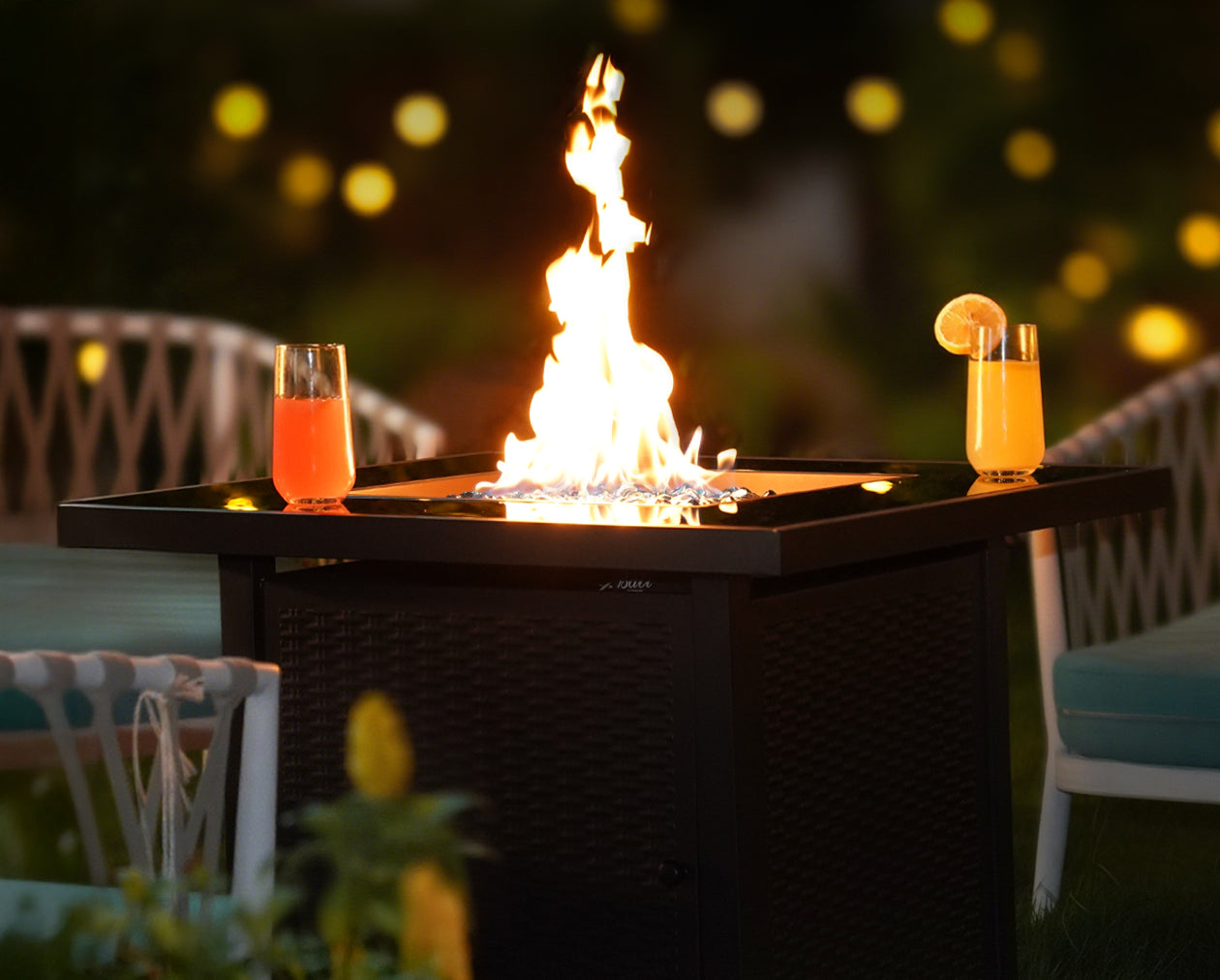


Small Patio Fire Table Layout: Footprint, Shapes & Furniture Match
A small patio fire pit looks compact in a product photo, then somehow eats half a balcony in real life. Once you add chairs, the door swing, the propane tank access panel, and a 36-inch heat clearance, the working footprint of a 28-inch table can stretch past 90 inches across.
This guide covers how to set the size baseline, draw a paper footprint before you spend a dollar, choose between round/square/rectangular shapes, and match table height to the chairs you already own — so the BALI OUTDOORS model you pick actually fits.
1. Small Patio Size Baseline and Clearance Rules
Before you measure anything, lock in two safety numbers. They override every aesthetic choice you make later.
The FEMA 10-foot rule requires 10 feet of clearance between any open flame and your house, fence, eaves, or branches. Almost no urban balcony can meet that literally. The practical baseline most propane fire table manufacturers use is a 36-inch (3 ft) clearance from the burner edge to any combustible surface, plus 12–18 inches of buffer in a corner where two walls reflect heat.
The second number is vertical: 72–96 inches of overhead clearance. A 50,000 BTU burner pushes a hot column that will warp vinyl soffit or scorch a fabric awning long before it touches a wood beam.
What "small patio" actually means in inches
"Small" usually falls in three buckets: apartment balcony 40–80 sq ft (5–8 ft deep, 8–10 ft long), townhouse deck 80–150 sq ft (8–10 ft by 10–15 ft), and compact patio 100–200 sq ft (typically 10x10 or 10x15 off a sliding door). For all three, the unit width sweet spot is 28–32 inches square or 30 inches round. Anything wider than 32 inches eats too much floor; anything smaller than 28 inches throws too little heat against the wind a small space sees.
Clearance reference table
| Parameter | Value | Unit | Why it matters |
|---|---|---|---|
| Burner-to-combustible (open) | 36 | Inches | Manufacturer minimum for 50,000 BTU units |
| Burner-to-wall (corner) | 48–54 | Inches | 36" base + 12–18" reflection buffer |
| Seating clearance | 36 | Inches | Chair pulled back + standing room |
| Walking aisle | 36 | Inches | Single-person passage with chair occupied |
| Vertical clearance | 72–96 | Inches | Soffits, awnings, pergola beams |
| Side wind buffer | Diameter + 12 | Inches | Heat bloom from wind-pushed flame |
Keep this table next to your tape measure. It is the single source of truth for what comes next.
2. Footprint Mapping: Draw the Real Working Area
The fastest way to misjudge a small patio is to measure only the table. Industry data from outdoor furniture retailers shows that more than 60% of fire pit returns trace back to size and fit. The fix is a 30-minute paper-and-cardboard exercise before you click buy.
The cardboard mockup method
Cut a flat cardboard panel matching the exact width and depth of the table you are considering — 28x28, 30x30, 32x32, or 42x21. Place it where the table will actually sit. Stand a second box on top so the mockup reaches 24 inches tall (chat-height profile). Then drag your existing chairs around it. A flat tape outline fails because the brain ignores tape but reacts to a 3D shape. You will quickly find out whether a chair pulled back hits the door, whether the propane tank access door clears the wall, and whether the dog can still reach the railing.
The 18-inch comfort zone
Manufacturer clearance is a safety floor, not a comfort target. Add 18 inches of leg-and-elbow room beyond the burner edge before you call it done. For a 32-inch square table with chairs on two sides, the math looks like this:
| Parameter | Value | Unit |
|---|---|---|
| Table width | 32 | Inches |
| Chair depth (each side) | 24 | Inches |
| Comfort buffer (each side) | 18 | Inches |
| Total linear span | 116 | Inches (9 ft 8 in) |
If your patio is shorter than 9 ft 8 in along the seating axis, drop down to a 28-inch table or move chairs to only one side. There is no clever workaround for inches you do not have.
The nighttime flow check
Leave the mockup in place for one full evening with the lights you actually use. Walk from door to railing, from chair to grill. Anywhere you turn sideways is a future trip hazard. Move the mockup six inches and try again.
3. Shapes and Traffic Flow
Shape changes how people move around the table more than width does. A 30-inch round and a 30-inch square cover roughly the same area, but the round shape opens up about 8 sq ft of "slip-past" space at the corners that a square cannot match.
Round tables on square patios
If your space is roughly square — a 10x10 concrete pad, a 8x8 deck — a round table almost always wins. Round geometry has no corners to snag a hip or a chair leg. People walk in arcs around it. The 30-inch round fire pit table guide covers the full set of round options. For a small patio, an X-frame open base lets the eye see through to the floor, which makes the patio feel larger than a solid skirted base would.
Square tables in corners and symmetrical patios
Square tables sit flush against walls better than round ones. If you have a defined corner — say, a 6 ft section of wall between a sliding door and a railing — a 28 or 32-inch square fits cleanly. Tradeoff: the corner-facing side loses 50% of its useful surface since no one sits there. Use that side as the propane tank access side and you reclaim the loss.
Rectangular tables on narrow decks and balconies
Long, skinny patios — a 5x12 balcony, a 6x14 deck — punish square footprints. A rectangular 42x21 fire table runs along the long axis of the space, leaves a wide corridor on one side, and seats four people lined up rather than crowded around. The rectangular fire table guide covers sizing in detail. The pitfall to watch: a 36-inch exterior door swung open will sweep a 30-inch arc. If a 42-inch table sits within that arc, you have just blocked your own exit.
Shape comparison at a glance
| Shape | Best patio type | Traffic benefit | Common pitfall |
|---|---|---|---|
| Round | Square patios, 8x8 to 12x12 | No corners, circular flow | Wastes corners against walls |
| Square | Symmetrical patios, corner placements | Sits flush in corners | Pinch points at corners in tight aisles |
| Rectangular | Narrow decks, 5x12 or 6x14 balconies | Aligns with long axis | Blocks door swing arcs |
4. Traffic Path Design: The 36-Inch Rule
Once shape and size are settled, plan the corridors. Two rules cover most small patio failures.
Door-to-seat path: 36 inches minimum
The path from your sliding door to the closest chair should never narrow below 36 inches — the width a person carrying drinks needs without turning sideways. If your mockup forces 24-inch shuffling, the layout is wrong, not the human. Propane units that hide the tank inside the base — the BALI OUTDOORS 28-inch and 32-inch models — remove the hose trip hazard external-tank designs leave on the floor.
The chair-plus-one test
Sit in the chair you will actually use. Have someone walk behind you. If they have to turn sideways or you have to pull your knees toward the fire, the layout fails. The fix is almost always to slide the table 6 inches farther from the door, not to buy a smaller table. Most "table is too big" complaints are actually "table is in the wrong spot."
The door swing arc
A 36-inch hinged door sweeps a 36-inch radius. Mark that arc with painter's tape. Anything inside the arc is invisible to the door — you will hit it eventually. On rectangular tables, the long edge often cuts through this arc.
5. Corner vs Center Placement
Where you put the table changes the safety math, not just the look.
Center placement
A centered fire table works on patios with at least 12 ft in the shorter dimension. It gives 360-degree seating, which is the social win — everyone faces the flame, no one gets the cold seat. The cost: you sacrifice the floor center, which kills walkthrough patios where you cross from house to yard. Center placement is also more wind-exposed; a 5–7 mph breeze on an open balcony will push the flame off-center and chase guests on the leeward side back two feet.
Corner placement
Corner placement is the only realistic choice on patios under 100 sq ft. You free up the center of the floor for movement and pin the heat against two walls that act as a windbreak. The cost is heat reflection. Walls reflect radiant heat back, raising the surface temperature of adjacent siding or railings by roughly 15–20% compared to open-air. This is why the corner buffer rule adds 12–18 inches beyond the standard 36-inch clearance on the two wall-facing sides.
Thermal tracking on wood and composite decks
On composite or wood decks, heat conducts down through the metal legs into the boards over a 2–3 hour evening. Use small non-combustible pavers or heat pads under each leg, not one oversized mat — individual pads create an air gap that lets heat dissipate before it stains the boards. A 32-inch fire table has four legs; use four 6x6 pavers, not one 36x36 mat.
Placement decision matrix
| Factor | Center placement | Corner placement |
|---|---|---|
| Min patio dimension | 12 ft on shortest axis | 8 ft on shortest axis |
| Primary risk | Traffic crossing, wind exposure | Heat reflection, downdrafts |
| Clearance focus | 360° perimeter, 36" each side | 48–54" on wall sides |
| Seating geometry | 4 chairs around | L-shape, 2–3 chairs |
| Best for | Hosting 4+ people | Solo/couple, tight balconies |
6. Fire Table Height: Match the Chairs You Already Own
Buying a fire table without measuring your chair seat heights is how customers end up with knees jammed under the apron or shoulders hunched up to reach the surface. The rule is the 7-to-12-inch differential. Measure from floor to seat top while someone is sitting on it (cushions compress 1–2 inches under weight), then add 7 inches for the minimum table height and 12 inches for the maximum. Your fire table should fall inside that range.
The three height categories
Chat height (24 inches). Pairs with lounge chairs that have a 14–17 inch seat height. This is the most relaxed posture: feet flat, shoulders down, drinks within easy reach. Most BALI OUTDOORS small-patio models — including the 28-inch propane fire pit table — sit at chat height. This is the right pick for evenings spent talking, not eating.
Dining height (29–30 inches). Pairs with standard 18-inch dining chairs. This is the upright posture for full meals, where you actually plate food on the table surface. The 32-inch square propane fire pit table at dining height converts to a true outdoor dining table when the burner cover is on. If your fire table will double as a dining surface, pick this height. The fire pit seating ideas guide covers chair pairings in more depth.
Bar height (40–42 inches). Pairs with 28–30 inch counter stools. Gives a "lean-in" social profile, popular for outdoor kitchens. Less common in small patios because the higher fire profile pushes radiant heat closer to face level on adjacent guests. Skip bar height unless your space is big enough to keep the burner 4 ft from the nearest seated face.
Burner pan depth — the gotcha
A propane burner pan sits 4–6 inches below the tabletop rim. A 24-inch chat-height table has its hot zone at 18–20 inches off the floor — shin level for a person in a 14-inch lounge chair. If you tuck knees under the apron, look for at least 24 inches of clear underside on dining-height units.
Height-to-chair pairing reference
| Use case | Chair seat height | Table height | Differential | BALI OUTDOORS pick |
|---|---|---|---|---|
| Lounge / chat | 14–17 in | 24 in | 7–10 in | 28-inch propane (chat height) |
| Casual dining | 17–18 in | 25–28 in | 7–11 in | 30-inch round propane |
| Full dining | 18 in | 29–30 in | 11–12 in | 32-inch square (dining height) |
| Wide rectangular dining | 18 in | 25–28 in | 7–10 in | 42-inch rectangular |
7. Style Match: Make the Table Disappear Into the Patio
The right table reads as part of the architecture, not a separate appliance. Use one rule: match the dominant metal finish already on the patio.
Modern minimalist patios
Clean lines, glass railings, concrete or aluminum decking. A matte black square with tempered glass top is the cleanest fit. The black frame disappears against neutral siding; the glass top picks up the existing glass-railing language. Avoid wood-grain finishes — they read as "stuck-on" against a modern envelope.
Farmhouse and rustic patios
Natural wood decking, wicker furniture, planters with greenery. A wood-burning chiminea or a propane fire table with a slate-look or stone-textured surround works best. Avoid high-gloss black; it reads as "modern intrusion" against organic textures. A 32-inch square in matte brown sits halfway between the two languages.
Coastal patios
Light woods, white railings, blue-and-white textiles, salt-air exposure. Stainless-steel hardware lasts longer than powder-coated steel here. Fire glass color matters: clear or pale blue complements coastal blues, while red or orange fights the palette.
Industrial patios
Exposed brick, dark steel, Edison bulbs, urban setting. Black or graphite tables with visible bolts and X-frame bases match the visual vocabulary. A 30-inch round X-frame model is the most consistent pick — the open base reads as industrial honesty rather than decorative skirting.
The fire glass color rule
Clear and blue glass are the most versatile and reflect flame light without competing for attention during the day. Reserve red, orange, and yellow for patios where the table is the deliberate focal point and the rest of the palette is neutral.
8. Recommended BALI OUTDOORS Models for Small Patios
Three SKUs cover the small-patio range. Pick by patio dimension and chair height, not by aesthetics first.
28-inch propane fire pit table — chat height, smallest footprint
This is the right pick for apartment balconies (40–80 sq ft) and townhouse decks where you want low-profile lounge use, not dining. At roughly 24 inches tall it sits below standard 36–42 inch railing height, which keeps sightlines open and stays under most HOA "visual nuisance" thresholds. Internal propane tank storage means no exposed hose. Pair with 14–17 inch seat-height lounge chairs for the cleanest 7–10 inch differential.
32-inch wood / square propane fire pit table — dining height versatility
The 32-inch square at dining height (29–30 inches) is the most flexible small-patio pick. With the burner cover on it functions as a real outdoor dining table for four — most "small fire table" models force you to keep a separate dining table because they sit too low to eat at. Pair with 18-inch standard dining chairs. Best for compact patios at 100–200 sq ft where you want one piece of furniture to do two jobs. Browse the square fire table collection for the full lineup.
42-inch rectangular propane fire pit table — narrow decks and balconies
The 42x21 rectangular footprint is the answer for long, skinny patios — 5x12 balconies, 6x14 decks, narrow side yards. The long axis aligns with the deck axis, leaving a 36-inch corridor on one side. Wider base equals lower center of gravity, which matters on elevated wood decks where slight vibration can rock taller, narrower units. Browse the round fire pit table collection for the curved-shape alternative if you have a square space instead.
Quick selection table
| Patio profile | Recommended model | Height | Why |
|---|---|---|---|
| 40–80 sq ft balcony | 28-inch propane (chat) | 24 in | Smallest footprint, sits below railing |
| 8x8 to 10x10 square deck | 30-inch round propane | 25 in | No corners, opens up flow |
| 100–200 sq ft compact patio | 32-inch square (dining) | 29–30 in | Doubles as dining surface |
| Narrow 5x12 to 6x14 deck | 42-inch rectangular | 25 in | Aligns with long axis |
Final Layout Checklist
Before you click buy, run through this list one more time. Each item maps to a real failure pattern we see in customer support tickets.
- Mockup test passed. A cardboard footprint sat in the actual spot for one full evening. No turning sideways to walk past it.
- Clearances verified. 36 inches from burner to nearest combustible, 48–54 inches in corners, 72–96 inches overhead.
- 18-inch comfort buffer added. Beyond manufacturer minimum, on the seating sides.
- Door swing arc clear. Patio door opens fully without hitting the table or the chair pulled back.
- Height matches chairs. 7–12 inch differential between seat top and table top.
- Tank access reachable. Side panel for the 20 lb propane tank not blocked by a wall.
- Deck protection planned. Heat-resistant pads under each leg if the deck is composite or wood.
- Style match confirmed. Frame finish matches the dominant metal already on the patio.
- HOA / lease checked. Open-flame device approved, propane tank size within local code.
- Two sides open to air. Not under a closed roof, screened porch, or low awning.
A small patio fire table will anchor most of your outdoor evenings for the next five years and either reward or punish your layout choices every time you pull a chair up. Spend 30 minutes on the cardboard mockup, run the chair-plus-one test, match the height to your existing chairs, and the table will quietly do its job for the next decade.
Disclaimer: This guide is for informational purposes only and does not replace professional fire-safety, electrical, or structural advice. Always check your local fire code, HOA bylaws, lease terms, and the manufacturer's installation manual before installing or operating a fire table. Carbon monoxide is a real risk with any gas-burning appliance — only use propane fire tables in well-ventilated outdoor settings with at least two sides fully open to the air.