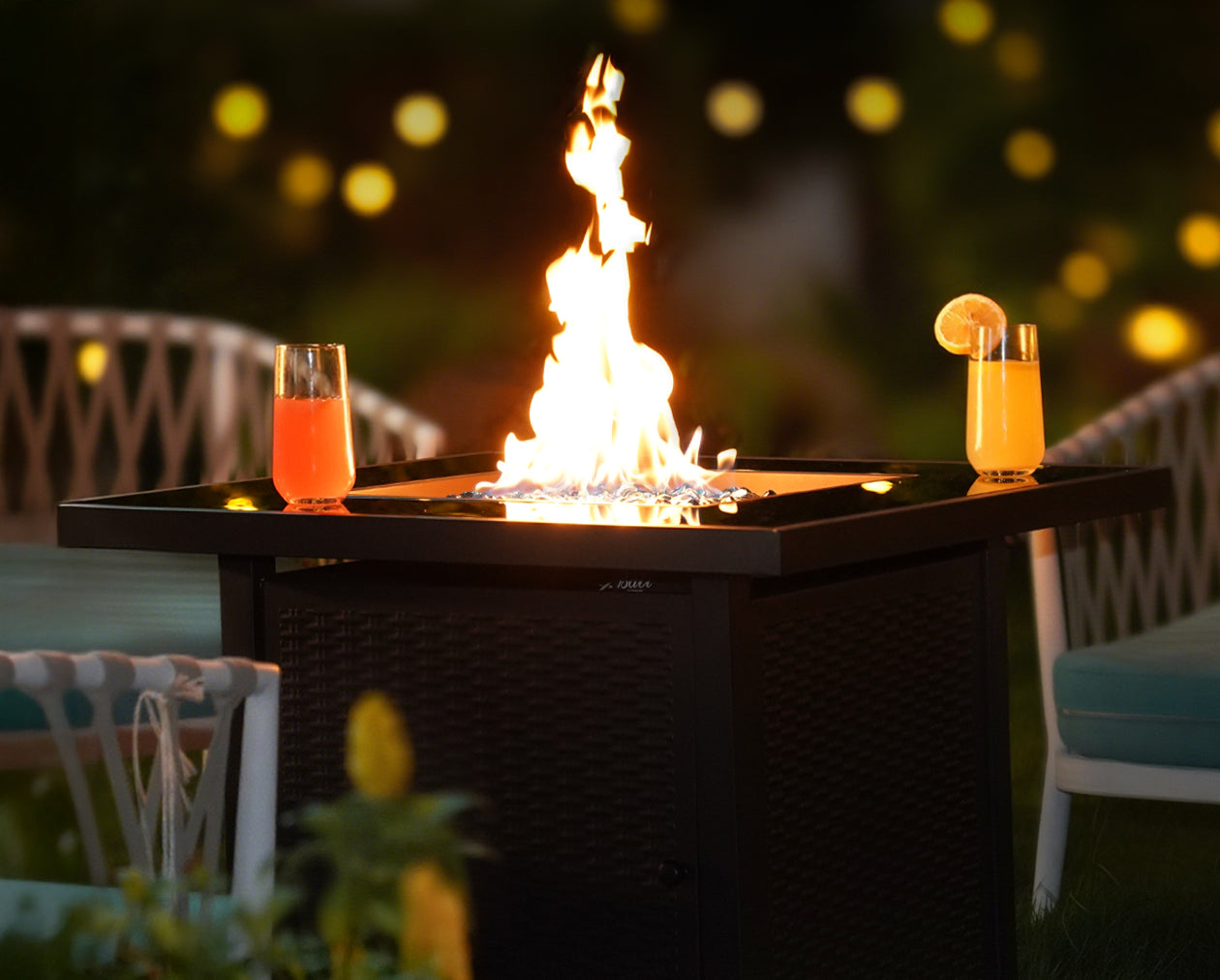

Navigating HOA Rules for Fire Tables on Apartment Balconies
The desire to transform a small apartment balcony into a cozy sanctuary is a common goal for urban dwellers. A fire pit table offers the perfect centerpiece for social ambiance and warmth. However, for those living in multi-family housing, the path to a cozy evening is often blocked by a complex web of Homeowners Association (HOA) covenants, rental agreements, and local fire ordinances.
For the risk-averse resident, the fear of a heavy fine, an evicted lease, or—worse—a safety hazard often outweighs the desire for a fire feature. This guide provides a definitive roadmap to navigating these regulations. We will break down the structural, legal, and safety requirements you must verify before investing in an outdoor heating solution.

The Legal Landscape: Municipal Code vs. HOA Covenants
Before looking at product specifications, you must distinguish between two different sets of "laws" that govern your balcony: municipal fire codes and private HOA rules.
The Rule
Municipal fire codes (established by your city or county) are non-negotiable legal requirements focused on public safety. HOA covenants or rental lease addendums are private contracts that can be even more restrictive than city law.
Why It Matters
A city might allow propane fire tables on balconies, but your HOA may prohibit them entirely to lower the building's insurance premiums. Conversely, your HOA might allow them, but if you violate the U.S. Fire Administration's (FEMA) guidelines regarding proximity to combustible structures, you could face legal liability in the event of an accident.
Our Recommendation
- Request the "Rules and Regulations" Document: Do not rely on a verbal "okay" from a neighbor. Obtain the most recent version of your HOA’s CC&Rs (Covenants, Conditions, and Restrictions).
- Search for "Open Flame" Clauses: Look specifically for language regarding "open flame devices," "liquid petroleum gas (LPG)," or "charcoal burners."
- Check the Fire Marshal’s Website: Search for your city’s specific "Multi-family Dwelling Fire Code." Many cities adopt the International Fire Code (IFC), which typically prohibits open-flame cooking or heating on balconies unless the building is protected by an automatic sprinkler system.
Fire Safety and Clearance Requirements
The most frequent cause of fire-related property damage in apartment settings is the failure to maintain adequate clearance from combustible materials like vinyl siding, wooden railings, or overhead soffits.
The Rule: The 10-Foot and 5-Foot Heuristics
According to FEMA's Outdoor Fire Safety guidelines, a minimum distance of 10 feet from any structure is the gold standard. However, on a balcony, this is often physically impossible.
Logic Summary (Heuristic Labeling): In restricted balcony environments where the 10-foot rule cannot be met, we use a Safety Buffer Heuristic. This is a practical baseline based on typical heat-deflection patterns from 50,000 BTU burners. It is not a substitute for local law but a minimum recommendation for risk mitigation.
| Clearance Type | Requirement | Rationale |
|---|---|---|
| Horizontal | 36 - 60 Inches | Prevents radiant heat from warping vinyl siding or scorching railings. |
| Vertical | 60 Inches (5 Feet) | Protects overhead ceilings/soffits from convective heat plumes. |
| Floor | Non-combustible base | Protects wood or composite decking from heat transfer. |
Why It Matters
Vinyl siding can begin to deform at temperatures as low as 160°F. A high-output propane burner, such as the 30 Inch Propane Fire Pit Table for Outdoor, Black, produces significant convective heat that rises directly upward. Without at least 5 feet of vertical clearance, you risk permanent damage to the balcony above yours.
Our Recommendation
Measure your balcony height before purchasing. If your balcony has a low ceiling (under 8 feet), a fire table with a high BTU output may be unsuitable. For standard balconies, the 28 Inch Propane Fire Pit Table, Gray provides a compact footprint that makes maintaining horizontal clearances easier in tight spaces.
The Propane Storage Hurdle: The "Secret" Reason for Denial
In our experience handling customer compliance queries, the fire table itself is rarely the reason for a "No" from an HOA. The real issue is the storage and handling of the 20lb propane cylinder.
The Rule
Many high-rise and multi-family covenants explicitly prohibit the transport of 20lb propane tanks through internal hallways or elevators. Furthermore, storing "excess fuel" on balconies is often a violation of the building's fire insurance policy.
Why It Matters
Propane is heavier than air. If a tank leaks on a balcony, the gas can "pool" near the floor or seep into lower units through sliding door tracks, creating a significant explosion risk. This is why the CDC emphasizes outdoor use only for gas-burning appliances to prevent carbon monoxide buildup and gas pooling.
Our Recommendation: The Locking Cabinet Workaround
If your HOA is hesitant, propose the use of a locking, ventilated, fire-rated storage cabinet for the tank. Some property managers will approve a fire table if the fuel source is secured in a manner that prevents tampering and ensures proper ventilation.
Additionally, consider a model where the tank is housed internally, such as the 30 Inch Propane Fire Pit Table, Black. This keeps the tank protected from direct sunlight and physical damage, which are common concerns for safety inspectors.

Structural Integrity: Can Your Balcony Handle the Weight?
A non-obvious mistake made by many condo owners is ignoring the "Live Load" capacity of their outdoor space.
The Rule: The 50 PSF Threshold
Most modern residential balconies are designed for a live load of 40 to 60 pounds per square foot (psf). Older wood-frame constructions may be rated even lower.
Why It Matters
A fire table is not just the weight of the metal frame. You must account for the propane tank, the decorative glass media, and—most importantly—the weight of the people who will be congregating around it.
Methodology Note (Scenario Modeling): We modeled a "Social Gathering Scenario" to estimate the load on a typical 5' x 8' (40 sq. ft.) balcony.
- Assumptions: 2 adults, 1 fire table, 1 full tank, 2 chairs.
- Boundary Conditions: This model assumes weight is distributed; "point loading" (all weight in one corner) increases risk.
| Component | Estimated Weight | Unit | Rationale |
|---|---|---|---|
| Fire Table | 70 | lbs | 30 Inch Propane Fire Pit Table, Black specs |
| Full Propane Tank | 38 | lbs | Standard 20lb tank + tare weight |
| Fire Glass/Media | 15 | lbs | Standard fill for 30" pan |
| 2 Adults (Avg) | 360 | lbs | ~180 lbs per person |
| Total Weight | 483 | lbs | Sum of all components |
| Load per Sq Ft | 12 | psf | 483 lbs / 40 sq ft |
Our Recommendation
While 12 psf is well within the 40-60 psf limit for a 40 sq. ft. balcony, problems arise on "micro-balconies" (e.g., 10-15 sq. ft.). If your total calculated load approaches 50 psf, or if you notice any sagging or cracking in the balcony structure, consult a structural engineer before adding heavy furniture.
Wood-Burning vs. Propane: The "Smokeless" Question
Many residents ask if they can use a wood-burning pit if it is labeled as "smokeless."
The Rule
In almost all apartment and condo settings, wood-burning is strictly prohibited on balconies. This is due to the risk of flying embers and the inability to "turn off" the fire instantly.
Why It Matters
Even a 22 inch Smokeless Wood Firepit Outdoor, Black produces embers during the initial lighting phase. In a high-density building, these embers can be carried by wind into a neighbor's open window or onto a flammable patio rug. While the EPA's Burn Wise program provides excellent tips for reducing smoke through seasoned wood, these practices are intended for ground-level backyards, not elevated balconies.
Our Recommendation
Stick to propane for balcony use. Propane fire tables are generally classified as "decorative gas appliances" rather than "open-flame pits," which often puts them in a different, more permissible regulatory category.
The Pre-Purchase Checklist for Property Managers
To position yourself as a responsible resident, do not ask "Can I have a fire pit?" Instead, present a professional plan to your property manager or HOA board using this checklist:
- Product Specifications: Provide the UL Listing or CSA Certification for your chosen model, such as the 30 Inch Propane Fire Pit Table for Outdoor, Black. This proves the unit has been safety-tested.
- BTU Rating: Disclose the heat output. Most apartment-friendly units are around 50,000 BTU.
- Clearance Map: Show a simple sketch of your balcony with the fire table placed at least 3 feet from the walls and railings.
- Extinguisher Proximity: Confirm that you have a Class B fire extinguisher (for gas fires) within 10 feet of the table.
- The "Lid" Policy: Mention that your table includes a lid (like the one found on the 28 Inch Propane Fire Pit Table, Gray), which allows it to function as a standard table when not in use, reducing the "perceived risk" of an unattended flame.
By addressing safety, weight, and storage concerns proactively, you significantly increase your chances of approval. Remember that the goal of these rules is not to prevent your enjoyment, but to ensure the collective safety of the building.
Disclaimer: This article is for informational purposes only and does not constitute professional legal, structural engineering, or fire safety advice. Regulations vary significantly by jurisdiction and individual building contracts. Always consult with your local Fire Marshal and HOA board before installing any fire-producing appliance.