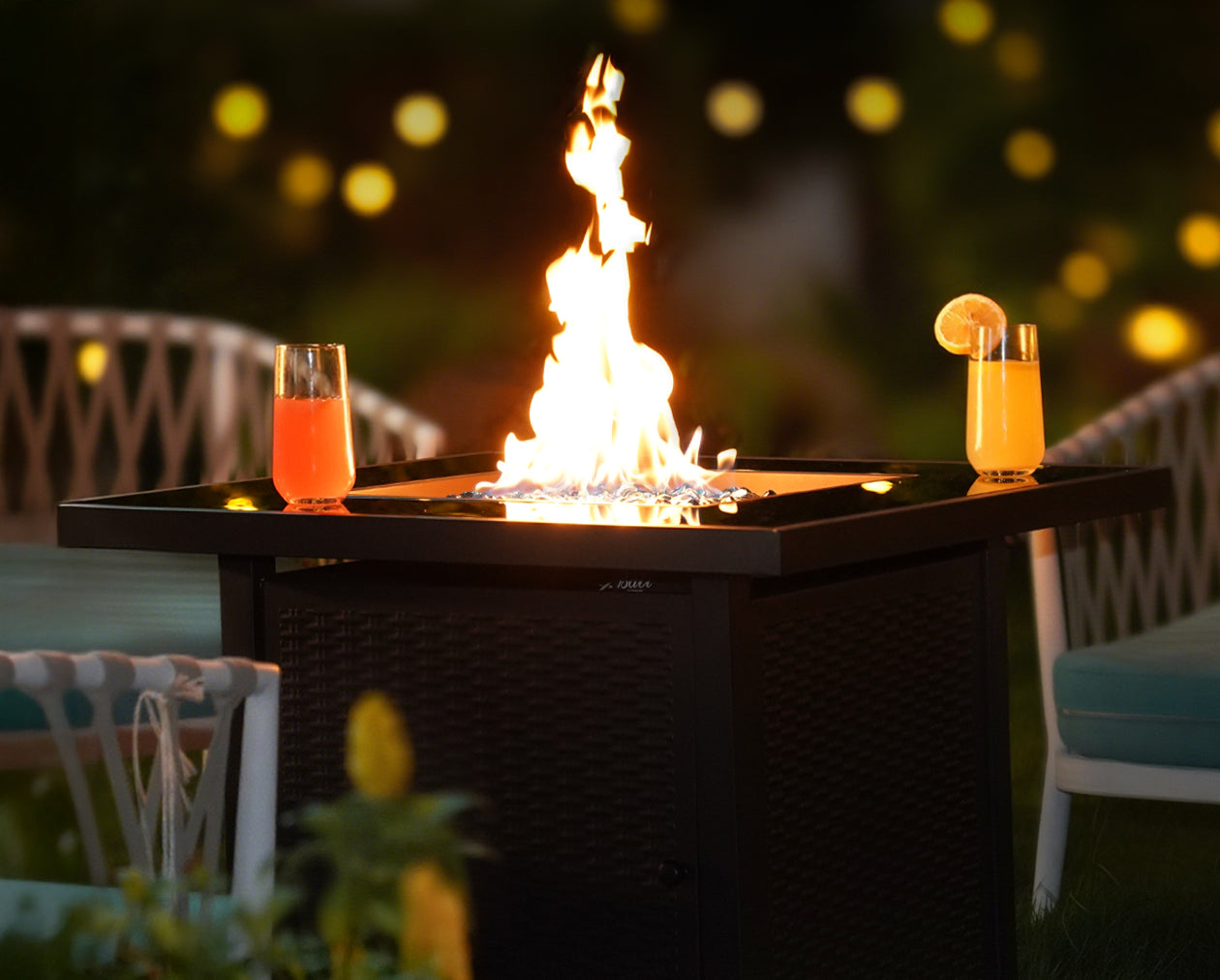

The 3-Step Footprint Test for Your Small Patio Fire Table
You have likely spent hours scrolling through photos of cozy, fire-lit patios, imagining your own small balcony or deck transformed into a warm social hub. However, for many new homeowners and renters, the transition from inspiration to installation is filled with anxiety. Will it fit? Is it safe? Will the HOA (Homeowners Association) send a violation notice the moment you strike a match?
In our experience assisting thousands of customers with compact outdoor spaces, we have observed a consistent pattern: homeowners frequently underestimate the "functional footprint" of a fire table by 30-40%. They measure the unit itself but forget to account for the arc of a patio umbrella, the swing radius of a door, or the space required to pull out a chair comfortably.
To bridge the gap between a beautiful catalog photo and the liability-heavy reality of fire safety, we developed the 3-Step Footprint Test. This methodical approach uses simple household items to create a physical mockup, ensuring your new fire table is an asset to your home, not an obstacle.
Step 1: The Safety Perimeter and the "10-Foot Rule"
Before you consider aesthetics, you must address the non-negotiable requirements of fire safety. The most common mistake in small-space planning is placing a heat source too close to combustible structures.
According to the U.S. Fire Administration - FEMA, a critical safety standard is the 10-foot rule. You should maintain at least 10 feet of clearance between any fire source and your home, overhanging branches, or wooden fences. In a small patio environment, this 10-foot radius often dictates exactly where a unit can—and cannot—be placed.
Understanding Your Clearances
When evaluating a product like the 32 Inch Propane Fire Pit Table, Brown, you aren't just placing a 32-inch square; you are placing a 50,000 BTU heat source. BTU (British Thermal Unit) is a measure of heat output; for context, 50,000 BTU is a high-performance rating that provides significant warmth but also requires strict adherence to "clearance to combustibles" (the minimum distance required between the fire and anything that can catch fire).
Logic Summary: Our safety recommendations are grounded in the FEMA outdoor fire guidelines and standard gas appliance safety protocols. We prioritize the 10-foot rule as the primary constraint for small-space placement to mitigate fire spread risks.

Step 2: The Cardboard Mockup and the "3-Foot Heuristic"
While many people use painter's tape to mark out a new furniture layout, tape is insufficient for a fire table. Tape lacks "visual bulk." It doesn't tell your brain that you might trip over a corner in the dark or that a chair won't have enough room to slide back.
We recommend using cardboard boxes to replicate the height and width of the unit. For example, if you are eyeing the 30 Inch Propane Fire Pit Table, Black, find a box or combine several to create a 30-inch square (or round) shape that stands roughly 24-25 inches tall.
The 3-Foot Rule for Functional Flow
Professional installers often use the "3-Foot Rule" heuristic. This suggests that for any fire table, you should plan for the unit’s width plus 3 feet of clearance on at least two opposing sides.
- Seating Side: You need ~3 feet to accommodate a standard patio chair and the space for a guest to stand up and walk behind it.
- Fuel/Access Side: For propane units, you need space to access the tank housing and the ignition controls safely.
Modeling the Functional Footprint
To help you visualize the total space required, we have modeled the typical "Small Patio Scenario" based on standard ergonomic clearances.
| Parameter | Value/Range | Unit | Rationale |
|---|---|---|---|
| Unit Width | 28 - 32 | Inches | Based on standard small-space models |
| Seating Clearance | 36 | Inches | Space for chair + legroom + egress |
| Walkway Clearance | 24 - 30 | Inches | Minimum width for comfortable passing |
| Safety Buffer | 120 | Inches | FEMA 10-foot rule from structures |
| Vertical Clearance | 80+ | Inches | Avoidance of low-hanging umbrellas/awnings |
Modeling Note: This is a scenario model based on common industry heuristics for residential patios. It is not a controlled lab study. Individual comfort levels and local building codes may vary.

Step 3: The Nighttime "Flow" Test
The final step is the most overlooked: testing the setup at night. Spatial perception changes dramatically in low light. Shadows can hide "trip hazards," and the glow of the fire might reveal that your chosen spot reflects uncomfortably off a window or into a neighbor’s yard.
Place your cardboard mockup in the desired spot and leave it there for a full evening. Perform the following "Flow Checks":
- The Grill Path: Can you still get to your grill without shimmying past the fire table?
- The Door Arc: Open your patio door fully. Does it come within 12 inches of the mockup? If so, the "functional footprint" is too tight.
- The Lighting Check: Use the same lighting you plan to use during a gathering. Does the mockup create a "dead zone" where people will be forced to walk in total darkness?
If the 32-inch model feels like a "permanent obstacle," consider a more compact footprint like the 28 Inch Propane Fire Pit Table, Gray. That 4-inch difference in width might seem small, but it adds 8 total inches of "breathing room" to your walkways.
Critical Safety Considerations for Small Spaces
When you are operating in a confined area, the margin for error is slim. Beyond the physical footprint, you must manage the invisible risks.
Carbon Monoxide (CO) Awareness
Gas-burning appliances, including propane fire tables, produce Carbon Monoxide. According to the Centers for Disease Control and Prevention (CDC), CO is an odorless, colorless gas that can be deadly in enclosed spaces.
- Never use a fire table inside a screened-in porch, under a heavy tent, or in a garage.
- Ensure the area has at least two sides open to the air to allow for natural ventilation.
Managing Embers and Smoke
If you choose a wood-burning model instead of propane, the footprint test must include a "downwind" assessment. The EPA Burn Wise Program emphasizes using seasoned (dry) wood to minimize smoke. In a small patio, smoke doesn't just annoy guests; it can enter your home through open windows or irritate neighbors. Propane models, such as our 50,000 BTU tables, are often preferred for small decks because they offer "clean" combustion without the risk of flying embers.
Protecting Your Investment
Once you have confirmed the fit, you must protect the unit from the elements. A high-quality cover, such as the 28 Inch Square Durable Fire Pit Cover, Brown, is essential. For small spaces, a cover also serves a secondary purpose: it keeps the unit clean so it can function as a usable coffee table when the fire isn't lit.

Finalizing Your Selection
By performing this 3-step test, you move from "guessing" to "knowing." You replace the anxiety of a potential mistake with the confidence of a well-planned environment.
- If your space is extremely tight: Prioritize a 2-in-1 design. Both the 28 Inch Propane Fire Pit Table, Gray and the 32 Inch Propane Fire Pit Table, Brown feature lids that transform the unit into a full-surface table, maximizing the utility of your square footage.
- If safety is your primary concern: Stick to the FEMA 10-foot rule and ensure you have a clear path to a fire extinguisher or a water source, as recommended by Ready.gov.
A fire table should be the heart of your outdoor gatherings, a place where the only thing you have to worry about is who is bringing the marshmallows. Taking thirty minutes to mock up your space today ensures years of safe, comfortable relaxation tomorrow.
Disclaimer: This article is for informational purposes only and does not constitute professional safety, legal, or fire-prevention advice. Always consult your local fire department, HOA bylaws, and the manufacturer’s manual before installing or operating a fire pit or fire table. Carbon Monoxide is a serious health risk; ensure proper ventilation at all times.