
Understanding Traffic Flow in Small Outdoor Spaces
Selecting a fire pit table involves more than just matching a color palette or choosing a heat output. For suburban homeowners and renters with limited square footage—such as a small balcony or a narrow deck—the shape of the table dictates how safely and comfortably people move through the space.
Traffic flow refers to the clear paths guests use to enter, exit, and navigate around furniture. In a confined area, a poorly chosen shape can create "dead zones" or, worse, safety hazards where guests are forced to squeeze too close to a heat source. By applying spatial planning principles, you can transform a cramped patio into a functional lounge.
The Concept of the Functional Footprint
The most common mistake we observe in small patio layouts is underestimating the "functional footprint." This is the total area occupied by the fire pit table, the chairs, and the necessary clearance for movement. A table that measures 30 inches across does not simply require 30 inches of space; it requires a surrounding buffer to remain usable.
The 24-Inch Service Path Rule
Based on common patterns from customer support and layout modeling (not a controlled lab study), we recommend adding a minimum of 24 inches behind any seated position. This creates a "service pathway" that allows a person to walk behind a seated guest without forcing them to tuck in their chair.
In extremely tight spaces, 18 inches is the absolute minimum for single-file passage. However, this often feels cramped and can lead to accidental bumps. When planning your layout, you must account for the chair being pulled out. A guest needs approximately 20 to 22 inches of depth to sit comfortably. Therefore, a 30-inch table effectively requires a "clear zone" of roughly 74 to 78 inches in total width to function without obstructing traffic.
Logic Summary: Our spatial analysis assumes a standard dining or lounge chair depth of 20 inches plus a 24-inch clearance for passage. This heuristic helps homeowners avoid "trapped" seating where guests cannot leave the table without others moving first.

Rectangular Tables: Maximizing Narrow Decks
For narrow decks or long, slim balconies, rectangular fire pit tables are typically the most efficient choice. Their geometry aligns with the long axis of the space, allowing you to maintain a wider corridor for traffic on at least one side.
Managing the Door Swing Arc
A critical "gotcha" in narrow layouts is the door swing. We have seen many instances where a standard 36-inch exterior door, when opened, completely blocks access to one side of a rectangular table. Before finalizing your placement, you must measure the arc of your door. If the table falls within this arc, you risk collisions and restricted emergency egress.
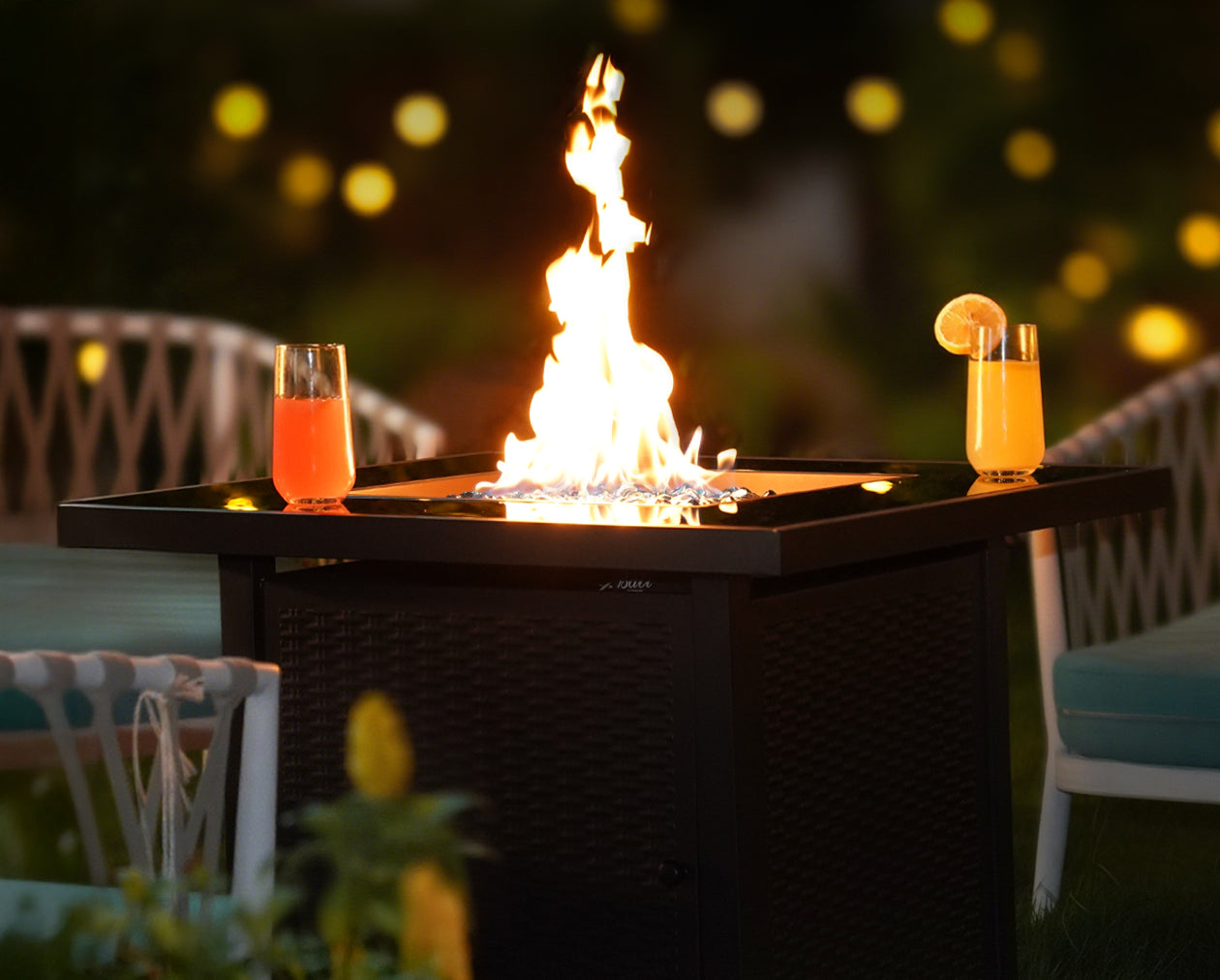
The 28 Inch Propane Fire Pit Table, Black is a high-performance option for these narrow environments. At 28 inches, it provides a 50,000 BTU output—a measure of heat energy—while maintaining a slim profile. This model features an integrated design that houses the propane tank internally, which is vital for traffic flow because it eliminates the tripping hazard of an external hose and tank.
Why Surface Area Matters
Rectangular models often serve as 2-in-1 furniture. When the fire is not in use, the included lid converts the unit into a functional coffee or dining table. This multi-purpose utility is essential for small spaces where you cannot fit both a heater and a separate table.
Round Tables: Optimizing Square Patios
If your outdoor space is square or roughly circular, a centered round table often improves traffic flow more than a square one. Round tables eliminate sharp corners, which naturally facilitates "mingling" movement.
The "Corner Friction" Effect
In tight quarters, square corners act as physical and visual obstructions. Guests navigating a square patio tend to move in straight lines and sharp turns. A round table, such as the 30 Inch Propane Fire Pit Table, Black, encourages a circular flow. This allows guests to "slip" past each other more easily in the transition zones between the table and the patio edge.
The 30-inch round model is particularly effective because of its modern X-frame design. In spatial design, the "perceived bulk" of an object is as important as its physical dimensions. A table with a solid, skirted base feels heavy and "closes in" a small patio. Conversely, an open-frame design like the X-frame allows the eye to see through the furniture to the floor beyond, making the entire area feel larger and more open.
Safety Standards and Compliance
Safety is the foundation of outdoor comfort. When dealing with fire pits in suburban settings, you must adhere to local Homeowners Association (HOA) rules and national safety guidelines.
The 10-Foot Rule
According to the U.S. Fire Administration (USFA), you should maintain at least 10 feet of distance between a fire pit and any structures, including your home, deck railings, or overhanging branches. For small patios, this can be challenging, which is why propane-fueled tables are often preferred over wood-burning ones. Propane provides a "clean" burn without the risk of flying embers or sparks that can ignite nearby materials.
Ventilation and Carbon Monoxide
Safety must always come first when using gas-burning appliances. As noted by the Centers for Disease Control and Prevention (CDC), carbon monoxide (CO) is an odorless, colorless gas that can be deadly. Fire pit tables are designed for outdoor use only. You must never use them inside a garage, screened-in porch, or any partially enclosed space where CO can accumulate.

Material Durability and Maintenance
In high-traffic areas, furniture is prone to bumps and scrapes. Choosing materials that can withstand frequent movement is essential for long-term value.
- Powder Coating: Look for frames with a powder-coated finish. This is a dry finishing process that creates a thick, protective "skin" over the metal, making it highly resistant to chipping and weather-induced corrosion.
- Integrated Ignition: Models like the 28 Inch Propane Fire Pit Table, Gray use a pulse ignition system. This simplifies the lighting process, reducing the time you spend leaning over the burner—a small but significant safety benefit for anxious users.
Comparison of Spatial Impact by Shape
| Table Shape | Best Patio Type | Traffic Flow Benefit | Common Pitfall |
|---|---|---|---|
| Rectangular | Narrow Decks / Balconies | Aligns with long axis; creates clear corridors. | Can block door swing arcs or narrow exits. |
| Round | Square Patios / Small Decks | No sharp corners; facilitates circular movement. | Requires more "center-room" clearance. |
| Square | Symmetrical Patios | Provides maximum surface area for dining. | Corners can create "pinch points" in tight paths. |
Methodology Note: This comparison is based on hypothetical layout modeling using standard suburban patio dimensions (approx. 100-150 sq. ft.). Individual results may vary based on specific furniture dimensions and architectural features.
Creating a Social Anchor
The ultimate goal of choosing the right shape is to create a social anchor—a place where people naturally want to gather. For a family of four on a suburban patio, a 30 Inch Propane Fire Pit Table for Outdoor, Black with decorative glass stones provides both warmth and a visual centerpiece. The glass stones reflect the flame, increasing the perceived light without increasing the physical footprint.
When the layout is planned correctly, the fire pit becomes a seamless part of the home. You avoid the "furniture tetris" frustration of moving chairs every time someone needs to get to the grill or go inside. Instead, you get a safe, compliant, and inviting space for social gatherings.
Final Selection Checklist
Before you make your purchase, perform this quick self-check to ensure your choice supports a healthy traffic flow:
- Measure the "Walk-Around": Do you have at least 18 inches (minimum) to 24 inches (recommended) of clear space behind where the chairs will sit?
- Check the Door Arc: If using a rectangular table, is it at least 36 inches away from any out-swinging doors?
- Assess the Base: For the smallest patios, does the table have an "open" leg design to reduce visual bulk?
- Confirm Fuel Storage: Does the table hide the propane tank internally to prevent tripping hazards?
- Verify Compliance: Does your placement follow the 10-foot safety rule from structures?
By prioritizing these spatial and safety factors, you can move forward with confidence, knowing your new fire pit table will enhance your outdoor lifestyle rather than clutter it.
Disclaimer: This article is for informational purposes only and does not constitute professional safety or architectural advice. Always consult your local fire department and HOA guidelines before installing an outdoor heating appliance. Ensure all gas connections are leak-tested according to the manufacturer's instructions.