
The Critical Relationship Between Heat and Overhead Clearance
When designing a comfortable outdoor living space, the transition from an open-air deck to a covered patio or pergola introduces a complex variable: heat accumulation. For homeowners, the selection of a heating appliance is not merely a matter of aesthetic preference or heat output; it is a calculation of safety dictated by the structural limits of the overhead covering.
In semi-enclosed spaces, heat does not simply dissipate into the atmosphere. Instead, it rises and can become trapped against ceilings, awnings, or rooflines. This creates a thermal pocket where temperatures can quickly exceed the ignition point of building materials. Understanding the specific vertical clearance requirements of your heater is the most effective way to prevent property damage and ensure compliance with local fire codes.
Understanding BTU and the Thermal Gradient
The primary metric for patio heaters is the British Thermal Unit (BTU), which measures the amount of heat energy produced. However, a higher BTU rating does not just mean a warmer patio; it directly increases the size of the "danger zone" above the unit.
In our technical analysis of residential heating patterns, we observe that heat intensity does not dissipate linearly. Instead, it forms a vertical column of high-temperature air. For a standard umbrella-style heater, such as the 32 Inch Propane Patio Heater, Black, which produces 40,000 BTUs, the heat concentrated at the reflector cap is significant.
Logic Summary: Our clearance recommendations are based on a thermal gradient model where the air temperature must drop below 120°F (49°C) before reaching a combustible surface to prevent long-term material degradation or ignition.
Vertical Clearance Requirements by Heater Type
| Heater Type | Typical BTU Range | Minimum Vertical Clearance | Unit Design Impact |
|---|---|---|---|
| Umbrella Style | 36,000 – 48,000 | 8 – 9 Feet | Reflector cap concentrates heat upwards. |
| Spiral Flame/Glass Tube | 30,000 – 42,000 | 6 – 7 Feet | Heat is diffused along the length of the tube. |
| Fire Pit Table | 25,000 – 50,000 | 5 – 6 Feet (from flame) | Radiant heat zone extends 2-3 feet above flame. |
| Portable Fire Pit | 20,000 – 30,000 | 10 Feet | High variability in flame height requires more buffer. |
Note: These are estimated ranges based on common industry heuristics. Always refer to your specific product manual for certified distances.

The "Umbrella" Effect: Why Design Matters
The design of the heater significantly influences how heat is directed. The 32 Inch Propane Patio Heater, Black utilizes an umbrella-style reflector. While this is highly efficient for pushing heat down toward users, the area immediately above the reflector becomes a high-intensity heat zone.
In practice, we have found that 40,000 BTU umbrella heaters require a minimum of 8 to 9 feet of vertical clearance from the top of the heater to any combustible surface. This remains true even if the unit is equipped with a reflector cap, as the cap itself becomes a secondary radiant heat source.
Conversely, models like the 20 inch Propane Patio Heater, Dark Brown use a spiral flame encased in a glass tube. This design allows the flame to transfer heat stably and more evenly along its vertical axis. Because the heat is not concentrated at a single top-mounted reflector, these units can sometimes operate safely with slightly lower overhead clearances, though we still advise a conservative buffer of at least 6 feet from the top of the unit.
Fire Pit Tables: The Common Installer Mistake
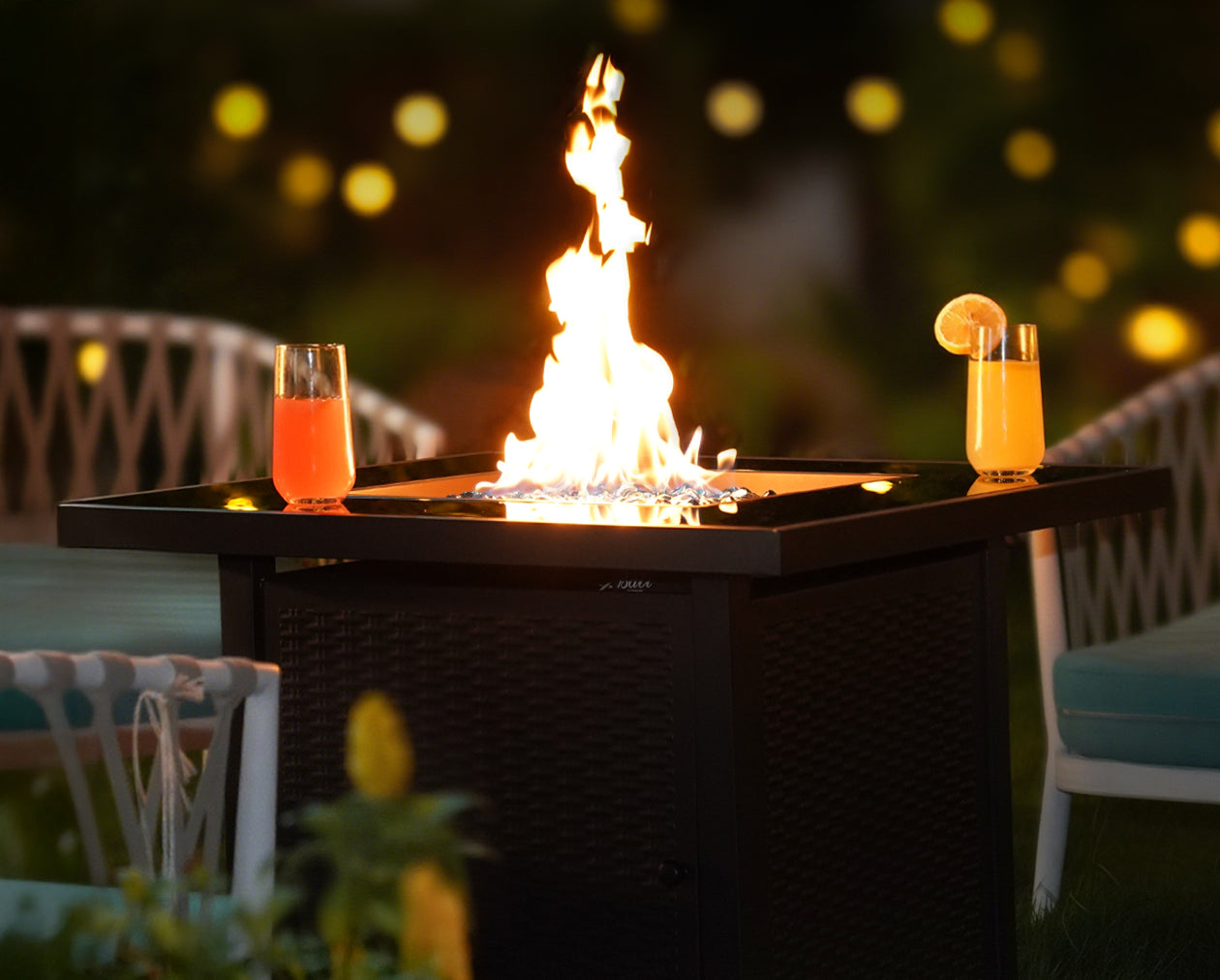
A frequent error we encounter in the field involves the installation of fire pit tables under covered structures. Installers often measure the clearance from the surface of the table to the ceiling. However, the heat source is the flame itself, which can reach heights of 6 to 12 inches.
For a unit like the 30 Inch Propane Fire Pit Table for Outdoor, Black, which produces 50,000 BTUs, the radiant heat zone extends approximately 2 to 3 feet directly above the flame. If the table is 24 inches high and the flame is 12 inches, your "starting point" for measurement is already 3 feet off the ground.
If your ceiling height is only 8 feet, you are left with only 5 feet of clearance. While this may meet the absolute minimum in some municipal codes, it leaves a very small margin for error if wind redirects the heat or if the flame height is adjusted to its maximum setting.
Heuristic Labeling: We use the "30-Minute Ceiling Test" as a practical shop baseline. If you can feel significant radiant heat on your hand when held flat against the ceiling after 30 minutes of operation, the clearance is inadequate and poses a long-term fire risk.
Compliance and Regulatory Standards
Safety isn't just a recommendation; it is often a legal requirement. Many municipal fire codes reference the National Fire Protection Association (NFPA) 58, which governs propane use.
Standard fire codes typically require a minimum of 5 feet of vertical clearance for any unvented fuel-fired heater. However, local amendments for covered structures—especially those with three or more walls—can be much stricter. According to the U.S. Fire Administration (USFA), the "10-foot rule" is a critical safety distance for any open flame from a permanent structure. While gas-fired heaters have different profiles than wood-burning pits, the principle of maintaining distance remains the foundation of fire prevention.
30 inch propane fire pit table with glass stones and tile top on a patio.
The Silent Risk: Carbon Monoxide in Covered Spaces
While the focus is often on fire prevention, the chemical byproduct of combustion—Carbon Monoxide (CO)—is equally dangerous in covered patios. According to the Centers for Disease Control and Prevention (CDC), CO is an odorless, colorless gas that can cause sudden illness and death.
A covered patio with a roof and two or more walls can act as a trap for CO, even if it feels "airy." For this reason, heaters like the 15 inch Propane Fire Pit, Sliver are strictly labeled for outdoor use only.
Safety Precautions for Semi-Enclosed Areas:
- Ventilation: Ensure at least 25% of the total wall area is completely open to allow for cross-ventilation.
- CO Monitoring: If you frequently use a heater under a deep roof, consider installing a battery-operated CO detector on an adjacent wall.
- Supervision: As noted by the U.S. Fire Administration, never leave a heating appliance unattended, especially in spaces where heat or gas could accumulate.
Scenario Analysis: Matching Your Space to the Right Heater
To help you decide, we have modeled two common suburban patio scenarios based on typical ceiling heights.
Scenario A: The Standard 9-Foot Ceiling
In a standard covered patio with a 9-foot ceiling, an umbrella-style heater is often too tall. A 40,000 BTU heater standing 7 feet tall leaves only 2 feet of clearance, which is a significant fire hazard.
- Better Choice: A low-profile fire pit table or a spiral flame heater. The 20 inch Propane Patio Heater, Dark Brown is approximately 71 inches (just under 6 feet) tall, providing 3 feet of clearance—a much safer margin for a 9-foot ceiling.
Scenario B: The High-Pitch Pergola (12+ Feet)
High-pitch structures offer more flexibility. Here, the primary concern is heat reaching the occupants rather than the ceiling.
- Better Choice: High-output units like the 32 Inch Propane Patio Heater, Black. The 86-inch height and 40,000 BTU output will effectively warm the area while remaining safely below the roofline.
Maintaining Your System for Safety
Even with perfect clearance, a poorly maintained heater can become a hazard.
- Inspect the Burner: Ensure no debris or spider webs are blocking the gas ports, which can cause "flame lick" or irregular heat patterns.
- Check the Regulator: Use a soapy water solution to check for leaks at the connection point.
- Proper Extinguishment: When finished, always turn off the gas at the tank, not just the control knob. For portable units, follow the National Park Service (NPS) guideline of ensuring the unit is "cool to the touch" before moving or covering it.
By prioritizing vertical clearance and understanding the physics of heat accumulation, you can create an outdoor sanctuary that is both warm and compliant with the highest safety standards.
Disclaimer: This article is for informational purposes only and does not constitute professional fire safety or legal advice. Always consult your local fire marshal and building codes before installing heating appliances in covered or semi-enclosed spaces.