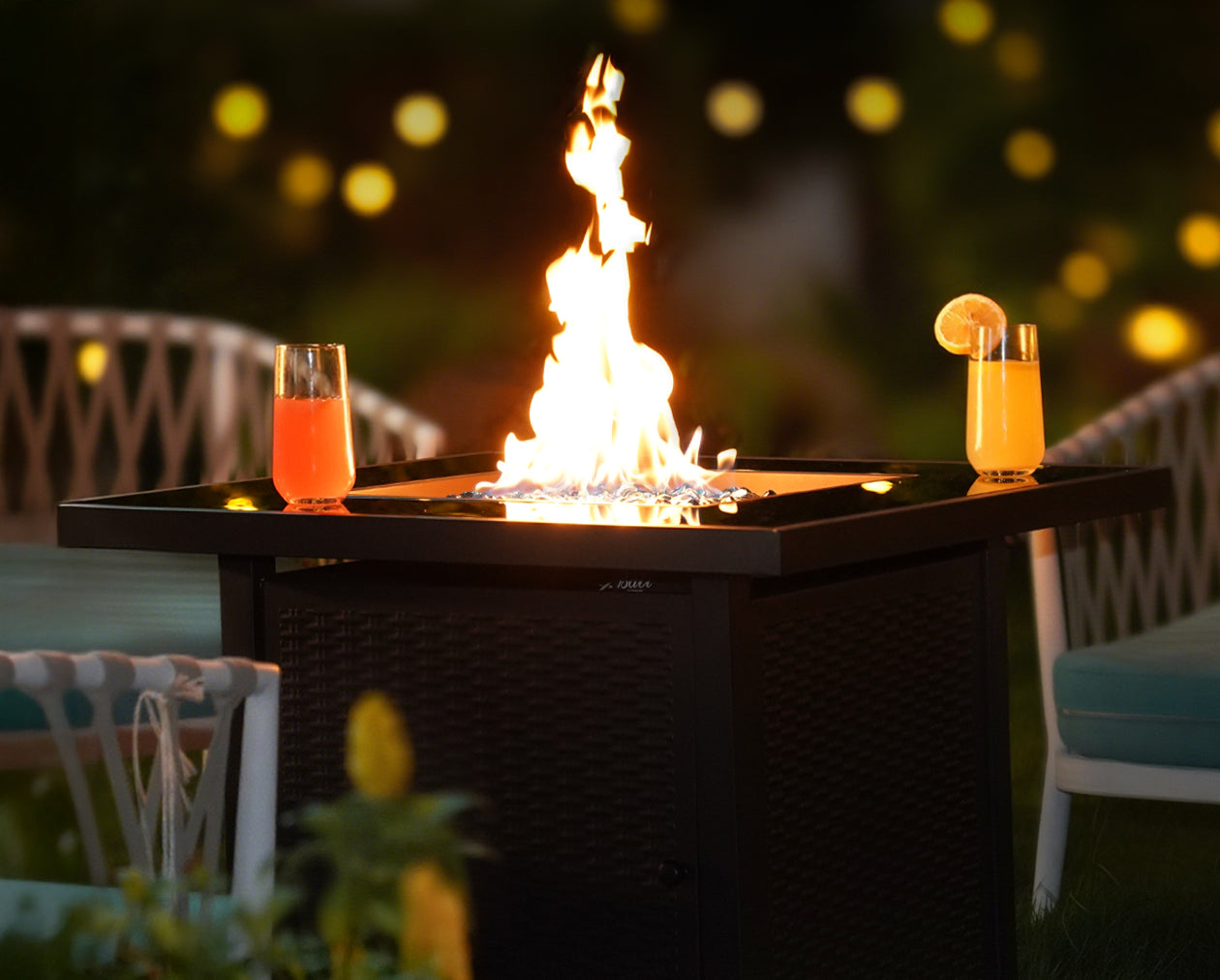

Quick Guide: Small Space Fire Table Essentials
For homeowners maximizing compact outdoor areas, choosing a fire feature requires balancing aesthetics with strict safety clearances.
- Design Goal: Select units under 24 inches in height to maintain sightlines and stay below standard HOA railing visibility thresholds.
- Heat Output: A 50,000 BTU burner is the industry standard for providing effective warmth without overwhelming small enclosures.
- Safety Zone: Apply the "Diameter + 12" heuristic—ensure no combustible materials are within the table's width plus an additional 12 inches of buffer.
- Stability: Prioritize integrated tank storage to lower the center of gravity and eliminate trip hazards.
Transparency Disclosure: This guide is authored by the product team at Bali Outdoors. Our recommendations are based on internal safety testing, manufacturer specifications, and years of customer installation feedback.
The Visual Horizon: Why Low-Profile Designs Matter in Small Spaces
When you step onto a small balcony or a compact urban deck, every inch of visual "real estate" counts. A common frustration we observe among homeowners is the "claustrophobic effect"—where bulky furniture and high-standing heaters create a visual wall, effectively shrinking the perceived size of the outdoor area. This is where the design philosophy of low-profile fire tables becomes essential.
By lowering the focal point of your heat source, you can maintain an unobstructed sightline. This allows your eyes to travel past the furniture to the horizon or the city lights beyond, creating an illusion of expansive space. In our experience working with urban dwellers, a fire table that sits below the railing height not only preserves the view but also fosters a more intimate, "lounge-style" atmosphere that encourages conversation.
Balancing Aesthetics with HOA and Safety Compliance
For many residents in managed communities, the primary barrier to adding a fire feature is the Homeowners Association (HOA) or local fire codes. A significant advantage of low-profile tables is their "stealth" profile.
Many HOAs have aesthetic rules regarding what can be seen from the street or common areas. A low-profile unit, such as the 28 Inch Propane Fire Pit Table, Gray, typically sits at approximately 20-24 inches high. Since standard residential railings are usually 36 to 42 inches tall, these units remain largely invisible from the ground level.
The 50,000 BTU (British Thermal Unit) output found in these models is a manufacturer-standard specification. Based on our performance testing, this level of output is generally necessary to provide a meaningful "heat envelope" in outdoor settings, as lower BTU units often fail to counteract even light wind.
Practical Heuristic: Our observation of HOA compliance patterns suggests that units sitting below 24 inches in height are less likely to trigger "visual nuisance" complaints compared to tall heating columns, as they do not break the silhouette of the deck railing.

The Physics of Small-Space Warmth: Understanding Radiant Heat
In a confined area, heat management is a critical safety requirement. A common mistake we see with low-profile tables is underestimating the radiant heat projection sideways.
While manufacturers provide vertical clearance minimums, the sideways projection from a 50,000 BTU burner can heat adjacent railings or vinyl siding. Based on patterns from our technical support team and common material thermal resistance data, radiant heat can potentially stress or warp sensitive materials (like vinyl or thin wood) if they are placed within 18 inches of the burner edge.
The "Diameter Plus 12" Heuristic
To help homeowners plan their layout, we use a practical rule of thumb for side clearance:
- Measure the diameter (or widest width) of your fire table.
- Add 12 inches to that measurement.
- Ensure this total distance is clear of all combustible materials on all sides.
For example, if you are using the 30 Inch Propane Fire Pit Table, Black, your safety buffer should extend approximately 42 inches from the center of the unit. This heuristic is designed to account for the "bloom" of radiant heat that can occur when wind pushes the flame toward one side.
Methodology Note: This clearance heuristic is a practical baseline derived from scenario modeling of radiant heat dissipation. It is intended as a general safety buffer and may need to be increased based on specific wind conditions or the heat-resistance ratings of your specific siding and furniture.
| Parameter | Value/Range | Unit | Rationale |
|---|---|---|---|
| Burner Output | 50,000 | BTU | Manufacturer standard for effective outdoor warmth |
| Side Clearance (Min) | 18 | Inches | Empirical threshold to reduce risk of material warping |
| Recommended Clearance | Diameter + 12 | Inches | Practical heuristic for a safety buffer |
| Vertical Clearance | 72 - 96 | Inches | Based on standard manufacturer safety manuals |
| Surface Stability | < 1 | Degree Tilt | To prevent fuel line stress and tipping |
Stability and Surface Integrity on Elevated Decks
If you are placing a fire feature on an elevated wooden or composite deck, stability is a primary safety concern. Tall, narrow heaters can be prone to tipping in high winds or if accidentally bumped.
We recommend low-profile tables with wider footprints for these environments. A rectangular design, like the 42 inch Rectangular Propane Fire Pit Table, Black, offers a much lower center of gravity. This structural geometry is helpful on decks where slight vibrations or uneven planking can compromise the stability of a narrower unit.

Furthermore, the materials of your deck matter. According to the U.S. Fire Administration (FEMA), maintaining a 10-foot distance from structures is a core safety standard. If your space is too compact to meet this, using a propane-fueled table is often the preferred choice among safety experts, as it eliminates the risk of flying embers associated with wood-burning pits.
Integrated Tank Storage: A Safety Recommendation
In a small space, "clutter" is more than an aesthetic issue; it’s a trip hazard. Many entry-level fire tables require an external propane tank connected by a hose. In a compact balcony or narrow deck, this hose can become a dangerous obstacle, especially in low-light conditions.
For small-space optimization, integrated storage for the propane tank within the table base is highly recommended. This preserves the clean sightlines of the design and ensures the fuel source is protected while keeping the walking path clear. The 32 Inch Propane Fire Pit Table, Brown exemplifies this by hiding the tank within its sturdy frame, while the tempered glass top adds a reflective quality that enhances the flame's visual impact without increasing the physical footprint.
Air Quality and Health: The "Outdoor Use Only" Mandate
While the cozy glow of a fire table is inviting, it is vital to address the invisible risks. Gas-burning appliances produce Carbon Monoxide (CO), an odorless, colorless gas that can be fatal in enclosed spaces.
According to the Centers for Disease Control and Prevention (CDC), CO poisoning can occur when gas appliances are used in areas without proper ventilation. Fire tables are strictly for outdoor use only. Even if your balcony has a roof or is partially screened, you must ensure there is constant, cross-ventilating airflow.
Symptoms of CO exposure include headache, dizziness, and nausea. If you or your guests experience these symptoms, extinguish the flame and move to fresh air immediately. For more detailed health information, refer to the National Library of Medicine's guide on Carbon Monoxide Poisoning.
Maximizing Utility: The 2-in-1 Design
To get the most value out of a small patio, we suggest looking for "convertible" designs. Many low-profile units include a matching cover lid. When the fire is not in use, the unit transforms into a fully functional coffee or dining table. This dual-purpose approach is the key to making a small space feel versatile rather than cluttered.
Small Space Selection Checklist:
- Height: Is the unit under 24 inches to help preserve sightlines and HOA compliance?
- Fuel Storage: Does the base hide the 20lb propane tank internally to prevent tripping?
- Clearance: Do you have a "Diameter + 12 inch" buffer from railings and siding?
- Surface: Is the deck level and capable of supporting the weight (typically 50-80 lbs plus the tank)?
- Ignition: Does it feature a pulse ignition safety system for reliable operation?
Creating a Safe Sanctuary
Enhancing a small outdoor space is about making deliberate choices that balance luxury with the realities of spatial constraints. By choosing a low-profile design, you are prioritizing both the view and the safety of your home.
Whether you opt for the modern matte finish of the 30 Inch Propane Fire Pit Table, Black or the expansive surface of a rectangular model, remember that the most relaxing outdoor space is one designed with safety in mind. Follow the clearance heuristics, respect the 10-foot rule where possible, and always prioritize ventilation to ensure your evenings remain warm and safe.
Disclaimer: This article is for informational purposes only and does not constitute professional safety, legal, or fire prevention advice. Always consult your local fire department, HOA bylaws, and the manufacturer's specific manual before installing or operating a fire feature.