

Patio Heater Buying & Safety Guide: Costs, BTU, Venting & Placement
Buying a patio heater looks simple at first: pick a BTU number, plug in or hook up a tank, and start using it. The reality is that the heater you can safely run, the fuel it should burn, and the monthly cost it adds to your bill all depend on the shape of your patio, the climate you live in, and the rules in your lease, HOA, or state fire code. Most of the regret we see in customer-support tickets traces back to one of three mismatches: a 40,000+ BTU mushroom heater shoved under an 8-foot pergola, a propane unit run on a screened porch with one open door, or a 1,500W electric unit bought to fight a 20°F windy night.
This guide is the long version of the conversation a careful retailer would have with you before checkout. We cover heater types and how they actually deliver heat, BTU sizing for cold and exposed patios, the cost gap between electric and propane, the carbon-monoxide and clearance rules that determine whether a unit is even legal in your space, and a buying checklist you can run through before you commit. Where the numbers come from agencies (CDC, US Fire Administration, EPA, NFPA 58), we cite them; where they come from internal modeling or shop heuristics, we say so.
Patio Heater Types: Propane, Electric, and Natural Gas
The fuel and form factor of a heater determine more than just its operating cost. They dictate where you can put it, how much heat actually reaches the people sitting at the table, and whether you need a permit, an electrician, or a plumber to install it.
Propane (Liquefied Petroleum Gas)
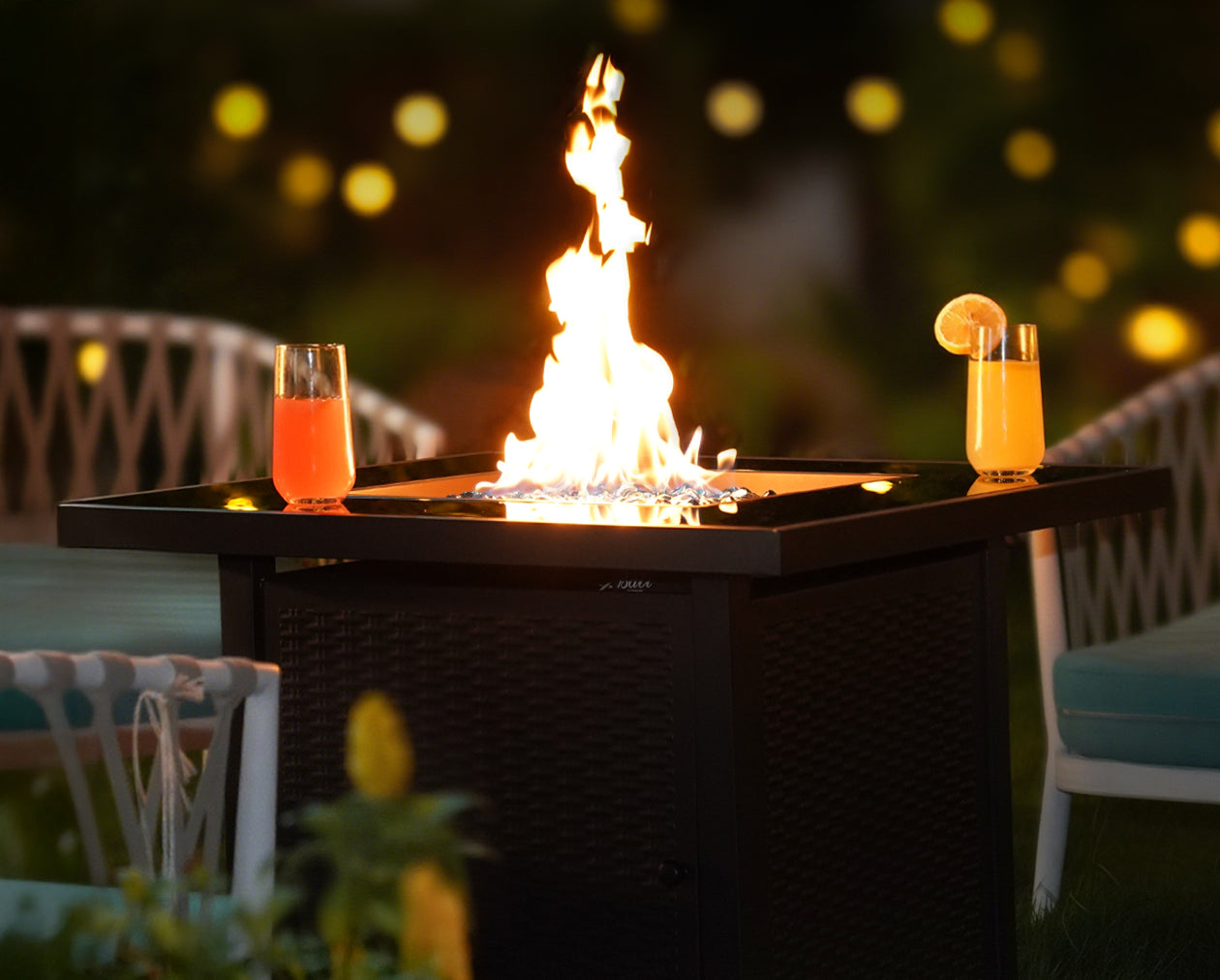
Propane heaters are the default for most US backyards because they are portable, do not require any wiring or trenching, and produce intense radiant heat. The two common form factors are the umbrella-style standing heater (around 36,000–48,000 BTU, 86–88 inches tall, with a reflector cap that pushes heat downward in a roughly 8–10 foot radius) and the spiral-flame glass-tube heater (around 30,000–42,000 BTU, often closer to 71 inches tall, with the flame visible inside a tempered glass tube). A third category—propane fire pit tables—doubles as furniture and produces 25,000–50,000 BTU.
The rule of thumb the industry uses is that for every 1,000 BTU consumed, a propane heater burns roughly 0.01 gallons per hour. A 40,000 BTU unit at full output therefore burns about 0.4 gallons per hour. A standard 20 lb propane tank holds about 4.7 gallons, so on max output that tank lasts roughly 11–12 hours. A 50,000 BTU fire pit table eats through the same tank in 9–10 hours.
Electric (Resistance and Infrared)
Electric patio heaters are easier to live with on the small end and harder on the large end. Most plug-in models are limited to 1,500 watts so they fit a standard 120V circuit; 1,500W is roughly 5,120 BTU equivalent, which is enough to take the edge off a still 50°F evening on a covered porch and not enough for an exposed patio at 30°F. Higher-output infrared and quartz units typically need a dedicated 240V circuit, which means an electrician, a permit in many jurisdictions, and a one-time install cost that can erase several seasons of fuel savings.
The advantage of electric is total emissions control at the point of use: no CO, no propane storage, no flame. That makes electric the only safe choice for fully roofed spaces like screened-in porches or sunrooms. The disadvantage is that, because they often rely on convective heat (warming the air), they fade fast in any wind.
Natural Gas (Plumbed)
Natural gas heaters connect to the same line that feeds your range or water heater. Operating cost per BTU is usually the lowest of the three, and you never run out of fuel mid-evening. The trade-off is that the unit is fixed in place, install requires a licensed plumber and often a permit, and you are limited to homeowners with an existing gas stub or the budget to run one. For renters and apartment dwellers, natural gas is generally not on the table.
Quick Selection Logic
- Open backyard or large deck, owner-occupied, plans to stay 5+ years: natural gas if a stub exists; otherwise a 40,000–50,000 BTU propane unit.
- Suburban deck or patio, frequent use, no gas line: propane standing heater or fire pit table.
- Small balcony or apartment patio with a roof overhang: electric infrared, mounted on a wall.
- Screened-in porch or sunroom with no open walls: electric only. Combustion appliances of any kind are not safe here.
If propane fits your space, browse our outdoor heater collection for the standing units we carry.
BTU Sizing: Calculating Heat for Cold and Exposed Patios
BTU per hour is a measure of energy output, not of how warm you will feel. The number you actually need depends on three things: the square footage you are trying to heat, the temperature gap between outside and your target comfort zone, and how much wind is stripping heat off your skin and the heater itself.
Step 1: Set a Temperature Delta
Pick the coldest temperature at which you reasonably expect to use the patio. If your evening low is 20°F and you want to feel like it is 70°F under the heater, the delta is 50°F. In a mild climate (above 50°F) the delta is closer to 20°F and you almost never need full output.
Step 2: Apply the Square-Foot Multiplier
The common indoor heuristic is 40 BTU per square foot. Outdoors, even in a windbreak, you should treat that as a floor, not a target. The table below is what we use to size for unshielded patios when ambient is below 32°F.
| Patio Size | Delta 30°F (mild night) | Delta 50°F (cold night) | Typical product match |
|---|---|---|---|
| 50 sq ft (small balcony) | ~15,000 BTU | ~25,000 BTU | 15-inch column propane fire pit |
| 100 sq ft (standard patio) | ~30,000 BTU | ~45,000 BTU | 20-inch glass-tube standing heater (36,000 BTU) |
| 150 sq ft (large deck) | ~45,000 BTU | ~65,000+ BTU | 42-inch propane fire pit table (50,000 BTU) plus a second standing unit |
Estimated ranges based on shop practice for unshielded outdoor spaces. Actual performance varies with geometry and overhead cover.
Step 3: Add a Wind Buffer
Wind is the variable that turns a "right-sized" heater into an underperforming one. A 5 mph cross-breeze can drop the effective temperature on a patio by 10°F. For exposed balconies or rooftop decks where 10–15 mph evening winds are normal, add a 25–50% BTU buffer on top of the table above. If your math says 36,000 BTU, look at units in the 45,000–50,000 BTU range, or pair a smaller heater with a wind guard or a wall-side placement.
Radiant vs Convective Heat in Cold Weather
Convective heaters warm the air. Radiant heaters warm objects—including you—directly with infrared. In still, mild conditions both feel similar. In cold or windy conditions, convective heat is blown away before it does anything useful, while radiant heat still reaches your skin. Propane fire pit tables, glass-tube spiral heaters, and quartz infrared electric units are radiant-dominant. Mushroom-style propane heaters with reflector caps are a hybrid: convective heat at close range, radiant farther out.
Cold-Weather Propane Quirks
Below 20°F, propane behavior changes in two ways most buyers never hear about until the unit fails on them. First, the regulator can freeze: as liquid propane vaporizes inside the regulator, the process pulls heat from the surroundings, and in damp sub-20°F air, moisture freezes inside the regulator body and chokes the flame. Second, internal tank pressure drops with temperature, so a tank at 0°F delivers visibly weaker flame than the same tank at 50°F. Keeping the tank dry, sheltered from wind, and ideally inside an insulated tank cover (not a sealed enclosure) helps. A spare tank kept warmer indoors and swapped in mid-evening is the cleanest workaround for serious cold-snap use.
Electric vs Propane: Cost and Efficiency in Practice
The "electric is 100% efficient" claim is technically true at the heating element and misleading in the open air. A 1,500W electric heater converts essentially all 1,500W into heat at the coil. But on a 30°F patio with a 5 mph breeze, most of that heat blows past the seating area before anyone feels it. Propane, despite running closer to 85–90% combustion efficiency, often delivers more "felt" warmth per dollar in real outdoor conditions because it is built around radiant output and high BTU.
Operating Cost Math
The numbers below assume a US national-average electricity rate of $0.15/kWh, a 20 lb propane refill priced at $20 ($4.25/gallon equivalent), and a 4-hour evening session.
| Metric | Electric (1,500W, 120V) | Propane (40,000 BTU) |
|---|---|---|
| Heat output per hour | ~5,120 BTU | 40,000 BTU |
| Conversion efficiency at the unit | ~100% | ~85–90% |
| Hourly fuel cost | ~$0.23 (1.5 kWh × $0.15) | ~$1.70 (0.4 gal × $4.25) |
| Hourly cost per 1,000 BTU delivered | ~$0.045 | ~$0.043 |
| 4-hour session cost | ~$0.92 | ~$6.80 |
| Effective heat in 5 mph wind | Low–moderate | High (with wind guard or wall placement) |
| Install cost | $0 (plug-in) / $400–1,500 (240V circuit) | $0 |
Heuristic estimates based on average residential rates. Local propane refills can swing from $15 at a tank-exchange kiosk to $35+ at a marina or remote dealer; check before you assume a number.
Two patterns emerge from this math. First, on a per-1,000-BTU-delivered basis, electric and propane are within 5% of each other at average US rates. Second, the absolute hourly cost for propane is much higher because each unit runs at far higher BTU. If you only want to take the chill off an enclosed porch a few nights a month, electric is cheaper to run and easier to install. If you need real warmth on an open deck for several hours twice a week through the cold months, propane is what you actually need; the electric "savings" disappear because a 1,500W unit cannot do the job and a 240V install wipes out two seasons of fuel difference.
Wind Guards and Placement Boost Propane Efficiency
A glass wind guard on a fire pit table or fire-bowl-style unit improves effective heat delivery by an estimated 30–40% in breezy conditions, by stabilizing the flame and keeping the radiant cone intact. Placement against a wall or in a corner (subject to clearance rules below) blocks crosswind and can cut fuel consumption by up to 25% over the same heater placed in the open. These two moves together often matter more to your monthly propane bill than picking a slightly higher-BTU unit.
Carbon Monoxide Safety: The Rule That Decides Where You Can Put a Heater
Propane and natural gas heaters are for outdoor use only. The reason is carbon monoxide (CO), an odorless, colorless gas produced by every combustion appliance. The Centers for Disease Control and Prevention (CDC) reports that more than 400 Americans die each year from unintentional CO poisoning unrelated to fires, and approximately 100,000 visit the emergency room. The hazard is highest where combustion appliances are run in spaces that look outdoor but behave indoor—garages with the door cracked open, screened porches with a solid roof, balconies tucked into a building corner, tents, and ice-fishing huts.
For context, OSHA's permissible exposure limit is 50 ppm averaged over 8 hours; symptoms typically begin at 70 ppm, become significant at 150–200 ppm, and 800 ppm causes loss of consciousness within 2 hours. A poorly tuned propane appliance running in a partially enclosed porch can push CO past 70 ppm in under 30 minutes.
The 50% Open Wall Rule
Industry safety practice, broadly aligned with the International Fuel Gas Code's definition of "outdoors," is that a covered space only counts as outdoor if at least 50% of the total wall area is completely open to the atmosphere. Below that threshold, natural convection cannot reliably clear combustion byproducts and you should not run a propane or natural gas heater there.
Practical translations:
- A patio with a solid roof, two solid walls, and two open sides: borderline. Check that openings are on opposite sides for cross-flow.
- A screened-in porch with a solid roof: not safe for combustion. Treat as indoor and use electric.
- A balcony with a solid railing on one side, the building wall on another, and an overhead floor above (the next unit's balcony): treat the overhead as the worst-case ceiling and check whether two of the remaining sides are fully open.
The 50 Cubic Feet per 1,000 BTU Rule
Even when a space technically passes the 50% rule, BTU output has to fit the air volume. The shop heuristic is 50 cubic feet of unobstructed air per 1,000 BTU of propane output.
| Heater BTU | Min air volume (cu ft) | Example space (L×W×H) | Ventilation |
|---|---|---|---|
| 10,000 | 500 | 8' × 8' × 8' | 1 side fully open |
| 30,000 | 1,500 | 12' × 15' × 8.5' | 2 sides fully open |
| 50,000 | 2,500 | 15' × 20' × 8.5' | 2+ sides fully open |
| 60,000+ | 3,000+ | large deck or open yard | fully open air |
The 18-Inch Trap and Detector Placement
Field observation: a solid roof or overhang extending as little as 18 inches over the heater can be enough to trap CO on a still evening, because the warm exhaust hits the underside of the cover, pools, and circulates back down toward seated guests. If you have any overhead obstruction at all, install a battery-operated CO detector at "seated head height"—roughly 3 to 4 feet off the ground—within 10 to 15 feet of the appliance. Ceiling placement (the smoke-detector default) gives a delayed alarm in semi-enclosed outdoor spaces, because gas reaches the breathing zone before it reaches the roof.
Watch for incomplete-combustion symptoms in the flame itself: a healthy propane flame is mostly blue with occasional yellow tips; a solid yellow or orange flame, sooty deposits on the burner, or a "lazy" wandering flame all indicate higher CO output and a unit that needs cleaning. Spider webs in the venturi tubes are the most common cause and a soft brush or compressed air clears them in minutes. For a deeper safety briefing, see our guides on propane safety outdoors and carbon monoxide and outdoor fires.
Recognizing Exposure
According to MedlinePlus, early CO symptoms—dull headache, dizziness, weakness, nausea, shortness of breath, and confusion—mimic the flu. If you or a guest start to feel any of these around an outdoor heater, kill the gas at the tank, move everyone to fresh moving air, and do not re-enter the space until you have confirmed flame quality and ventilation.
Ceiling Height Clearance: 8 Feet Minimum
Heat in a covered patio rises in a column above the unit and pools against the ceiling. The clearance number you need is not how tall the heater is; it is how far the hottest part of the heat column sits below combustible material. The shop benchmark is that ambient air temperature must drop below 120°F (49°C) before reaching a combustible surface to avoid long-term degradation or ignition.
| Heater type | Typical BTU | Minimum vertical clearance | Why |
|---|---|---|---|
| Umbrella-style standing | 36,000–48,000 | 8–9 ft | Reflector cap concentrates heat upward and becomes a secondary radiator. |
| Spiral-flame glass tube | 30,000–42,000 | 6–7 ft | Heat is diffused along the tube length, not stacked at the top. |
| Fire pit table | 25,000–50,000 | 5–6 ft above the flame | Radiant heat zone extends 2–3 ft above flame height. |
| Portable fire pit | 20,000–30,000 | 10 ft | Highly variable flame height demands a larger buffer. |
The Common Mistake
Installers measure from the table surface to the ceiling. They should measure from the top of the flame. A 30-inch fire pit table 24 inches high with a 12-inch flame puts the heat source 36 inches off the ground; under an 8-foot ceiling that leaves 5 feet of clearance—within minimum, but with no safety margin if the dial gets cranked to max or the flame is pushed sideways by wind.
The 30-Minute Ceiling Test
Run the heater on its normal setting for 30 minutes. Then hold the back of your hand flat against the ceiling directly above. If you feel significant radiant warmth, clearance is inadequate and the assembly will degrade over time even if it does not catch fire today. Vinyl fascia and PVC trim begin to soften around 150°F; sustained exposure at 130–150°F is enough to cause discoloration and warping over a season.
Propane Venting Rules for Semi-Enclosed Spaces
Propane is approximately 1.5 times heavier than air. A leak in a fully open backyard dissipates harmlessly. A leak inside a half-walled patio or under a deep balcony settles to the floor and pools, waiting for an ignition source. The venting rules below assume you have a space that just barely passes the 50% open-wall test and that you want belt-and-suspenders safety.
Two Vents, High and Low
Effective venting needs both a low vent (within 6 inches of the floor) to clear pooled propane and a high vent (within 6 inches of the ceiling) to clear hot exhaust and CO. The minimum net free area is the shop heuristic of 1 square inch of vent per 1,000 BTU, doubled in restricted spaces.
| Appliance output | Standard vent area | Restricted-space vent area |
|---|---|---|
| 10,000 BTU | 10 sq in | 20 sq in |
| 30,000 BTU | 30 sq in | 60 sq in |
| 40,000 BTU | 40 sq in | 80 sq in |
| 50,000 BTU | 50 sq in | 100 sq in |
The Soapy Water Leak Test
Mercaptan (the rotten-egg additive in propane) helps you smell large leaks but small slow leaks can pool below your nose-level before you smell anything. Once a season, and after any tank swap:
- Mix 50% water and 50% liquid dish soap in a spray bottle.
- Open the tank valve fully but do not light the heater.
- Spray the regulator, hose, and heater inlet.
- If bubbles form or grow, you have a leak. Close the valve, tighten the connection, and retest. Most "leaks" trace back to a missing or torn regulator O-ring; replace the O-ring before assuming the regulator itself is bad.
Tank Storage and HOA Limits
Many HOAs and multi-family buildings prohibit propane cylinders larger than 1 lb on balconies because of elevator transport hazards and fire-spread concerns; some restrict propane appliances entirely. NFPA 58 (the national reference standard for liquefied petroleum gas) is the document your local fire marshal is enforcing or amending. Check both your CC&Rs and your municipal code before buying a 20 lb tank for an apartment balcony.
Awnings, Pergolas, and the Heat-Trap Problem
Retractable awnings and pergolas pose a special risk because their fabric is rated for UV and weather but not for sustained radiant heat. Solution-dyed acrylic, polyester, and vinyl-coated awning fabrics typically begin to lose structural integrity or off-gas above 150°F. The shroud of a 40,000 BTU mushroom heater can exceed 150°F within a 3-foot radius in minutes.
Clearance vs Radiant Distance
The "minimum clearance" printed in the manual prevents ignition. It does not prevent fabric damage. A 40,000 BTU radiant heater with a labeled 3-foot clearance can still warp or discolor vinyl awning fabric 6–8 feet away through sustained exposure. The shop rule of thumb is that radiant impact on heat-sensitive synthetic fabric extends roughly 2.5x further than the labeled fire-safety clearance.
Cross-Ventilation Drops Peak Temperatures
| Cross-ventilation | Estimated reduction in peak underside temp | Risk level |
|---|---|---|
| Stagnant air (0 mph) | 0% | High—heat trap likely |
| Light breeze (2–3 mph) | 15–20% | Moderate |
| Steady cross-breeze (5+ mph) | 30–40% | Low |
| High wind (15+ mph) | n/a | High—flame instability |
The 10-Minute Hand Test
Run the heater at its normal setting for 10 minutes. Place the back of your hand against the awning fabric or the closest surface to the heater. If the heat feels intense or uncomfortable on your skin within 5 seconds, the heater is too close. If the fabric itself feels hot to the touch (around the sensation of a hot coffee mug), increase distance or drop the setting immediately. Human skin reads the 130°F–150°F range very accurately, which is exactly the range at which most awning fabric starts to fail.
For exposed installations under awnings, lower-profile units like a 20-inch glass-tube heater (around 36,000 BTU, 71 inches tall) leave more vertical buffer than 86-inch mushroom heaters. Tabletop fire bowls (around 25,000 BTU, often 15 inches tall) sit even further from a typical 8-foot awning. For deeper coverage, see our guide on heater safety near awnings.
Operating Costs by Climate
The seasonal budget for outdoor heating splits roughly into two scenarios that map onto most of the US.
Mild Climates (Above 50°F): Coastal South, Most of California, Pacific Northwest in Fall
Users typically run heaters at 40–60% output to take the edge off a 50–60°F evening. A 40,000 BTU standing heater that lasts 10 hours at full output stretches to 15–20 hours at this duty cycle. For two 3-hour evenings per week through a 4-month shoulder season, that is roughly one 20 lb tank per month, or about $20 in fuel.
Freezing Climates (Below 30°F): Northeast, Upper Midwest, Mountain States
Below freezing, you need 20–30% more BTU than the manufacturer's rating implies for still, temperate air. The trap most users fall into is "cycling": crank to max, get warm, kill the unit, and then cold air rushes back in. Modeling suggests that continuous low-heat operation is more fuel-efficient than cycling, because the heater never has to reheat the surrounding air column from scratch. Plan on two 20 lb tanks per month at the same use intensity, plus a backup tank for cold-snap nights when regulator performance drops.
Wind and Placement Matter More Than the Spec Sheet
Place the heater against a wall or in a corner, observing all clearance rules above. This blocks crosswind and concentrates radiant output toward the seating area. Pair the heater with a wind guard if it has an open flame. Position seating first, then place the heater so the radiant cone covers the chairs—not the empty space behind them. These three moves can cut fuel consumption by 25% with no change in comfort.
Carbon Footprint: Choosing the Lower-Impact Fuel
For buyers who care about more than the fuel bill, the question is which fuel has the lowest lifecycle carbon impact. There is no universal answer; the right choice depends on your local electrical grid mix and how far your propane has to travel to reach you.
Propane releases approximately 12.7 lb of CO2 per gallon (EPA emission factor) and is captured as a byproduct of natural gas processing and petroleum refining, so its upstream "burden" is shared with the primary fuels. Natural gas burns cleaner per BTU at the appliance, but methane leakage in older distribution lines—above the 3–4% threshold—can erase its advantage and even make it worse than propane on a 20-year horizon. Electric is "zero emission" at the unit, but the actual footprint depends entirely on the carbon intensity of your local grid. As a rough heuristic: if your grid runs above 0.5 kg CO2e per kWh (much of the Midwest, parts of the South), a high-efficiency propane heater likely has a lower operational footprint than electric. If your grid is below that (Pacific Northwest, much of New England, anywhere on solar), electric wins.
Wood is renewable but locally polluting. Per the EPA Burn Wise Program, seasoned hardwood (under 20% moisture content, dried at least six months) burns up to 80% cleaner than green wood on PM2.5. Wet wood is the dominant source of complaint-level smoke in residential settings.
Buyer Checklist
Run through these questions before you click buy. The order matters: clearance and CO rules can disqualify a heater for your space before BTU or budget enter the picture.
- Is your space outdoor by the 50% rule? If less than half the perimeter is fully open, do not buy a propane or natural gas heater. Switch to electric infrared.
- What is your overhead clearance? Measure from the top of the planned heat source (flame top for fire pit tables, top of reflector cap for mushroom heaters) to the ceiling, awning, or overhang. Compare to the 8-foot minimum for umbrella-style or 6-foot minimum for spiral-flame units.
- Can you keep 10 feet from the house and any combustible structure? The US Fire Administration (USFA) 10-foot rule applies to fire pits and any open-flame heater.
- What is your coldest expected use temperature? Calculate your delta and pick a unit that hits the 50°F-delta column of the BTU table for your patio size, plus a 25–50% wind buffer if you are exposed.
- How will you fuel it? If propane: confirm tank-exchange or refill availability, check HOA limits on tank size, and budget for one to two 20 lb tanks per month at typical use. If electric: confirm whether 120V is enough or you need a 240V install.
- Do you have a CO detector? Battery-operated, mounted at seated head height, within 10–15 feet of any combustion appliance. Non-negotiable for anything semi-enclosed.
- Have you done the soapy-water leak test? Before first use of the season and after every tank swap.
- Local rules? HOA CC&Rs, lease, and state and city fire codes can override everything else. Check before you buy.
Ready to Pick a Heater?
If you have worked through the checklist and your space is genuinely outdoor by the 50% rule, has at least 8 feet of clearance, and can keep a 10-foot buffer from the house, a propane standing heater or fire pit table will give you the most heat per dollar in real conditions. Browse our outdoor heater collection for the propane standing units we carry—glass-tube spiral models for tighter clearances and corner placement, and umbrella-style units for open decks where you want the widest radiant cone. Pair any propane unit with a CO detector at seated head height and run the soapy-water leak test before the first cold evening of the season. For seasonal value bundles and our most-reviewed units, check the best seller collection.
Disclaimer: This article is for informational purposes only and does not constitute professional safety, legal, or fire-engineering advice. Carbon monoxide is lethal; propane is explosive when pooled. Always follow the manufacturer's manual, local fire codes, HOA rules, and—when in doubt—consult a certified gas technician or your local fire marshal before installing or operating outdoor heating equipment.